
Returning to Pancasila's Global Politics
Our economic fundamentals are strong across the board: government spending, public expenditure, controlled inflation, solid investment.
Our economic fundamentals are strong across the board: government spending, public expenditure, controlled inflation, solid investment.
1 June is commemorated as Pancasila Day, marking the 1945 BPUPK session where Indonesia’s foundational principles were drafted. On that date, Sukarno presented his vision of the five principles, which became the philosophical basis of the nation. However, for 71 years, this historic date was not officially recognised as a national holiday.
Presidential Decree No. 24 of 2016 established two key points: first, 1 June 1945 as Pancasila Day; second, 1 June officially designated as a national holiday. The recognition of 1 June as Pancasila Day had been advocated since President Susilo Bambang Yudhoyono’s administration and was finally enacted through Presidential Decree No. 24 of 2016.
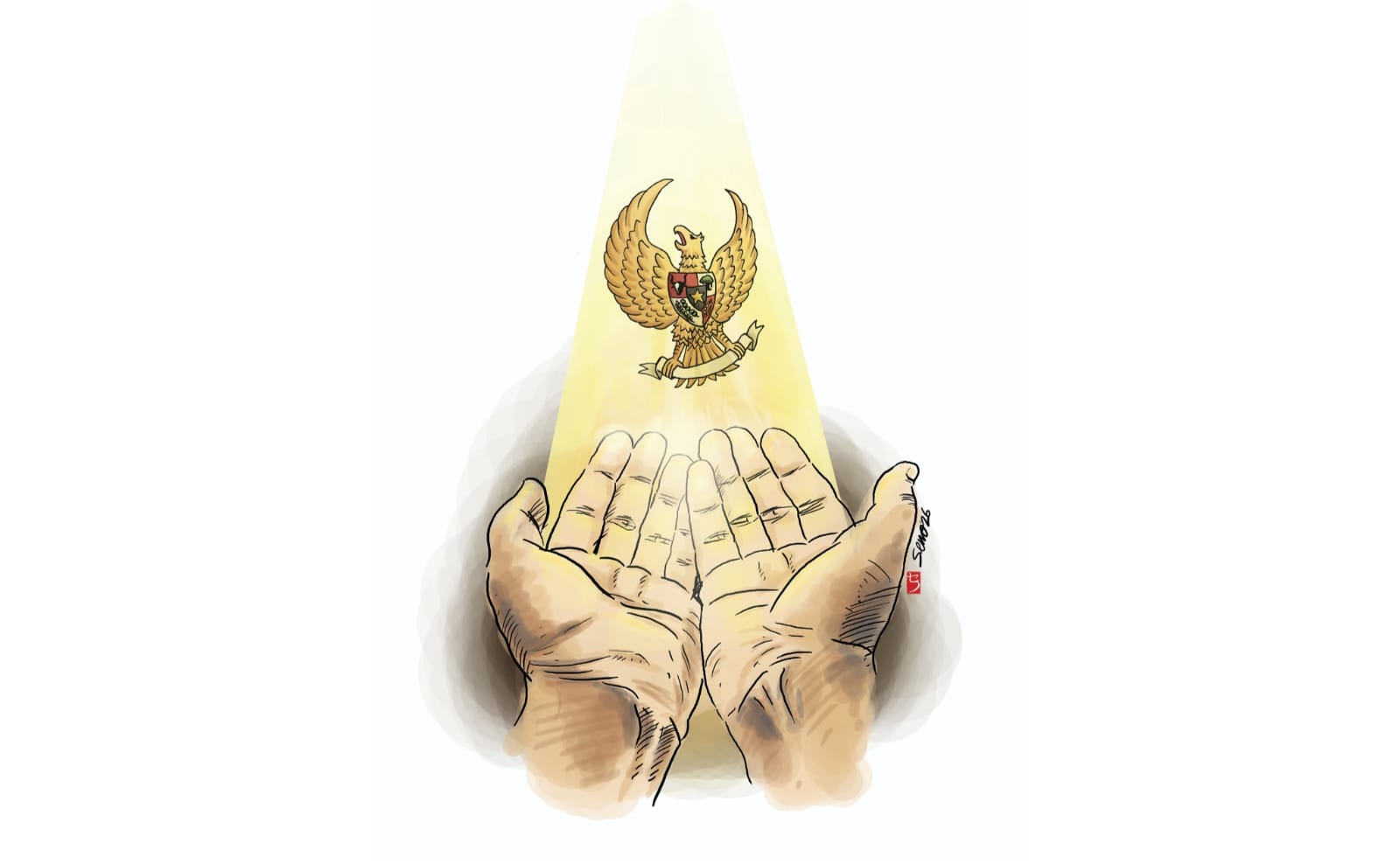
This recognition is more than ceremonial; it affirms Pancasila as not just a constitutional foundation but a living ideology that remains relevant and must be nurtured.
Under this decree, all segments of society commit to commemorating Pancasila Day as part of mainstreaming Pancasila as a guide in all aspects of social, national, and state life. Thus, Pancasila is not merely a relic to be displayed; it is a compass that must be actively used, including in shaping Indonesia’s global relations.
This was deeply understood by Sukarno. On 30 September 1960, at the UN General Assembly in New York, he delivered his historic speech titled ‘To Build the World Anew’, offering Pancasila as a third path for a world divided between Western and Eastern blocs.
Sukarno stated that Pancasila’s values reflect the aspirations of oppressed nations across Asia, Africa, and Latin America: independence, humanity, brotherhood, and social justice. The speech was more than a political address; it was a declaration that Indonesia stood on the global stage not as a follower of any major power, but as the voice of conscience for colonised nations.
A WORLD STILL RIFE WITH INEQUALITY
Sixty-six years after Sukarno’s New York speech, the world has still not rebuilt itself fairly. Instead, global inequality has reached alarming levels.
The third edition of the World Inequality Report, published in late 2025, concludes that global wealth inequality has reached emergency levels, with globalisation’s benefits disproportionately flowing to a tiny minority.
The top 1% of the global population now controls 45% of the world’s wealth, while 44% of humanity lives on less than $6.85 a day according to the World Bank’s poverty line.
Oxfam notes that the wealth of the top 1% has increased by over $33.9 trillion since 2015—more than enough to end global poverty 22 times over at the World Bank’s highest poverty line.
The wealth of just 3,000 billionaires has surged by $6.5 trillion over the same period, equivalent to 14.6% of global GDP. Meanwhile, nearly 3.7 billion people remain in poverty, nearly a decade after world leaders pledged to eradicate it by 2030.
Between 2019 and 2025, workers worldwide saw a 12% decline in real purchasing power while the super-rich widened the gap. Concurrently, armed conflicts in Gaza and Ukraine continue to claim civilian lives without effective multilateral mechanisms to halt them.
The UN Security Council, designed as the world’s peacekeeper, is often paralysed by the veto power of major nations prioritising their geopolitical interests over the lives of vulnerable civilians.
This is today’s paradox: technology advances at unprecedented speeds, yet social justice for all humanity grows ever more distant. This is precisely the condition Sukarno warned of in New York in 1960—that peace is unattainable without economic freedom for formerly colonised nations. Six decades on, his warning remains unheeded.
RETURNING TO PANCASILA
In this heated geopolitical climate, Indonesia cannot stand idle. We have a clear constitutional mandate to lead the fight for international justice. The fourth preamble of the 1945 Constitution states that one of the nation’s goals is to contribute to a world order based on freedom, perpetual peace, and social justice. This is not merely aspirational; it is a legal obligation.
The 1999 Foreign Relations Law, Article 2, states that foreign relations and foreign policy are based on Pancasila and the 1945 Constitution. Although the article still references the Broad Outlines of State Policy (GBHN), this was abolished via 2002 constitutional amendments, leaving Pancasila and the Constitution as the sole constitutional basis.
Article 3 of the same law mandates a free and active foreign policy dedicated to national interests. Article 4 stipulates that foreign policy must be implemented through creative, proactive, and anticipatory diplomacy, not merely routine.