
Retracing Diponegoro’s Struggle: Sleman Tourism Office Seeks to Revive Historical and Religious Tourism
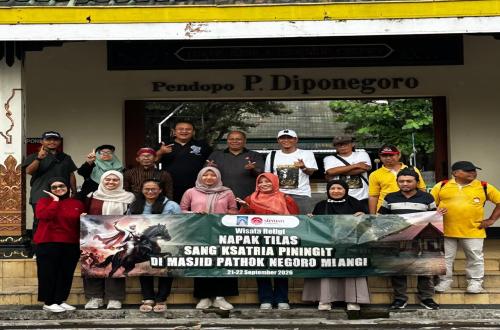
The event, attended by dozens of participants, brought together tourism stakeholders and historical communities, including the Association of Indonesian Travel Agents (ASTINDO) in Yogyakarta and the Indonesian Tour Guides Association (HPI) in Yogyakarta.
Kus Endarto, head of tourism marketing at the Sleman Regency Tourism Office, said the heritage trail was part of efforts to develop historical tourism by exploring the connections between mosques, historic sites and Prince Diponegoro’s struggle. Participants were invited to visit several locations linked to Diponegoro’s life and fight, particularly during the Java War.
He said the activity was not merely about visiting historic places, but also about helping participants understand the stories and historical evidence behind each site.
“The main point is to trace Prince Diponegoro’s footsteps, especially the influence of mosques on his struggle. We want to explore history using valid information, not just stories,” Kus said in an interview in the area around the Gedhe Kauman Mosque in Yogyakarta on Sunday.
The journey began at the Pathok Negara Mosque in Plosokuning, before continuing to the Prince Diponegoro Monument Museum, or Sasana Wiratama, in Tegalrejo. The site was Diponegoro’s home from childhood until shortly before the Java War broke out.
The trail then continued to the Ngayogyakarta Hadiningrat Palace complex, where participants visited the Gedhe Kauman Mosque and took part in an educational tour to learn more about Yogyakarta’s history. It proceeded towards Bantul, passing the Pathok Negoro mosques in Babadan and Dongkelan. Participants then visited the Selarong Cave area, one of Diponegoro’s early strongholds in the Java War. There, they took part in a historical reflection and performed the Asr prayer before returning to the Pathok Negoro Mosque.
Kus said history-based religious tourism was one of the areas of potential that Sleman Regency was beginning to develop. He hoped the tour would help visitors understand the influence of Diponegoro’s struggle on Yogyakarta’s history.
He also said the event had educational and reflective, or wellness, value, as it encouraged people to revisit history and learn from the struggle of national heroes.
“These places certainly all have a story. That is why we have invited Ki Roni, because he has the ability, expertise and extensive knowledge of Diponegoro’s history,” he said.
The Sleman Regency Tourism Office plans to produce a guidebook to Prince Diponegoro’s historical trail. It is expected to serve as a reference for tourists, tour guides and travel operators, setting out the route and the historical stories associated with each destination.
“The aim is for this activity to continue without always needing the tourism office’s direct support. Ki Roni and I will make a guidebook so that the public, tour guides and travel agents can learn the history of each location,” he said.
Meanwhile, historical researcher Ki Roni Sadewo, who is also Prince Diponegoro’s seventh-generation descendant, said it was important to reintroduce Diponegoro because his struggle had a major influence on Indonesian history.
He said the Java War, led by Diponegoro, was one of the major uprisings against the Dutch East Indies government. It lasted for years and had a significant impact on the colonial administration at the time.
Ki Roni said he had studied Diponegoro’s history since 2008. He hoped the heritage trail would be a first step towards wider public involvement in developing historical tourism.
“I am spreading a virus, and one of those who has caught it is the Sleman Regency Tourism Office,” he said.
Ki Roni said four of Diponegoro’s main qualities should be introduced to younger generations: honesty, firmness, courage and wisdom. Diponegoro’s honesty, he said, was reflected in the alignment of his words and his heart. This gave rise to firmness in distinguishing right from wrong. That honesty and firmness, in turn, fostered the courage to face risks in defence of his principles.
His wisdom was reflected in his respect for other people’s choices and his ability to decide when a struggle should begin and end.
“This is a part of history that I believe is important to bring back to life,” he said.
He said the tourism office was currently acting as an initial catalyst. In the future, however, the management and promotion of historical tour packages should be carried out independently by various parties, including HPI, travel agents and hotels.
“My hope is that the tourism office will no longer need to be involved in managing Diponegoro tourism. HPI, travel agents and hotels will be able to take it forward, bringing out wider community participation. For now, the office is providing the fishing rod; in the future, they must be able to operate on their own,” Ki Roni said.
Source: jawawa.id (https://jawawa.id/newsitem/retracing-diponegoros-struggle-sleman-tourism-office-seeks-to-revive-historical-and-religious-tourism-1795503168)
Originally published by Republika (https://rejogja.republika.co.id/berita/toztas291/napak-tilas-perjuangan-diponegoro-upayadispar-sleman-hidupkan-wisata-sejarah-dan-religi), translated from Indonesian