
Retno: Water Crisis Worsening Due to Climate Change
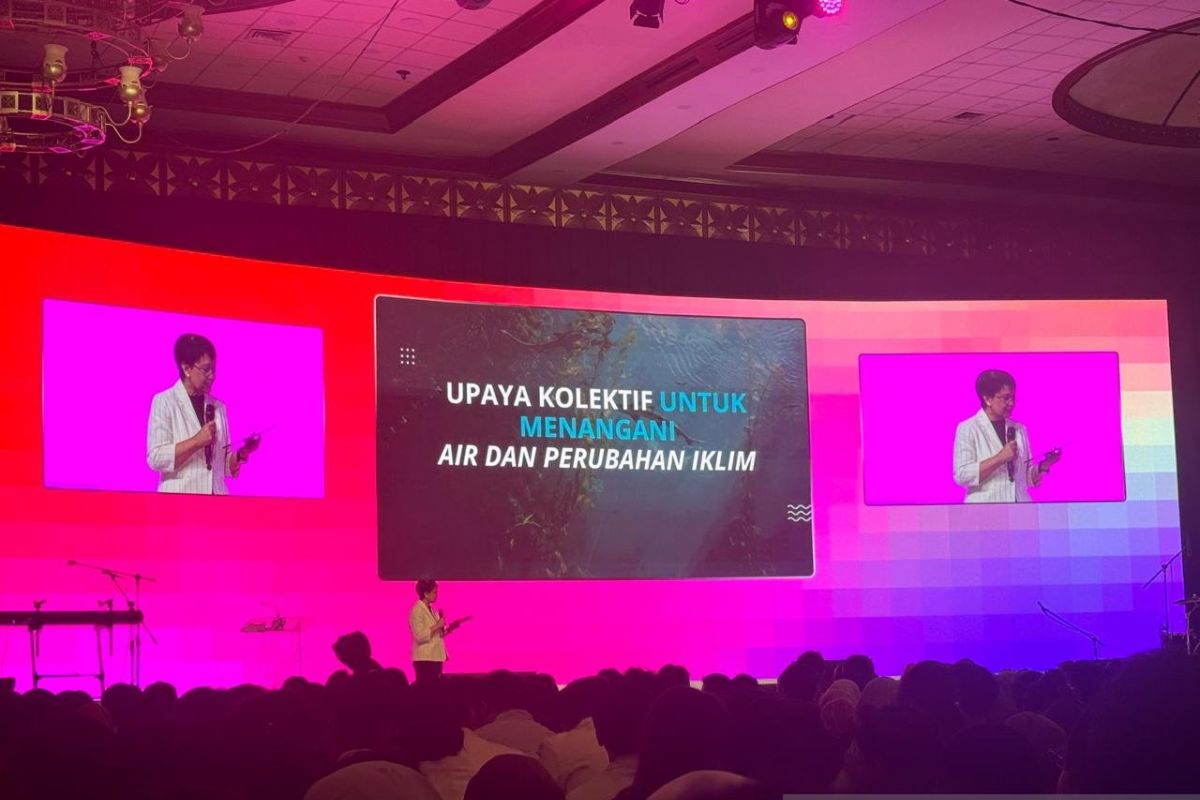
Jakarta (ANTARA) - The UN Secretary-General’s Special Envoy for Water Issues, Retno Marsudi, stated that climate change is causing all human challenges to worsen, including the water crisis.
“Climate change is a threat multiplier that can exacerbate all challenges faced regarding water issues,” Retno said during the Indonesia Net Zero Summit (INZS) 2026 in Jakarta on Saturday.
Retno emphasised that water is not merely a technical and sectoral issue that needs addressing, but is also a political and comprehensive developmental issue. She noted that water issues can be addressed through acceleration, specifically by speeding up the implementation of Sustainable Development Goal (SDG) number six, which focuses on clean water and proper sanitation.
According to her, to achieve the SDGs by 2030, Indonesia requires an eightfold increase from the current progress level for safe drinking water management, a sixfold increase for safe sanitation, and a twofold increase for basic hygiene services. “If we do not do this, the targets for SDG number six will only be achieved by 2049,” Retno remarked.
Secondly, Indonesia needs to engage in cooperation to handle water issues, Retno said, stating that collaboration to achieve the SDGs must involve the government, the private sector, civil society, and all stakeholders. Retno noted that the private sector plays a vital role in expanding access to water services for the community, adding that currently, approximately 86 per cent of water and sanitation sector financing comes from public budgets.
“Most of the existing financing for water and sanitation comes from public budgets, 86 per cent from the public budget, while the private sector contributes only 2 per cent,” Retno added, noting that this situation demonstrates the need for increased private sector involvement in financing.
She also stated that the principle of collaboration must be applied in climate action efforts, particularly to achieve net-zero emission targets, emphasising that challenges related to water and climate change require cooperation from all parties.
At the INZS 2026, Retno revealed that more than 2.2 billion people, or one in four people worldwide, do not yet have access to safe drinking water, while 3.5 billion people, or four in ten people, lack access to proper sanitation. The scale of this crisis is exacerbated by the fact that approximately 4 billion people, or one in two people in the world, experience water scarcity, with renewable freshwater availability per capita having dropped by about 7 per cent in just the last decade.
Looking ahead, challenges are projected to become even more severe as the global population is expected to reach 9.7 billion by 2050, requiring an additional 50 per cent of food and more than 25 per cent additional water to meet demand. Retno highlighted that 72 per cent of additional freshwater is used for the agricultural sector, meaning that food security, the economy, health, and education ultimately depend on the availability of increasingly limited water resources.
The expansion of artificial intelligence and digital transformation also adds to the burden, with projections of an additional water requirement of up to 129 per cent in various regions, while 40 per cent of the world’s data centres are located in areas with high water stress levels.