
Residents Refute Negative Narratives, Welcome PSN Development in Wanam
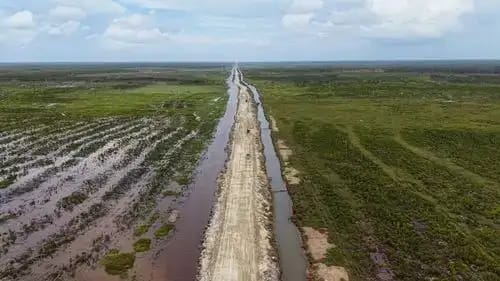
Negative narratives alleging the exodus of hundreds of thousands of people due to the National Strategic Project (PSN) in Wanam, South Papua, have been directly refuted by local residents. The community asserts that no displacement has occurred and instead hopes that the development of the Wanam PSN food estate continues.
Based on field findings, various circulating claims are deemed inconsistent with the actual situation. Current land clearing activities are reported to be limited to approximately 15,000 hectares, focusing on the construction of infrastructure such as roads, bridges, ports, solar panels, oil refineries, and cold storage facilities.
The total area of the Wanam PSN is also reported to be smaller than rumoured. Information suggesting an area of up to 2.5 million hectares is inaccurate, as the total area is estimated to be around 1 million hectares.
Furthermore, the issue regarding the exodus of up to 170,000 people was not found on the ground. Residents encountered confirmed that no mass movement of people has taken place as alleged.
Regarding heavy machinery, although there were claims of orders for up to 2,000 excavators, the actual realisation on the ground currently stands at only hundreds of units.
Amidst these various issues, the voices of local residents show hope for the development. Inosensio Sigipse, a farmer who has lived in Wanam for 10 years, expressed his support for the PSN project. He hopes the development will ease access and boost the local economy.
“If there is development, perhaps housing and roads can be built. So that we can sell our agricultural produce more easily,” said the man, known as Papa Ino, on Thursday.
He described the difficult economic conditions of the residents, where agricultural yields are not always absorbed by the market. The presence of the project is expected to create job opportunities for the community. “If there are jobs there, those of us who are unemployed can work too,” he added.
Similarly, Kleopaks Mause, a teacher and Chairman of the Village Consultative Body (Bamuskam) in Wanam, stated that the community has accepted the PSN from the beginning because it is seen as bringing change, even if it is not yet fully widespread. “The community has started to be involved in the work. It is not yet 100 per cent, but there has been change,”
he said.
He also highlighted the urgent need for basic infrastructure. “The community still has to walk to carry produce to the company. The hope is that there will be proper roads reaching the villages, so that life can be better.”
Meanwhile, Laurentius Gali Blagaise, a local hamlet leader, assessed that the development is providing a positive impact, despite initial concerns. “From what I see, this change is already very good. Local residents have also started to participate in the workforce,” said Papa Lau.
He acknowledged that some residents have not yet been absorbed into the workforce, but the future opportunities are seen as remaining open. “There are still many young people who want to work. The hope is that it can reduce unemployment.”
According to Laurentius, the development in Wanam is expected to drive regional progress so as not to be left behind. “We want Wanam to move forward, getting better little by little.”
From these various accounts, it is evident that the situation in Wanam is far from a narrative of exodus or crisis. On the contrary, the community places great hope in the development, particularly regarding improved infrastructure, employment, and local economic circulation.
Previously, there were widespread allegations that the Wanam PSN food estate covered 2.5 million hectares and that hundreds of thousands were displaced. In reality, land clearing is currently limited to 15,000 hectares for roads, bridges, ports, solar panels, oil refineries, and cold storage. The Wanam PSN area is 1 million hectares, not 2.5 million.
Additionally, there has been no exodus of the alleged 170,000 refugees, and while there were claims of 2,000 excavator orders, the actual realisation on the ground is only in the hundreds.
Religious leaders have called on the public to critically and fairly approach documentary narratives regarding development in South Papua, remaining open to clarification.
Merauke customary leader Mama Sinta expressed support for the South Papua Food Estate, stating she has moved away from the group opposing the PSN for the sake of her family’s welfare. She also noted that in the short term, existing land can be optimised to achieve food sovereignty.
The Wanam PSN in South Papua has shown significant progress, with several key facilities already 100 per cent complete. This downstream programme is supported by consolidated financing through the Daya Anagata Nusantara Investment Management Agency (Danantara).