
Residents Burning Charcoal Blamed for 125-Hectare Forest Fire on Mount Bromo
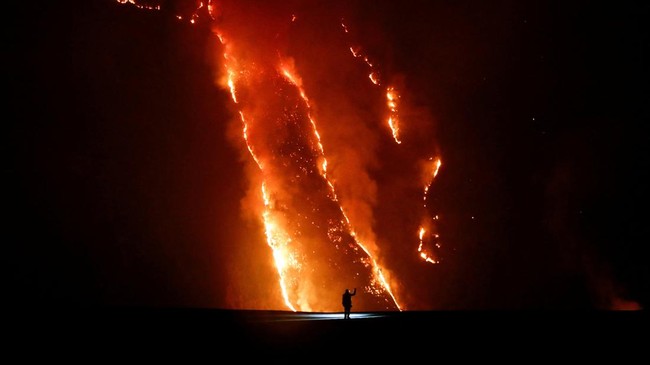
The forest and land fire that has again struck the Mount Bromo area since 3 August 2026 is apparently not a new problem. Decades ago, this area in the Tengger Mountains was also hit by major fires. One of them occurred in 1953 and was allegedly triggered by the activity of residents burning charcoal.
As a result, the forest fire raged for two days on the slopes of Mount Bromo, around Sapikerep, Sukapura District. A report by Java-bode (31 July 1953) stated that the fire destroyed around 125 hectares of casuarina forest and a plot of newly planted land.
“For two days, a forest fire raged on the slopes of Ringgit and Bromo around Sapikerep in Sukapura District. In total, 125 hectares of casuarina forest and a plot of newly planted land were destroyed by fire,” the report stated.
A similar account was reported by Het nieuwsblad voor Sumatra (3 August 1953), which covered the burning of hundreds of hectares of land. According to that newspaper, the fire was suspected to have been caused by charcoal-burning activities by local residents.
“The cause of the fire was most likely charcoal burning by residents,” wrote Het nieuwsblad voor Sumatra.
In fact, counting back 20 years, a fire caused by residents’ activities had also occurred. On 16 October 1933, fire also appeared in the Laut Pasir or Zandzee area in the Tengger Mountains. The flames then spread rapidly towards Lumajang and Malang.
A report by De Indische Courant (17 October 1933) noted that the fire occurred on the slopes of Zandzee and was suspected to have been caused by residents’ activities.
“On Monday afternoon, a fire broke out on the slopes of Zandzee, spreading from Lumajang to Malang,” wrote De Indische Courant.
The fire even affected the Bromo Nature Reserve. Nevertheless, the area was temporarily saved from further damage. Firefighting efforts were then carried out jointly. Officials and local residents stepped in to stop the flames.
“The Department of Home Affairs, the Forestry Service, and the Probolinggo Field Police, with the help of local residents, were busy carrying out firefighting efforts,” wrote the Bredasche Courant newspaper (18 October 1933).
The fire only subsided after lasting for 3-4 days. According to a report by Het Volk (23 October 1933), this occurred after the spread of the fire was successfully prevented. Officers dug trenches to stop the movement of the fire.
Although the fire was extinguished, its traces could not disappear quickly. It took a long time for Bromo to become green again as it once was.
Moreover, Bromo has long been known as a tourist destination. In the early 20th century, foreign travellers had already come to enjoy the beauty of this area, including watching the sunrise from Bromo.
One of the people who witnessed this beauty was an American tourist, Thomas H. Reid, in 1907.
“As we stood on the wall of the enormous crater, facing the sea of sand, we witnessed a golden glow slowly radiating from behind the mountain peak to the east. We felt our journey had not been in vain,” Reid wrote in Across the Equator, A Holiday Trip in Java (1908).
On this basis, the fires that have struck the Bromo area since long ago are not only about burning forests, but also concern the preservation of the natural landscape that remains a tourist attraction to this day.