
Reshaping the Value of Telecommunications Networks to Drive New Growth in the AI Era
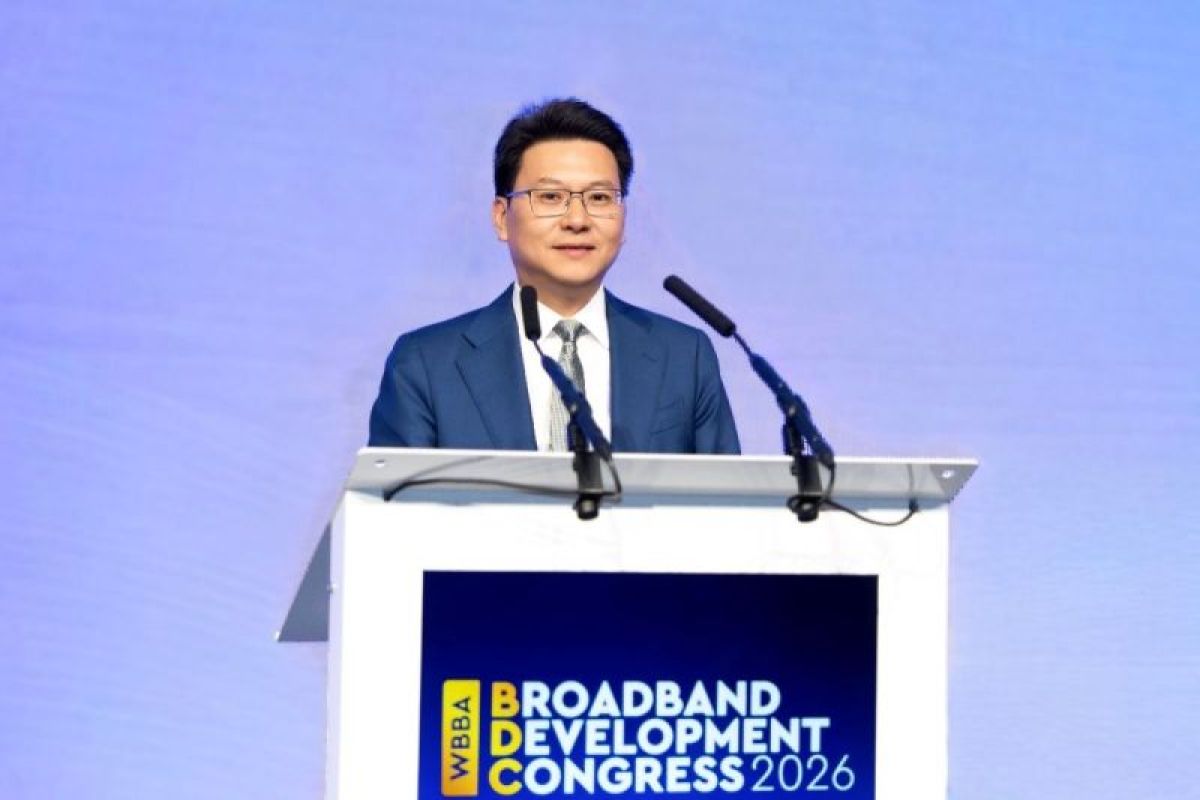
Vienna (ANTARA/PRNewswire) — The World Broadband Association (WBBA) held its Broadband Development Congress (BDC) at Network X 2026 in Vienna. At the congress, Bob Chen, President of Huawei’s Optical Business Product Line, delivered a presentation entitled “Reshaping Network Value for New Growth in the AI Era”. He emphasised the need to change how networks are built in the age of artificial intelligence (AI), setting out three principles: rebuild network architecture, reshape business models, and redefine network operations and maintenance (O&M). These steps, he said, are important to increase the value of telecommunications networks and unlock new growth opportunities.
Chen noted that over the past three decades, each wave of service growth — from voice communications to the internet and video — has depended on network support. AI is now developing at an accelerating pace. Large-scale AI models have reached nearly 10 trillion parameters, while token consumption has surged almost 50-fold over the past year. As these changes unfold, network connectivity patterns are shifting in terms of what is connected, how frequently connections are made and the quality required. The industry must therefore rethink how to increase the value of telecommunications networks.
Chen said the shift must begin with a new approach to network development. Network planning and construction should focus on the needs of AI services and the layout of AI data centres (AIDCs). At the same time, AI technology should be used to improve network O&M capabilities. This approach is encapsulated in the “3R” principles. First, rebuild network architecture by shifting the focus from administrative regions to AIDCs. Second, reshape business models. For enterprise customers, operators should move beyond selling bandwidth alone to services combining bandwidth, latency and reliability, as well as integrated computing and networking services. For home broadband, services should progress from basic connectivity to whole-home networks and smart-home experiences. Third, redefine network O&M, moving from semi-automated operations to intelligent management across the network lifecycle.
Rebuilding network architecture
Until now, networks have been built around administrative divisions, with national and provincial backbone networks and urban networks. AI is changing these requirements. The number of AIDCs has increased almost tenfold, while network traffic volumes are now determined more by computing capacity than by population.
Zhongwei in China is one example. The city previously accounted for about 0.1% of China’s total network traffic. It is now one of the country’s eight national computing hubs. Intelligent computing traffic there accounts for more than 10% of total national bandwidth, making Zhongwei an important node in the AIDC interconnection network. Similar changes are taking place around the world.
Network architecture should therefore shift from an administrative-region-based approach to one centred on AIDCs. Networks can be organised in tiers connecting core data centres (Core DCs), regional data centres (Regional DCs) and edge data centres (Edge DCs). Direct, one-hop mesh connections between data centres can support deterministic latency circles of 1, 5 and 20 milliseconds, while accelerating the launch of services.
Reshaping business models
Enterprise segment. AI is also changing companies’ production processes. For example, an industrial design company in China uses AI-based rendering to significantly shorten production cycles. As real-time AI rendering requires latency below two milliseconds, telecoms operators need to develop services that meet this requirement. One approach is to upgrade private-line services, moving from bandwidth-only offers to a package built around three core elements: bandwidth, latency and reliability. With support from OXC, ASON and quantum encryption, networks can provide measurable and consistent latency, high reliability and strong security. This can significantly increase the value of private-line services. Operators can also use computing platforms to expand their offerings from connectivity alone to “Network + Computing + Model/Applications” services, providing computing and networking in an integrated solution.
Home broadband segment. Operators can develop services beyond basic broadband connectivity through a “One Fibre, One Network, One Home” strategy. “One Network” refers to high-quality Wi-Fi coverage throughout the home using FTTR or Wi-Fi Mesh technology. “One Home” focuses on providing a range of smart applications supported by AI home devices and AI agents. Home AI agents are also changing how users interact with broadband services: users can communicate with the system in real time and control their home network using voice commands.
Redefining network O&M
In the AI era, intelligent technology needs to be applied at every stage of the network lifecycle, from planning and construction to maintenance, optimisation and operation. This includes intelligence at the level of individual network elements, the network as a whole and the services it supports. One application is Wi-Fi optimisation. Most user complaints about home networks stem from Wi-Fi problems. AI-based optimisation technology can now automatically detect the source and type of interference, then adjust transmission power and other parameters in real time. In conditions involving interference, this approach can improve Wi-Fi speeds by about 20%.
Another application is energy efficiency. Previously, network equipment operated at full capacity regardless of traffic levels, consuming more electricity than necessary. AI-based traffic analysis can now dynamically adjust power on OLT chassis and line cards, cutting total equipment energy consumption by more than 20%.
AI can also help restore network services automatically. Home broadband fault handling is divided into three service levels. Self-healing addresses air-interface problems, such as roaming failures, through automatic repairs by an AI O&M agent. Remote O&M handles configuration-parameter issues from a network operations centre (NOC), with assistance from an AI agent. On-site visits address faults in physical fibre-optic connections, with the fault location identified accurately by an O&M Copilot.
“Facing the AI era, we must change our approach by rebuilding network architecture, reshaping business models and redefining network O&M,” Chen said. “Through the three ‘3R’ principles, we can reshape the value of UBB networks and work together to drive new growth in the AI era.”
Source: jawawa.id (https://jawawa.id/newsitem/reshaping-the-value-of-telecommunications-networks-to-drive-new-growth-in-the-ai-era-1792169552)
Originally published by Antara (Indonesian) (https://www.antaranews.com/berita/5792465/dorong-perubahan-nilai-tambah-jaringan-telekomunikasi-guna-wujudkan-pertumbuhan-baru-pada-era-ai), translated from Indonesian