
Reservoir Water Vanishes: BMKG Chief Urges Dam Refilling, Highlights Solar and Wind Power
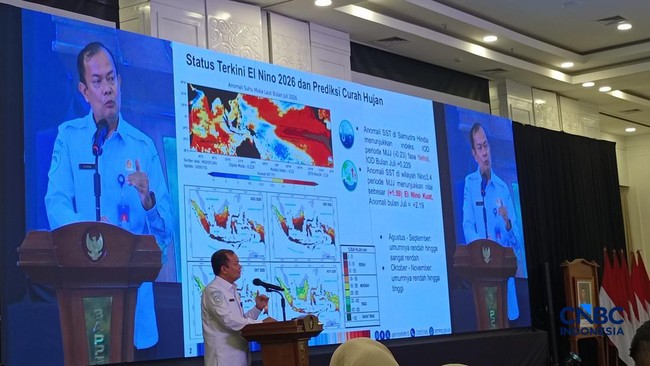
Jakarta, CNBC Indonesia — The Meteorology, Climatology and Geophysics Agency (BMKG) has warned that the El Nino phenomenon could disrupt the energy sector, particularly hydroelectric power plants (PLTA), as reservoir water flows decline during the dry season.
To anticipate these impacts, BMKG has coordinated with various ministries and agencies, including carrying out weather modification operations to maintain water supplies at dams.
BMKG Head Teuku Faisal Fathani explained that not all energy sectors are negatively affected by El Nino. According to him, the dry season can actually benefit solar power plants (PLTS) and wind power plants (PLTB).
However, the situation is different for power plants that rely on water availability.
“When it comes to solar and wind energy, these should actually perform better during the dry season, but energy from water resources is what needs attention,” Faisal said at a press conference at the Ministry of National Development Planning/Bappenas office in Jakarta on Tuesday (4/8/2026).
Faisal also said that reduced rainfall during El Nino could lower water flows at hydroelectric plants, thereby affecting electricity supplies.
He explained that El Nino is a global climate phenomenon marked by the warming of sea surface temperatures in the central and eastern equatorial Pacific Ocean. When it coincides with the dry season, the phenomenon causes rainfall to decrease, making the dry season drier and longer.
Faisal added that the impact of El Nino will be most keenly felt from August to September, when rainfall across most of Indonesia falls into the low to very low category. The most affected regions lie south of the equator, including East Nusa Tenggara (NTT), West Nusa Tenggara (NTB), Bali, Java — particularly coastal areas — southern Sumatra, and South Papua.
“In the energy sector, water flows at hydroelectric plants can decrease, affecting electricity supplies. This is why we are also carrying out reservoir filling operations,” he said.
To reduce these risks, BMKG together with the Ministry of Public Works has conducted weather modification operations to fill dams experiencing drought.
“We are directly coordinating with the Director General of Water Resources at the Ministry of Public Works to fill 240 dams across Indonesia. Not all of them, but those suffering the most severe drought,” he said.
Elaborating further, BMKG Deputy for Weather Modification Tri Handoko Seto said that reduced rainfall due to El Nino has also lowered water supplies to reservoirs. Yet reservoirs play a vital role as sources of raw water, irrigation and water supply for hydroelectric plants.
“Reservoirs in Indonesia generally serve not only raw water and agricultural needs, but also hydroelectric plants. That is why we have carried out weather modification operations to fill reservoirs, including for hydroelectric plants at Lake Toba and at Poso Energy in Sulawesi,” Seto said on the same occasion.
“Today we are conducting an operation in the Citarum river basin in West Java, so that supplies for energy, water and agriculture can be properly maintained,” he continued.
According to him, weather modification operations are one of the mitigation steps taken by BMKG together with stakeholders to maintain water supplies in reservoirs, so they remain able to support public needs, the agricultural sector, and electricity supply from hydroelectric plants during the El Nino period.
Source: jawawa.id (https://jawawa.id/newsitem/reservoir-water-vanishes-bmkg-chief-urges-dam-refilling-highlights-solar-and-wind-power-1785833515)
Originally published by CNBC Indonesia (https://www.cnbcindonesia.com/news/20260804130900-4-756408/air-di-waduk-hilang-kepala-bmkg-minta-isi-bendungan-sorot-plts-pltb), translated from Indonesian