
Researchers Uncover 'Lost World' of Extinct Species on Indonesia's Sumba Island
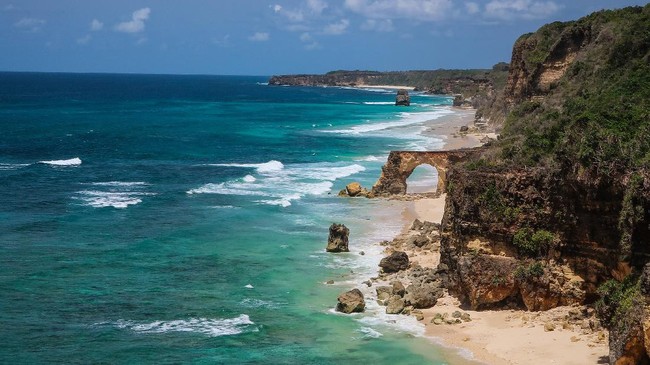
Jakarta, CNBC Indonesia – New research has revealed traces of a ‘lost world’ on Sumba Island, East Nusa Tenggara (NTT). Scientists have found evidence that the island was once a habitat for various animals, most of which are now extinct.
The findings include miniature elephants, several species of rats, giant lizards and even komodo dragon species. The scientists set out these facts in the journal Proceedings of the Royal Society B.
The report refers to the discovery of fossils of these animals. It states that fossils of the various species once lived on Sumba around 12,000 years ago, as quoted from Mongabay on Tuesday (28/7/2026).
In fact, the report found an important discovery indicating the possibility that these rare animals originally lived in the Sumba region. This is further reinforced by the discovery of komodo fossils, a species that today only inhabits Komodo Island and its surroundings on Flores.
This has fuelled the assumption that the animal, now considered rare, actually originated on Sumba.
The expedition to study these extinct animals took place from 2011 to 2014. The research team came from the Zoological Society of London (ZSL).
They collected fossils from Sumba as part of an island group known as ‘Wallacea’. The area is named after the biologist Alfred Russel Wallace, who was the first to define the boundaries of the region based on the distribution of animal species in Indonesia in the 19th century.
The region within Wallacea includes Sumba, Sulawesi, Lombok, Flores, Halmahera, Buru and Seram. Wallacea grew in prominence in 2004 when a team of archaeologists discovered fossils of ancient humans nicknamed the ‘hobbit’, or Homo floresiensis. These fossils were found on Flores, to the north of Sumba Island.
To this day, research on Sumba Island itself remains very scarce. Surveys of fossils and wildlife there have rarely been carried out.
“Perhaps because there are too many islands in Indonesia to study. There are still few biologists or palaeontologists focusing on the archipelagic regions of Indonesia,” said Samuel Turvey, one of the researchers from ZSL.
The scientists hope that further research can be carried out on Sumba to obtain new clues about the evolution of species in the area.
“Discoveries in this area could open up astonishing insights into a lost world. There were many animals that evolved in the isolated Wallacea islands, but then became extinct with the emergence of modern human civilisation,” Turvey explained.
Source: jawawa.id (https://jawawa.id/newsitem/researchers-uncover-lost-world-of-extinct-species-on-indonesias-sumba-island-1785217890)
Originally published by CNBC Indonesia (https://www.cnbcindonesia.com/tech/20260728111010-37-754357/heboh-peneliti-temukan-dunia-yang-hilang-lokasinya-ada-di-ri), translated from Indonesian