
Researcher: Asset Forfeiture Law Need Not Adopt Illicit Enrichment and NCB
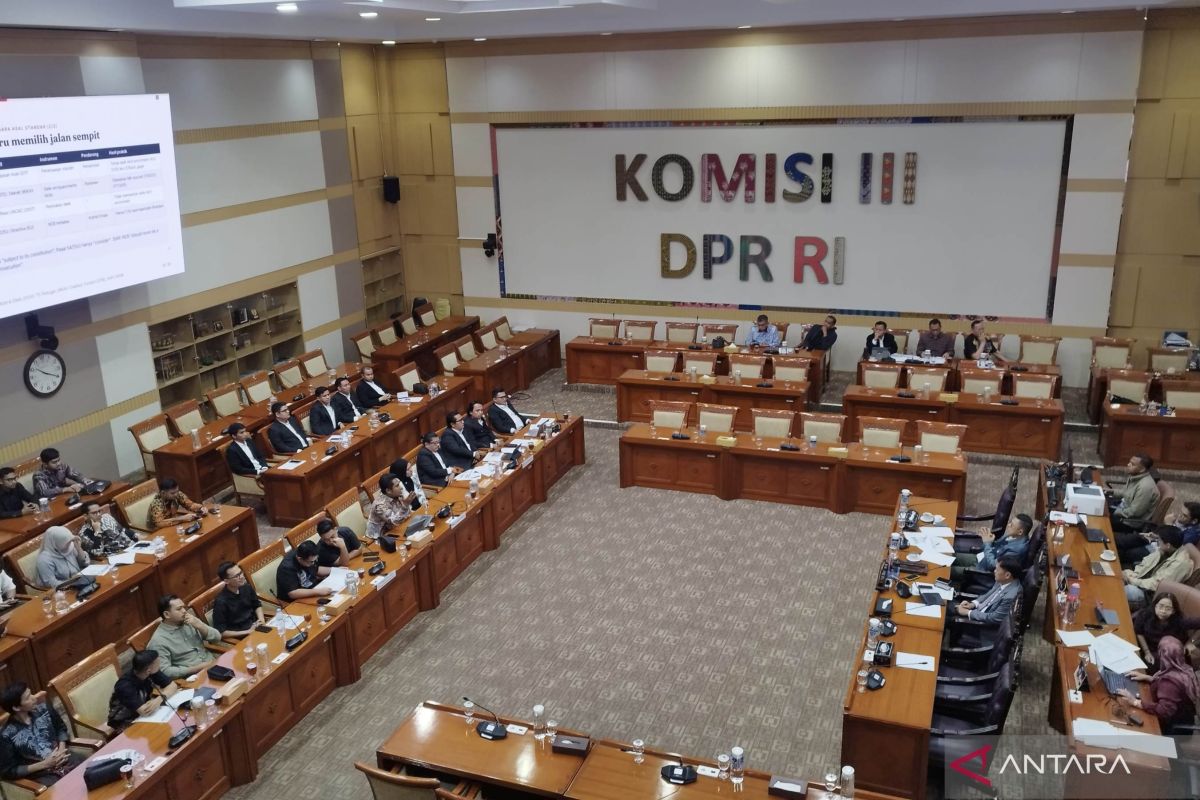
Jakarta (ANTARA) – Public policy researcher and Open Parliament Institute Director Yadi Surya Diputra said the United Nations Convention against Corruption (UNCAC) does not require an Asset Forfeiture Law to adopt provisions on illicit enrichment, or an unjustified increase in wealth, and non-conviction-based (NCB) forfeiture, in which assets are seized without a criminal conviction.
He explained that Articles 20 and 54 of the 2003 UNCAC, which address illicit enrichment and NCB, respectively, merely ask ratifying states to consider the measures. In practice, he said, adopting the two provisions could lead to complications.
“There is no obligation for member states to adopt them. They are just to be considered in light of the constitution of the country concerned, and then its legal circumstances,” Yadi said at a meeting with House of Representatives Commission III at the parliamentary complex in Jakarta on Tuesday.
According to Yadi, asset forfeiture laws in various countries have three main issues that are frequently debated: illicit enrichment, NCB and the reversal of the burden of proof. He said these issues did not emerge from efforts to mitigate specific circumstances, but from a global consortium of issues.
Adopting illicit-enrichment provisions, he said, has in practice caused complications in various countries. The rules can create the impression that all public officials and state administrators are corrupt.
“It seems to send the signal that all officials or state administrators are ‘rotten’. That is the message behind it, and that is what has happened in various countries,” Yadi said.
He said the provision would need to be applied very carefully if included in an Asset Forfeiture Law. If it is not drafted precisely, he warned, illicit-enrichment rules could also backfire on the House of Representatives.
He said measuring an increase in wealth would be difficult and must comply with the principle of legality, including the requirements of lex certa and lex stricta.
In the United States, for example, illicit enrichment is applied in circumstances where public officials have first divested themselves of their businesses. Their wealth is then calculated from zero when they take office, making it easier to measure, he said.
“In Indonesia, meanwhile, civil servants and political officials are all allowed to do business, so even the State Officials’ Wealth Report (LHKPN) is difficult to use as a benchmark,” he said.
As for NCB, he said other countries have also faced complications in applying it. He gave the example of an official seizing US$5,000 from a state official on suspicion that it was drug money: proving the case could be complicated, and the cost of proceedings could exceed the amount seized.
“I have researched 78 countries that have adopted it into their respective positive law, in various forms. Some have adopted it fully, some only partially, some have expanded it, and some have limited it,” Yadi said.
Source: jawawa.id (https://jawawa.id/newsitem/researcher-asset-forfeiture-law-need-not-adopt-illicit-enrichment-and-ncb-1793080482)
Originally published by Antara (Indonesian) (https://www.antaranews.com/berita/5814019/peneliti-perampasan-aset-tak-wajib-adopsi-illicit-enrichment-dan-ncb), translated from Indonesian