
Research Reveals Solar System May Have Once Had Two Extra Planets
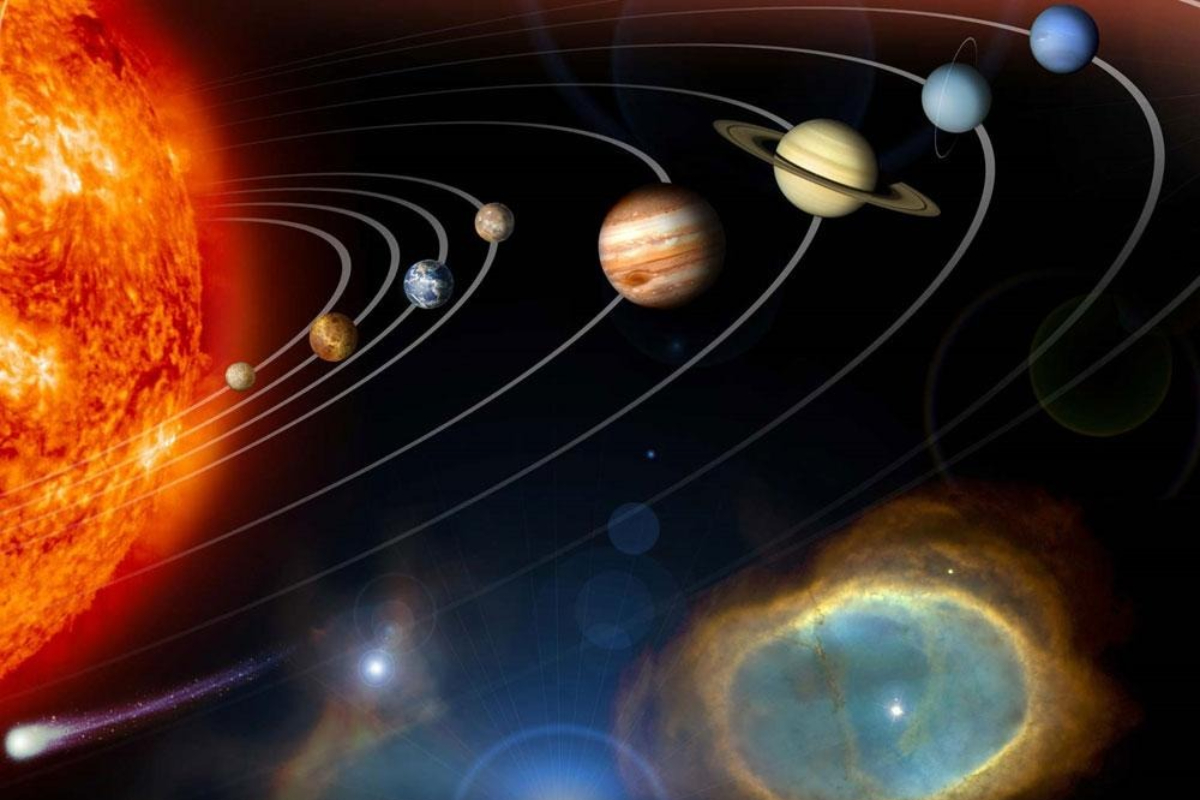
A recent study has revealed a surprising possibility that during its early formation, the Solar System may have possessed two additional giant planets that have since disappeared. These planets are believed to have played a significant role in disrupting the orbits of celestial bodies before eventually being flung out of the Solar System due to intense gravitational interactions.
The research, published in the journal I020Icarus, was conducted through more than 100 computer simulations that reconstructed the evolution of the Solar System from billions of years ago.
The simulation results show that the current configuration of the Solar System is more easily explained if there were one to two additional planets of a size comparable to Neptune during its early stages. These planets fall into the category of super-Earths or ice giants with masses larger than Earth.
Researchers found that approximately 40 per cent of the best simulations began with five giant planets, while the remainder required six giant planets.
In the six-planet scenario, the two additional planets experienced strong gravitational disturbances due to interactions with Jupiter, Saturn, Uranus, and Neptune. As a result, these two planets were ejected into interstellar space and are no longer part of the Solar System.
The presence of these two missing planets is thought to have triggered a period of gravitational instability that caused major changes in the orbits of the young planets. This event likely took place hundreds of millions of years after the Sun formed.
While this process sounds destructive, it actually helped form the stable Solar System configuration seen today.
Interestingly, the research also shows that the existence of two additional planets can explain why the natural satellite systems of Jupiter and Uranus have been able to survive until now.
In simulations involving only one additional planet, several of Uranus’s moons became unstable. Conversely, when two additional planets were included, the orbits of the primary satellites remained better preserved.
Astronomers assess that these findings provide a new picture of the Solar System’s youth, which was far more chaotic than current conditions. Furthermore, the research supports the theory that many planetary systems in the universe undergo a process of planetary ejection during their early evolutionary stages.
Although the existence of these two missing planets cannot yet be proven directly, the latest simulations suggest that this possibility is worth considering to explain the various unique characteristics possessed by the Solar System today.