
Rescue Mission for the JCI Begins to Pay Off, and the Hot Potato Is Now in BI’s Hands
Indonesia’s domestic stock market rebounded amid a series of measures by the Indonesia Stock Exchange (IDX), the government and Danantara to address investor concerns following MSCI’s announcement last week.
As trading begins today, Wednesday (21 October 2026), market participants will focus on Bank Indonesia’s (BI) interest-rate decision, progress on capital-market reforms and the direction of global financial markets.
The Jakarta Composite Index (JCI) finally recovered on Tuesday (20 October 2026), following steep declines over the previous two trading sessions.
According to IDX data, the JCI surged 282.28 points, or 5.65%, to close at 5,278.89.
The gain took the index back above the psychological 5,000 level, after it had closed at 4,996.61 the previous day.
The JCI initially opened lower at 4,980.16, slightly below the previous close. The decline was short-lived, however: the index began rising early in the session, fluctuating between 5,100 and 5,200 during the morning session.
Buying strengthened in the afternoon session. The JCI continued to rise, breaking through 5,200 before closing at its daily high of 5,278.89.
Trading was active, with total volume reaching 568 million lots and transaction value amounting to Rp26.5 trillion.
Foreign investors nevertheless remained significant net sellers, recording net outflows of Rp2.21 trillion across the market.
The rebound followed heavy selling in the domestic market after MSCI announced the possibility of reclassifying Indonesia from an Emerging Market to a Standalone Market. The JCI had fallen 11.57% on Friday (16 October 2026), then dropped a further 3.64% on Monday (19 October 2026).
Amid the pressure, several steps have been taken to restore investor confidence. The IDX, for example, has announced plans to exclude shares with concentrated ownership, or High Shareholding Concentration (HSC), from the JCI calculation.
Several conglomerate-owned issuers have also announced share buy-back plans worth trillions of rupiah.
Market participants are expected to monitor progress on these measures and foreign investors’ response to domestic capital-market reforms.
In the foreign-exchange market, the rupiah also strengthened against the US dollar on Tuesday, moving back below the psychological level of Rp18,000 per US dollar after trading above it during the previous two sessions.
The rupiah gained from the opening, rising 0.11% to Rp18,010 per US dollar before extending its advance through to the close. Its movement was in line with a weaker US dollar globally.
At 3pm Western Indonesia Time, the US dollar index (DXY), which measures the greenback against six major currencies, was down 0.22% at 101.758.
The dollar’s weakness gave the rupiah room to recover as domestic markets began to show signs of improvement. Even so, investors will continue to track the MSCI issue and BI’s efforts to stabilise the exchange rate.
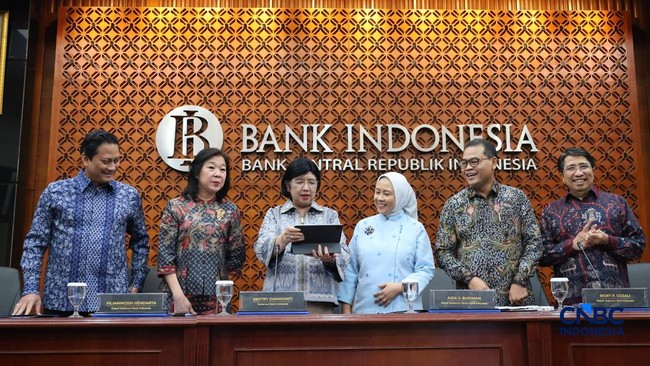
BI is scheduled to announce its benchmark interest-rate decision today, following a two-day Board of Governors Meeting.
Meanwhile, the yield on 10-year Indonesian government bonds (SBN) was unchanged at 7.169% on Tuesday. Bond yields move inversely to prices: when yields rise, bond prices generally fall, and vice versa.
US shares closed mixed on Tuesday (20 October 2026), or early Wednesday Indonesian time. Strong performances by several companies and falling oil prices lifted market sentiment, offsetting continued pressure on artificial-intelligence-related shares.
The Dow Jones Industrial Average jumped 529.85 points, or 1.02%, to 52,495.88. The S&P 500 rose 0.28% to 7,712.57, while the Nasdaq Composite edged down 0.02% to 26,424.82.
The Dow’s advance was led by industrial and safety-products manufacturer 3M, whose shares surged more than 5%. The company reported earnings above market expectations and raised its full-year outlook.
Aerospace and defence company Northrop Grumman also gained more than 4% after reporting profits above analysts’ estimates.
In commodity markets, oil prices fell after earlier gains. US West Texas Intermediate crude dropped 1.8% to US$101.79 a barrel, while Brent crude fell 0.7% to US$108.79.
The decline in oil prices, accompanied by lower US government-bond yields, helped improve investor sentiment. Market participants nevertheless continued to monitor developments in the Middle East conflict.
AI shares remain under pressure
Technology shares continued to face pressure amid concerns about the sustainability of the AI rally. Investors are beginning to question the scale of debt companies are taking on to build AI infrastructure and whether demand will be sufficient to support such substantial investment.
Sentiment in the technology sector was briefly hit after South Korean AI company Elice plunged more than 30% in its trading debut. The move also weighed on South Korean shares and dragged down several Asia-Pacific markets.
Some AI-related stocks nevertheless recovered during the session. Western Digital rose more than 3%, while Seagate Technology gained more than 2%. CoreWeave and Marvell Technology each advanced by more than 1%.
The S&P 500 had closed higher on Monday, while the Nasdaq Composite rose more than 1%. The gains marked an attempted recovery from last week’s sell-off, as concern grew over the debt required to build AI infrastructure.
Jake Behan, head of capital markets at Direxion, said the relationship between rising interest rates and share-price growth was beginning to be tested.
So far this year, markets have tended to overlook rising rates because the growth outlook, particularly for AI, was considered strong enough to justify them. That dynamic began to change last week, Behan said.
In his view, earnings reports from major technology companies, or hyperscalers, over the coming weeks will be the next major test for the AI rally.
Investors are expected to focus more closely on projected returns on investment (ROI), data-centre spending and capital expenditure (capex) for 2027 than on quarterly earnings alone.
The future direction of technology shares will therefore depend heavily on whether companies can demonstrate that their large AI investments will generate commensurate returns.
Indonesia’s financial markets face several significant domestic and international factors today. Investors are focused on BI’s interest-rate decision, while overseas developments include China’s central bank holding rates steady and the state of the UK labour market.
1. Danantara set to enter the market as state-owned shares rally?
Shares in state-owned enterprises (SOEs) and their subsidiaries broadly rose on Tuesday (20 October 2026), as the JCI rebounded after plunging over the previous two sessions.
Stockbit data showed that all 20 actively traded SOE shares ended in positive territory. No actively traded state-owned share closed lower, while six other shares remained suspended.
PT Pertamina Geothermal Energy Tbk (PGEO) recorded the biggest gain, surging 19.28% to Rp990 a share. PT Telkom Indonesia (Persero) Tbk (TLKM) jumped 16.38% to Rp2,060, while PT Wijaya Karya Beton Tbk (WTON) rose 11.86% to Rp66.
State-owned mining and energy companies also posted sharp gains. PT Timah Tbk (TINS), PT Elnusa Tbk (ELSA) and PT Aneka Tambang Tbk (ANTM) each rose by more than 10%.
Among banks, PT Bank Rakyat Indonesia (Persero) Tbk (BBRI) climbed 9.84%, PT Bank Mandiri (Persero) Tbk (BMRI) gained 9.82%, and PT Bank Negara Indonesia (Persero) Tbk (BBNI) rose 8.78%.
BBRI recorded the highest transaction value among SOE shares, at Rp1.87 trillion.
Combined transaction value for the 20 SOE shares was about Rp6.34 trillion, with BBRI, BMRI and TLKM accounting for nearly Rp4.6 trillion.
Six other SOE shares remained suspended: ADHI, INAF, PTPP, WIKA, WSBP and WSKT.
The gains in state-owned shares helped lift the JCI by 5.65% to 5,278.89. The infrastructure sector rose 8.8%, followed by financials, up 6.4%, and basic materials, up 4.6%.
One factor behind market optimism was Danantara’s plan to increase its shareholdings in several SOEs. Dony Oskaria, head of the SOE Regulatory Agency and chief operating officer of Danantara, said the agency was ready to raise its stakes in state-owned companies with strong fundamentals.
Danantara Indonesia chief executive Rosan Perkasa Roeslani said several companies under its umbrella remained in sound financial condition despite sharp falls in their share prices. He said this presented a long-term investment opportunity.
“We see this as an opportunity for us to invest for the long term,” Rosan said, as quoted by CNBC Indonesia.
Rosan cited bank shares, which he said were currently relatively low-valued. The price-to-book value (PBV) ratio of several bank shares was below one, even though he considered the national banking sector healthy and offering attractive dividends.
Danantara plans to buy shares gradually, while taking market conditions into account.
The plan comes after Indonesia’s stock market came under heavy pressure following MSCI’s announcement that it could reclassify Indonesia from an Emerging Market to a Standalone Market. The JCI had fallen 11.57% on Friday (16 October 2026) and declined a further 3.64% on Monday (19 October 2026).
Amid the pressure, capital-market authorities have announced several remedial measures, including the IDX’s plan to exclude shares with concentrated ownership, or HSC, from the JCI calculation.
President Prabowo Subianto has also asked the Financial Services Authority (OJK) to strengthen enforcement against capital-market violations, including coordinated share-trading practices.
Investors will now be watching how Danantara’s planned purchases are carried out and whether gains in state-owned shares can continue over the coming sessions.
2. Awaiting BI’s decision, with markets expecting a rate rise
Bank Indonesia will announce its benchmark interest-rate decision on Wednesday (21 October 2026), after holding a two-day Board of Governors Meeting that began on Tuesday.
The decision has attracted market attention, particularly after the rupiah again briefly breached Rp18,000 per US dollar and Indonesia’s stock market came under heavy pressure following the MSCI announcement.
In a poll of 13 financial institutions conducted by CNBC Indonesia Research, 10 respondents expected BI to raise its rate by 25 basis points (bps) to 6.00%. The other three expected it to remain at 5.75%.
If BI raises rates, it would be the first increase after the central bank held them steady for three consecutive months.
BI raised rates by a cumulative 100 bps between May and June 2026, from 4.75% to 5.75%, to support the rupiah and anticipate inflationary pressure.
Market pressure has also stemmed from investors’ concerns about MSCI possibly reclassifying Indonesia from an Emerging Market to a Standalone Market.
Bank Permata chief economist Josua Pardede said the pressure was no longer confined to shares, but could also spread to the bond and currency markets.
“This shows that pressure is spreading from the stock market to the bond market and the exchange rate,” Josua told CNBC Indonesia.
He said a rate rise could help maintain the appeal of rupiah-denominated assets and reduce the risk of foreign capital outflows. However, higher rates would not necessarily resolve all the problems facing Indonesia’s financial markets.
“However, an increase in the BI Rate does not guarantee that the rupiah will immediately strengthen, particularly because the current pressure is not entirely due to interest-rate differentials, but also to a heightened perception of risk in Indonesia’s financial markets,” Josua said.
3. China’s central bank holds rates steady again
China’s central bank, the People’s Bank of China (PBOC), kept its benchmark lending rates unchanged on Tuesday (20 October 2026), in line with market expectations.
Reuters reported that the PBOC held the one-year Loan Prime Rate (LPR) at 3.00% and the five-year LPR at 3.50%. Both rates have now remained unchanged for 17 consecutive months.
The one-year LPR is widely used as a benchmark for business lending, while the five-year rate is an important reference for longer-term loans, including mortgages.
The decision was widely anticipated. All 22 respondents to a Reuters survey of market participants expected both rates to remain unchanged.
One reason China has not rushed to cut rates is that its economic growth has begun to improve. The latest data showed the economy grew 4.5% year on year in the third quarter of 2026, up from 4.3% in the previous quarter.
Growth also exceeded market forecasts, making the government’s full-year target of 4.5% to 5.0% for 2026 more achievable.
However, China’s recovery remains uneven. Strong exports have been a key driver, while household consumption, private investment and the property sector continue to face pressure.
The situation requires the Chinese government to balance support for the economy with maintaining financial-system stability.
Alongside its decision to hold rates, the PBOC is considering changes to how it determines the direction of monetary policy. One proposal under review is to use the one-day interbank lending rate as a key policy guide…
Source: jawawa.id (https://jawawa.id/newsitem/rescue-mission-for-the-jci-begins-to-pay-off-and-the-hot-potato-is-now-in-bis-hands-1792540246)
Originally published by CNBC Indonesia (https://www.cnbcindonesia.com/research/20261020182146-128-777957/misi-selamatkan-ihsg-mulai-berhasil-bola-panas-kini-ada-di-tangan-bi), translated from Indonesian