
Rescue Measures Deployed: Can the JCI Weather the MSCI Storm?
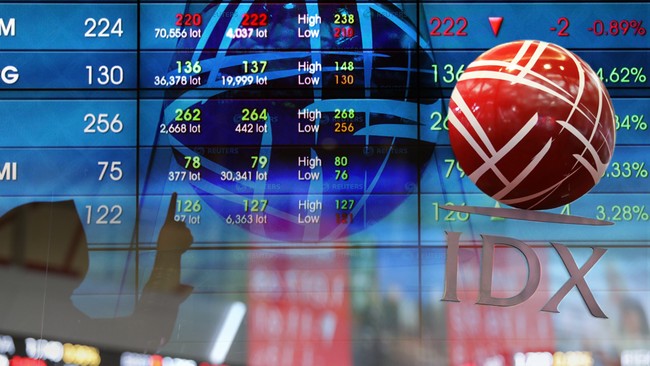
At the start of trading today, Tuesday (20 October 2026), market participants will continue to monitor developments surrounding MSCI and the authorities’ efforts to maintain financial-market stability. The Chinese central bank’s interest-rate decision and the start of Bank Indonesia’s (BI) Board of Governors Meeting will also be in focus.
The Jakarta Composite Index (JCI) closed lower again on Monday (19 October 2026), although it managed to recoup most of its losses towards the end of the second session.
According to Indonesia Stock Exchange (IDX) data, the JCI fell 188.49 points, or 3.64%, to 4,996.61.
The index was volatile throughout the session. It plunged as much as 5.36% to 4,907.37 before gradually paring its losses.
During the second session, the JCI briefly climbed back above the psychological 5,000 mark, reaching an intraday high of 5,012.87.
The recovery was not enough to take the index out of negative territory, however, and it ultimately closed below 5,000.
Trading remained active despite the market pressure. Total volume reached 34.07 billion shares, with a transaction value of Rp25.13 trillion.
A total of 100 shares rose, 656 fell and 43 were unchanged.
Foreign investors continued to sell, recording net outflows of Rp1.72 trillion across the market.
Several large-cap stocks also weighed on the JCI, including PT Bank Central Asia Tbk (BBCA), PT Bank Rakyat Indonesia (Persero) Tbk (BBRI), PT Bayan Resources Tbk (BYAN), PT Telkom Indonesia (Persero) Tbk (TLKM) and PT Amman Mineral Internasional Tbk (AMMN).
Ongoing selling pressure was linked to investor concerns about MSCI’s announcement that it may downgrade Indonesia’s stock-market classification from Emerging Market to Standalone Market.
The proposal remains under consultation and is not yet a final decision. But concerns about potential foreign-fund outflows have kept investors cautious.
In the foreign-exchange market, the rupiah also failed to recover against the US dollar on Monday.
Refinitiv data showed that the rupiah closed 0.17% weaker at Rp18,030 per US dollar, compared with Rp18,000 on Friday (16 October 2026).
The decline left the Indonesian currency above the psychological threshold of Rp18,000 per US dollar.
A stronger US dollar added to the pressure on the rupiah, as domestic financial markets remained unsettled by concerns over the MSCI announcement.
BI said it would remain active in the market to maintain rupiah stability in line with fundamentals.
Erwin Gunawan Hutapea, head of BI’s Monetary Management and Securities Department, said interventions were continuing to stabilise the rupiah amid financial-market pressure.
“[We are] ensuring that market mechanisms function properly. Interventions are being carried out consistently through Non-Deliverable Forward (NDF) transactions in offshore markets, spot and Domestic Non-Deliverable Forward (DNDF) transactions in the domestic market, as well as purchases of government bonds (SBN) in the secondary market,” Erwin said, as quoted by CNBC Indonesia on Monday (19 October 2026).
Meanwhile, the yield on 10-year government bonds was again broadly unchanged on Monday.
In the bond market, yields move in the opposite direction to prices: when yields rise, bond prices generally fall, and when yields decline, prices tend to rise.
In the US, Wall Street closed mixed on Monday (19 October 2026), or early Tuesday Indonesian time.
Wall Street gained as investors returned to technology stocks after the sector was hit by heavy selling last week amid concerns about artificial intelligence (AI).
The technology-heavy Nasdaq Composite rose 1.11% to 26,430.89. The S&P 500 gained 0.41% to close at 7,690.73. The Dow Jones Industrial Average, by contrast, fell 36.38 points, or 0.07%, to 51,966.03.
Intel shares rose 2% after JPMorgan analysts upgraded the chipmaker. Advanced Micro Devices (AMD) gained 1.8%, while Micron Technology jumped about 3%.
CoreWeave, one of the leading companies in the neocloud industry, reversed earlier gains to close 0.4% lower, despite Goldman Sachs upgrading its rating on the company’s shares.
CoreWeave shares plunged more than 25% last week, their steepest weekly decline since November 2025, amid investor concerns about the company’s debt burden.
Technology shares under pressure as investors grow wary of AI
Last week was a difficult period for US equity markets. The S&P 500 fell nearly 2%, its biggest weekly decline since late June.
The Nasdaq slumped 4.5%, ending a four-week run of gains.
The information-technology sector also dropped more than 6%, its worst weekly performance since April 2025.
Goldman Sachs data showed that technology was the global sector with the largest net selling last week. Hedge funds also sold technology shares at the highest proportion on record in the dataset.
Concerns about the sustainability of AI investment gained traction after CNBC reported that Anthropic’s revenue reached US$16.8 billion in the third quarter of 2026, up from US$11.6 billion in the previous quarter.
Despite the increase, the figures prompted investors to question the pace of AI-business growth against the scale of investment being poured into technology infrastructure.
Pressure also spread to corporate-bond markets.
Investors began avoiding CoreWeave debt, while the company’s credit default swap (CDS) contracts reached levels signalling serious credit stress.
LNW chief investment officer Ron Albahary said movements in CoreWeave’s bond spreads reflected a shift in investors’ view of the assumption that AI investment was relatively insulated from rising interest rates.
He said that if profit growth began to slow, markets could become increasingly vulnerable.
“Investors will be far more selective in assessing whether these companies can generate returns on capital sufficient to justify the debt they have taken on,” he said.
Before the latest sell-off, Albahary added, investors tended to assume that all AI investment would pay off. The reality, however, was not so straightforward.
Oil prices volatile as energy conflicts draw attention
Outside technology, market participants were also watching oil markets amid increased attacks on ships in the Persian Gulf and Russian and Ukrainian strikes against energy infrastructure.
On Sunday (18 October 2026), Ukraine attacked an oil terminal in St Petersburg, Russia. Damage to energy infrastructure raised concerns that supply pressures could persist into 2027.
Long-dated oil futures began to rise as concerns mounted over the possibility of prolonged supply disruptions.
On Monday, nearby West Texas Intermediate (WTI) crude futures closed 2.22% higher at US$103.66 a barrel. Brent crude, by contrast, fell 0.28% to US$109.55 a barrel.
Big technology companies’ results to set the tone
Investors will focus this week on earnings releases from several major companies, including Meta Platforms and Tesla.
Their results are expected to offer fresh indications of the technology sector’s outlook and help stabilise share-price movements after last week’s turbulence.
For investors, the key question is no longer simply how much potential AI has, but whether technology companies’ revenue and profit growth can keep pace with their substantial investments and the associated debt risks.
As the second trading day of the week begins, market participants are expected to monitor the IDX, the government and Danantara’s response to MSCI’s announcement, share buybacks by several conglomerate-owned companies, and President Prabowo Subianto’s direction to strengthen enforcement of capital-market rules.
Indonesia’s investment realisation for the first nine months of 2026 will also be watched.
Overseas, markets will monitor signs of an improving Chinese economy and the country’s central bank interest-rate decision today.
1. MSCI response: IDX to exclude HSC shares from JCI
The Indonesia Stock Exchange is taking further steps to improve the domestic capital market following MSCI’s announcement last week that it was considering downgrading Indonesia’s stock-market status from Emerging Market to Standalone Market.
On Monday (19 October 2026), the IDX announced two new initiatives to improve transparency and the calculation of stock indices.
One of its most significant measures is to exclude all shares on the High Shareholding Concentration (HSC) list from the calculation of the Jakarta Composite Index.
HSC refers to a situation in which ownership of a stock is concentrated among a small group of shareholders. This can limit the number of shares actually available for trading.
IDX president director Jeffrey Hendrik said the exchange had held an online meeting with MSCI after last week’s announcement, but the outcome of the discussion could not yet be disclosed publicly.
Jeffrey said the IDX had already introduced several reforms, including publishing the names of shareholders with stakes above 1%, providing more detailed investor data, raising free-float requirements and announcing which shares were classified as HSC.
“We are committed to continuing capital-market reform after completing four initiatives: disclosing the names of shareholders with stakes above 1%, providing granular investor data, increasing free-float requirements and announcing HSC shares. We have also removed the minimum price of Rp50,” Jeffrey said at the IDX in Jakarta on Monday (19 October 2026).
The IDX will now introduce two further policies.
First, it will add information about shareholders’ relationships with companies to its disclosures of ownership stakes above 1%.
This will allow investors to see not only who owns shares in a company, but also whether those shareholders are affiliated with other parties.
Second, the IDX will exclude all shares on the HSC list from the JCI calculation.
The move is intended to make the index more representative of actual market conditions and less affected by stocks with concentrated ownership.
“These two initiatives are expected to improve transparency and integrity. We will announce their effective dates shortly,” Jeffrey said.
The IDX disclosed that HSC shares currently account for 18% of the JCI’s weighting.
“The aim is to provide a more reasonable picture of the index’s movements, as we know there are potential risks in HSC shares. HSC shares account for 18% of the JCI,” Jeffrey explained.
Jeffrey stressed that the measure did not mean HSC shares would be removed from the Indonesia Stock Exchange or delisted.
They will remain tradable on the exchange, but will no longer be included in the JCI calculation while they remain on the HSC list.
HSC shares are already ineligible for inclusion in several major IDX indices, including the IDX30, LQ45 and IDX80.
If a stock is removed from the HSC list, it may be reinstated in the JCI calculation.
The IDX also confirmed that issuers would face no additional penalties simply because their shares were on the HSC list.
The latest IDX measures follow MSCI’s statement that opaque share ownership and suspected coordinated trading remain concerns for global investors.
MSCI also said the improvements made by Indonesian authorities would need to be followed by consistent implementation and clear evidence of enforcement.
Meanwhile, MSCI continues to freeze certain changes to Indonesian stocks in its indices until further notice.
Consultation on the proposed reclassification of Indonesia’s stock market will continue until April 2027, with a final decision to be announced no later than 30 June 2027.
Concerns over the announcement sent the JCI tumbling 11.57% on Friday (16 October 2026), followed by a further 3.64% fall on Monday (19 October 2026), when it closed at 4,996.61.
Market participants will now watch for the effective date of the IDX’s new policies and MSCI’s response to the reforms.
2. Danantara ready to buy more state-owned shares
Dony Oskaria, head of the State-Owned Enterprises Supervisory Agency (BP BUMN) and chief operating officer of Danantara, said the fund was ready to increase its holdings in state-owned companies with strong fundamentals, as the market faced pressure over MSCI’s plan to downgrade Indonesia from Emerging Market to Standalone Market.
“We will assess good stocks with strong fundamentals,” Dony said at the State Palace on Monday (19 October 2026).
Dony said he did not know whether his meeting with President Prabowo Subianto had also covered the stock-market turmoil. However, he described plans to demutualise the Indonesia Stock Exchange as part of the capital market’s transformation.
He said the JCI’s weakness was a normal feature of financial-market dynamics. Danantara, he added, still planned to increase its holdings in listed companies, particularly state-owned firms, that it considered to have strong fundamentals.
3. Conglomerate-owned issuers announce share buybacks
Several Indonesian conglomerate-owned companies have announced share buyback plans amid the heavy pressure on the domestic stock market following MSCI’s announcement.
On Monday (19 October 2026), the JCI fell again, touching an intraday low of 4,907.37 before closing down 3.64% at 4,996.61.
Against this backdrop, at least five companies owned by conglomerates Prajogo Pangestu and Franky Oesman Widjaja have set aside a combined Rp4.5 trillion for buybacks.
Four of them are affiliated with Prajogo Pangestu.
PT Barito Pacific Tbk (BRPT) has allocated Rp1 trillion to buy back its shares. The programme is scheduled to run until 31 December 2026 through PT Sucor Sekuritas, using the company’s internal cash.
PT Chandra Asri Pacific Tbk (TPIA) has also budgeted up to Rp1 trillion to repurchase as many as 800 million shares, or around 0.92% of its issued shares.
The company has set a purchase-price range of Rp1,250 to Rp3,000 per share. The buyback will run from 20 October 2026 to 19 January 2027 through PT Henan Putihrai Sekuritas.
Two other companies linked to Prajogo have taken similar steps. PT Barito Renewables Energy Tbk (BREN) has set aside Rp1 trillion, while PT Petrindo Jaya Kreasi Tbk (CUAN) has allocated Rp500 billion.
Meanwhile, PT Dian Swastatika Sentosa Tbk (DSSA), owned by Franky Oesman Widjaja’s Sinar Mas Group, has also announced a buyback worth up to Rp1 trillion.
DSSA has scheduled the share repurchase for 19 October 2026 to 18 January 2027.
The company said the move was intended to increase shareholder value and maintain investor confidence, as well as