
Requiring ID Cards and Photos for Building Entry Violates Law, Be Alert!
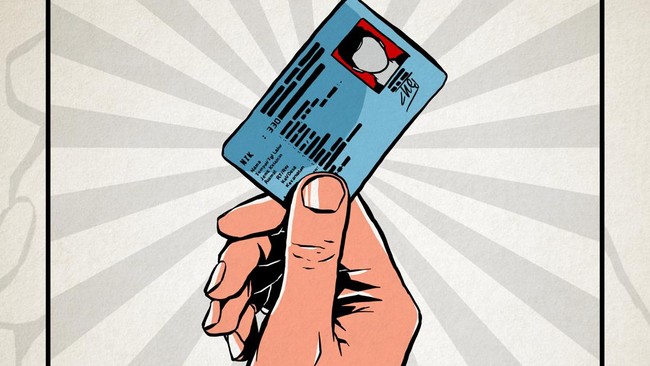
The practice of handing over National Identity Cards (KTP) at front desks or undergoing facial scans when entering office buildings and public facilities has become a daily occurrence. This procedure is often mandatory, with visitors frequently denied entry if they fail to provide identification.
However, behind these building security standards lies a serious legal controversy. This collection of personal data is considered a potential violation of privacy regulations, specifically Indonesia’s Personal Data Protection Law (UU PDP).
According to Parasurama Pamungkas, a researcher at the Institute for Democracy and Legal Reform (ELSAM), collecting identity data during building entry often violates basic data protection principles because it is irrelevant to the activity being performed. “The collection of personal data that is not actually relevant to the activities we perform, such as entering a tower and then registering an account, is essentially a failure by the controller to comply with personal data protection principles,” Parasurama told CNBC Indonesia.
He assessed that data controllers fail to meet the requirements of legality because the data harvested exceeds the primary purpose, lacks transparency, and carries the potential for misuse for interests outside of building visitor management. Ironically, although Indonesia has passed the UU PDP since 2022 with strict sanctions for negligent institutions, its implementation remains stalled. The government has yet to establish the personal data protection supervisory body, which was intended to be officially operational as of 17 October 2024.
When does this practice violate the UU PDP? Separately, Pratama Persadha, Chairman of the Centre for Cyber Security, Communication and Crime Research Centre (CISSReC), explained that the habit of exchanging ID cards does not automatically constitute a legal violation. It depends entirely on how building managers treat that data. If the KTP is merely glanced at for visual verification, the risk is vastly different from if the crucial document is photocopied, scanned, stored in a database, or accumulated without a clear retention period.
In accordance with the mandate of the UU PDP, data collection must be limited, specific, legally valid, and transparent. “Therefore, when someone is asked to hand over or scan their KTP to enter a building, it should first be explained who the data controller is, for what purpose the data is used, how long it is stored, who can access it, and when the data will be deleted,” Pratama emphasised.
He also stressed the importance of the data minimisation principle. This means that if the primary purpose is purely to ensure someone is a registered guest, building managers have no right to copy and store all the sensitive information displayed on the KTP.
Real Threats of Data Leaks and AI. From a cybersecurity perspective, Alfons Tanujaya, a cybersecurity expert from Vaksincom, warned that haphazardly collected selfies and KTP photos are not official identification instruments recognised by the Civil Registry (Dukcapil). Absolute security rests in the hands of building managers in securing their storage servers. If managers are negligent, the risk of data breaches becomes a costly gamble.
He even warned of a more terrifying threat in the era of Artificial Intelligence: leaked facial photos and KTP data can be easily misused by criminals. “Along with the photo, the face, the selfie—it can all be manipulated using AI,” he concluded.
Solutions and Public Rights. Given these various risks, observers are urging building managers to find alternative verification methods that are safer and more privacy-friendly, without restricting public mobility. ELSAM emphasised that privacy should be provided by default and by design. While waiting for regulatory decisiveness through the formation of an official supervisory body, the public is advised to be more vigilant and to dare to question the urgency of submitting identity data every time they visit public facilities or office buildings.
Source: jawawa.id (https://jawawa.id/newsitem/requiring-id-cards-and-photos-for-building-entry-violates-law-be-alert-1790769476)
Originally published by CNBC Indonesia (https://www.cnbcindonesia.com/tech/20260930113458-37-772077/masuk-gedung-diminta-ktp-dan-difoto-langgar-undang-undang-waspada), translated from Indonesian