
Republic Conference Endorses National Working Conference Mandate and White Paper Drafting
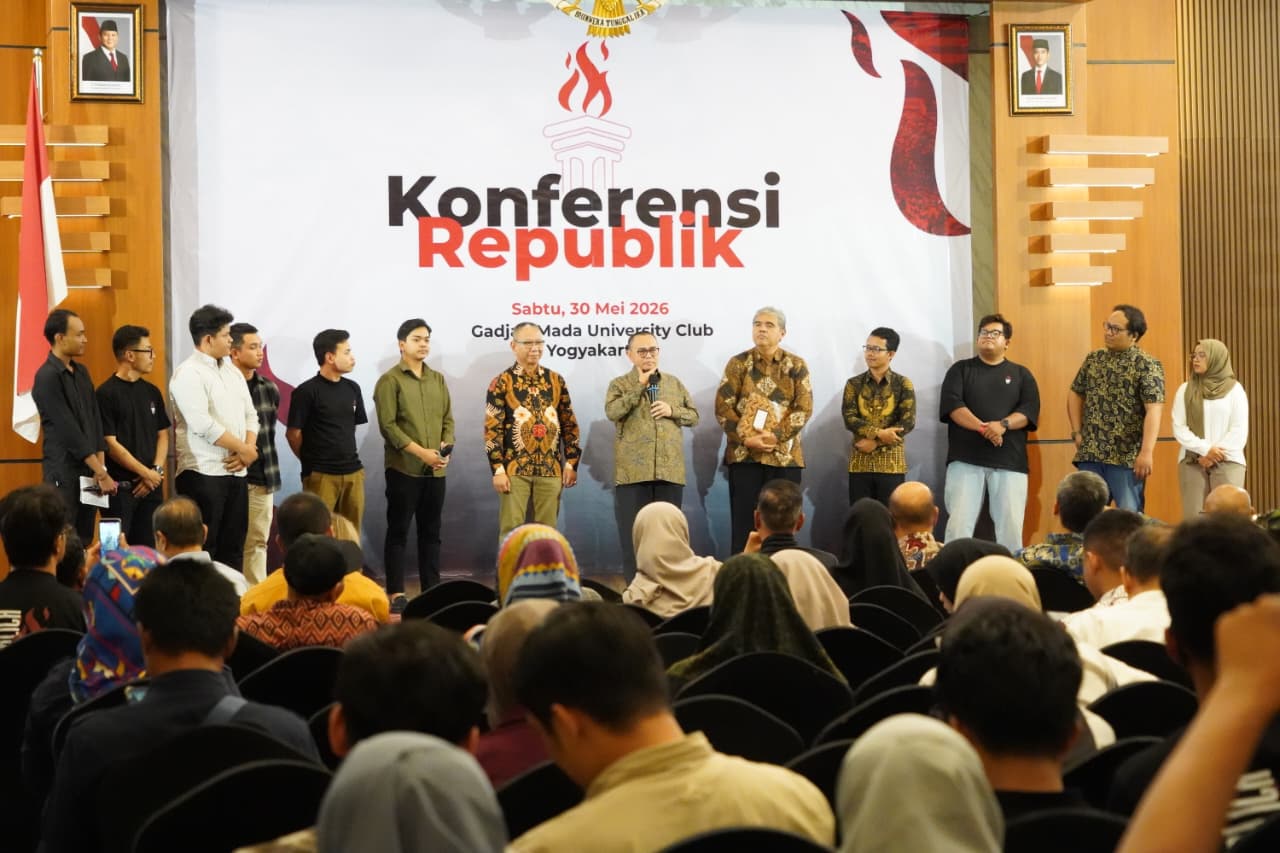
The national forum ‘Republic Conference: Strengthening Civil Society as a Pillar of the Republic’ held at Gadjah Mada University (UGM) has finalised three key demands. These include restoring civil society’s sovereignty, building a new republican framework to regain public trust, and unifying all civil forces across Indonesia.
To follow up on the conference outcomes, the forum has granted full mandate to Sudirman Said, as Committee Chairman, and Yanuar Nugroho, as Secretary-General, to promptly convene a National Working Conference.
Sudirman Said stated this mandate is a crucial opportunity to reset civil society’s paradigm to stand equal with other state pillars. He urged Civil Society Organisations (CSOs) to shift from traditional mindsets and build cross-sector communication with greater confidence. ‘Traditionally, in the name of independence, civil society has been uncomfortable engaging with political parties as if it were undignified. Yet decisions are made there. It’s time for a new paradigm—civil society must build bridges and engage with all stakeholders, including politicians, military, and police, so national decisions are based on data and evidence,’ Said at UGM on Saturday (30 May).
Committee Secretary-General Yanuar Nugroho emphasised the Republic Conference is not a mere theoretical discussion without direction. He stressed the movement is purely a space for collective idea exchange, entirely unaffiliated with practical or electoral political agendas.
The meeting, featuring seven discussion panels and dozens of speakers, was reportedly self-organised through the collective effort of hundreds of CSOs without corporate sponsorship. Speakers attended on self-funded basis as a show of solidarity. ‘This is not the concern of a few activists; it’s the collective unease of civil society across all regions,’ Nugroho said.
CELIOS Executive Director Bhima Yudhistira added that a key post-conference output is drafting a ‘White Paper’ outlining concepts for an economy prioritising people and environmental sustainability. ‘We cannot afford a deficit of ideas,’ he said.
From an academic perspective, UGM Vice-Rector Arie Sujito urged activists to link top-level political crisis narratives with the real economic struggles of ordinary citizens, such as employment and commodity prices. He warned that without integrating these issues, civil movements would remain confined to their own discourse. Microeconomic conditions were reinforced by Wijayanto Samirin’s data showing 76% of household income is spent on consumption, alongside a shrinking middle class.
Meanwhile, UI Electoral Expert Titi Anggraini categorised Indonesia’s current state as an ‘electoral autocracy’, where elections are held but not free or fair.
Closing the series of discussions, Gita Wirjawan highlighted Indonesia’s geopolitical challenges, constrained by low cognitive quality and uneven higher education distribution, particularly in STEM fields. ‘Geopolitical manoeuvring won’t happen if the national average IQ remains at 78. Indonesia will only truly be proud when it delivers high-quality public services and goods to all citizens,’ Wirjawan said.
The absence of a White Paper risks damaging foreign trust built through defence sector transparency. The document provides in-depth analysis of expertise needs for strategic outputs and highlights the importance of establishing centres of excellence.