
Republic Conference Consolidation Agrees on Common Platform and Selects 20 Formateur Names
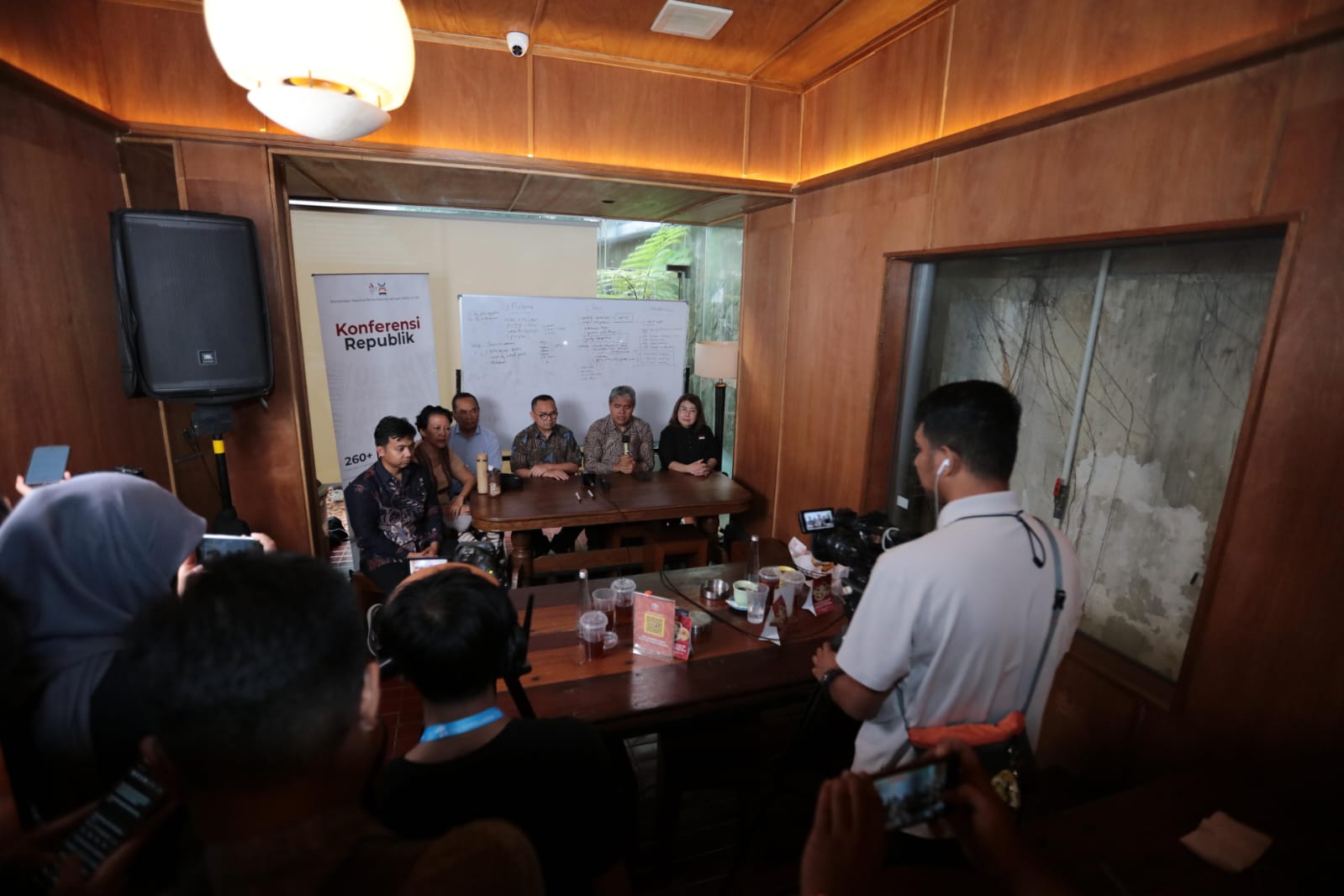
Amid the dynamics of a last-minute permit cancellation for the use of a venue by the University of Indonesia, the National Consolidation agenda of the Republic Conference proceeded in a hybrid format on Sunday (28/6/2026). This cross-generational civil society consolidation forum was attended by more than 200 organisational representatives online, and was directly attended by 150 participants at a café in the Cikini area, Central Jakarta. After an intensive discussion process lasting nearly five hours, the forum successfully agreed on three strategic mandates as the foundation for the movement going forward: the formulation of a common platform, the design of an organising framework, and the establishment of a pioneering formateur team. “The widespread unease across various regions is the reason for the gathering of representatives from seven generations in this forum. This momentum requires a public space to reaffirm that this republic does not belong to any individual,” said the General Chairperson of the Republic Conference, who is also the Rector of Universitas Harkat Negeri, Sudirman Said, on Sunday (28/6/2026). The Secretary General of the Republic Conference, Yanuar Nugroho, detailed the technical aspects of the two main macro-organisational outcomes. In terms of the platform, this document will serve as a unifying instrument for various civil groups with different backgrounds. Meanwhile, from a structural aspect, the agreed organisational design deliberately avoids a centralised institution with rigid branches, instead adopting a networking model that connects actors across sectors. Yanuar highlighted the shift in the leadership model offered by the forum, which is institutional in nature, executed collectively, and grounded in integrity values. This model is proposed as an alternative amidst a public condition that has been deemed to have faced pragmatic and egocentric leadership patterns for too long. Its primary target is to restore the position of citizens as subjects of sovereignty, rather than mere political objects. As a concrete follow-up step to the forum’s outcomes, the Republic Conference officially selected 20 prominent names to join the formateur team tasked with drafting the pioneering leadership structure. This formateur team is led directly by the main leadership ranks, namely Sudirman Said, Jaleswari Pramodhawardhani, and Yanuar Nugroho. A number of national figures and civil society activists from various fields also volunteered or were nominated by participants to strengthen the formateur team, including Chandra M. Hamzah (Former Deputy Chairperson of the KPK), Dandhy Laksono (Filmmaker/Media Activist), Agus Sari (Environmental Expert/Practitioner), Rene Suhardono (Writer/Consultant), Untoro Hariadi (Academic), Ahmad Mujahid (Executive Chairperson), Maria Selastiningsih, and Joko Susilo. The Deputy General Chairperson of the Republic Conference, Jaleswari Pramodhawardhani, added that the unilateral cancellation at the UI campus did not breed pessimism, but rather underscored the urgency of structuring civil ideas into concrete action. In line with this, Event Collaborator and UI Board of Trustees Member representing students, Razaan Bayu Rachman, expressed hope that this discourse on change could evolve more concretely at the grassroots level. Going forward, the Republic Conference is planned to be rotated to several cities that have declared their readiness to host, with a number of figures set to accompany the process. For the organisers, this momentum confirms that public space to discuss public issues remains necessary, and that citizens need to be repositioned as subjects in determining the direction of the republic.