
Republic Conference Agrees on 20 Formateur Members, Issues Three Mandates
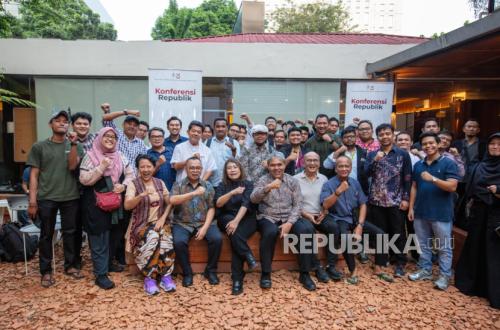
The cancellation of the venue by the University of Indonesia at the last minute did not stop the Republic Conference. The civil society consolidation forum proceeded in an online format, attended by more than 200 participants from hundreds of civil society organisations, who remained throughout the event, along with up to 150 participants who attended in person at a café in Cikini, Central Jakarta.
After nearly five hours of discussion, the forum agreed on three mandates that will serve as the foundation for the next steps: a common platform, an organisational design, and the formation of a pioneering board.
The General Chair of the Republic Conference, Sudirman Said, expressed gratitude for the energy that emerged in the forum and noted that the enthusiasm did not wane despite the event facing dynamics. “Reflecting on the previous Republic Conference in Yogyakarta, this forum was no less extraordinary,” Said stated in Jakarta on Monday (29/6/2026). He assessed that the forum’s character remained intact: growing from the grassroots, collective, and participatory. According to him, widespread restlessness is the reason people from seven generations gathered, and this momentum requires a public space to discuss public issues. “This is to remind us that this republic does not belong to individuals,” said the Rector of Universitas Harkat Negeri.
Vice General Chair Jaleswari Pramodhawardani asserted that the cancellation did not breed pessimism. “Today, the absence of citizens in the republic is strongly felt,” she said. According to Jaleswari, the conversation was deliberately opened in a public space, not a closed one, so that interconnected ideas could be structured together and concretised into action. She emphasised that the discussion did not stop at summarising similarities but also nurtured differences, thickening what is important and setting aside what is less important. “It’s not just enthusiasm, but how much we love Indonesia,” she said.
Secretary General Yanuar Nugroho explained the first two outcomes of the forum. The platform serves to unite various different parties, while the organisational design takes the form of a network connecting many actors from different backgrounds under a common goal, rather than a centralised structure with branches. He described how similar restlessness arises among students, professionals, and young people, and this network aims to connect them. “You are not alone,” Yanuar said.
Regarding the third outcome, Yanuar highlighted the leadership model. “It’s not about who, but about how,” he said. The intended leadership is institutional, carried out collectively, and grounded in values. He assessed that the public has been left too long with pragmatic and egocentric leadership, and this forum proposes an alternative. “The goal is to restore citizens as subjects, not objects,” said Yanuar, who noted that all discussions took place in a spirit of seeking breakthroughs and mutual cooperation across generations, sectors, and actors.
A member of the University of Indonesia Board of Trustees representing students, who was a collaborator for the event, Razaan Bayu Rachman, assessed that society needs more spaces like this—intellectual spaces that bring together the same spirit from various circles. He expressed hope that the Republic Conference would inspire the birth of similar forums that open discussions for all elements of civil society. According to Razaan, all forum participants radiated the same spirit for a better Indonesia. “We have the same goal, and we need a more concrete discourse on change,” he said.