
Reporting to Prabowo, Luhut: Indonesia's Economy Secure and Stable for the Next Three Months
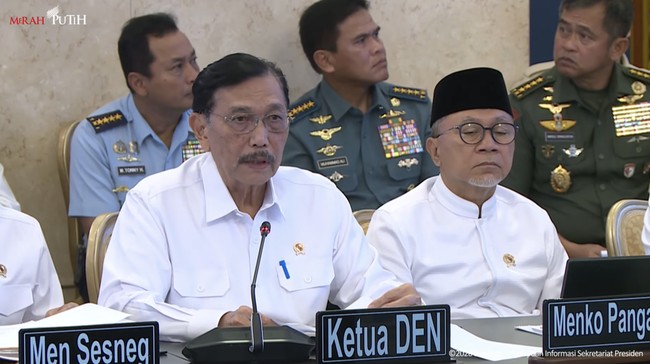
Jakarta, CNBC Indonesia - Chairman of the National Economic Council (DEN) Luhut Binsar Pandjaitan reported the latest national economic conditions to President Prabowo Subianto at Merdeka Palace on Tuesday (21/4). Luhut revealed that Indonesia’s economic fundamentals remain resilient and under control amid escalating global geopolitical tensions and uncertainties.
Luhut presented the latest economic simulation results compiled by DEN. Based on that analysis, national economic growth and activity are projected to remain stable over the next three months.
Nevertheless, the government has formulated various anticipatory policy scenarios as mitigation measures should geopolitical tensions persist longer than anticipated.
“Based on the comprehensive simulation we conducted, our economic conditions over the next three months are still very secure and stable. Our economic fundamentals are strong. However, in line with the President’s directives, we must not be complacent. The government has prepared concrete mitigation scenarios to anticipate the continuation of these global dynamics,” Luhut stated, according to an official statement on Wednesday (22/6/2026).
One of the main focuses of these anticipatory measures is to mitigate potential surges in energy prices, particularly concerning the widening gap between global crude oil prices and domestic fuel prices. DEN also emphasised the importance of maintaining supply chains for strategic commodities, such as sulphur, which is crucial for the sustainability of the nickel industry downstreaming programme and the development of the national electric vehicle (EV) battery ecosystem, to avoid disruptions from global dynamics.
From a fiscal resilience perspective, the government assures that the State Revenue and Expenditure Budget (APBN) remains within a healthy and controlled corridor. The fiscal deficit will be strictly maintained below 3% of Gross Domestic Product (GDP), through measured spending efficiency and optimisation of revenues from key export commodity sectors, such as coal and palm oil.
“The public and business community need not worry; our APBN is still very much under control. We will discipline the deficit to keep it below 3% through targeted spending efficiency, while maximising the momentum of export commodity prices to strengthen state revenues,” Luhut said.
To sustain growth momentum in the real sector, Luhut explained that the government will accelerate deregulation as a non-fiscal stimulus. He also stressed that resolving structural obstacles on the ground is a priority to make the licensing process simpler, more efficient, and provide legal certainty for businesses amid a dynamic global situation.
Furthermore, the government views this geopolitical situation not merely as a challenge, but as a strategic opportunity.
Beyond economics, in that meeting Luhut also discussed accelerating government digital transformation (GovTech) and strengthening initiatives for developing the Indonesia Financial Center to capture potential shifts in global capital flows.
“We are not just talking about survival, but how to benefit from this situation. Accelerating GovTech and building the Indonesia Financial Center are our strategic steps to leverage shifts in global capital flows. With solid collaboration between the government and the business world, we are optimistic that this momentum can serve as a catalyst for national advancement,” Luhut said.