
Remembering the Organic Intellectual: Airlangga Pribadi Kusman
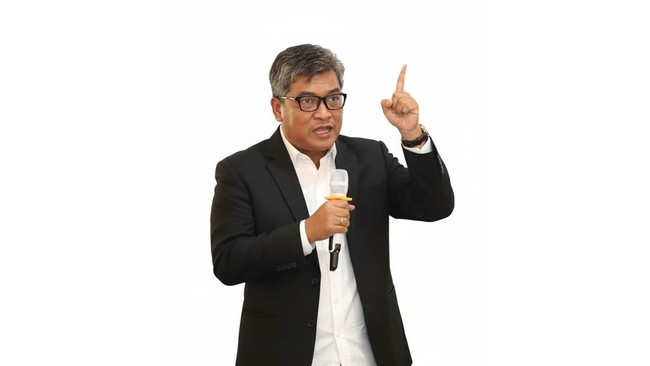
The passing of Airlangga Pribadi Kusman on 9 September 2026 leaves a significant void in Indonesia’s academic and intellectual spheres, particularly for those who knew him as a political science academic, a critical thinker, and an intellectual who consistently linked knowledge to issues of democracy and social justice.
Mas Angga was not the type of intellectual who treated science as an academic pursuit separate from society; rather, his thoughts always moved towards questions of power, inequality, dominance, freedom, and the possibility of social change.
In this sense, the term ‘organic intellectual’ is essential to understanding his position in Indonesian public life. An organic intellectual is not merely someone who produces knowledge through books, articles, research, and lectures, but someone who strives to connect knowledge with the concrete experiences of the community, making intellectual work part of a broader social struggle.
This way of thinking explains why Mas Angga’s focus on Indonesian politics ran parallel to his attention to international issues, including Palestine, Israel, Iran, the United States, and the power dynamics in the Middle East. For him, international issues were not far removed from Indonesian political life, as changes in the global power configuration always relate to Indonesia’s position, foreign policy orientation, economy, security, and how society understands justice and humanity.
While Mas Angga was not an academic specialising primarily in the Middle East, the region served as a vital space where his analytical tools regarding power, colonialism, state interests, the production of knowledge, democracy, and social justice could be applied to read global political realities.
One significant trace of this can be seen in his 2017 writing regarding the Zionist regime of knowledge behind the establishment of the State of Israel. That work demonstrated that his attention to Palestine and Israel predated the escalation of the Iran-Israel conflict in 2026, showcasing an approach that integrated history, ideology, colonialism, and power relations as inseparable from the Palestinian issue.
What was striking about his approach was his courage in moving the Palestinian issue beyond a purely military conflict narrative. He invited readers to see how history is produced, how narratives gain legitimacy, how knowledge is used to support power, and how political structures sustain themselves through the relationship between political and epistemic authority.
At this point, Mas Angga’s intellectual character became most evident, as he did not easily accept political realities at face value. When observing a conflict, he tended to question the underlying structures, the actors profiting, the resulting distribution of power, and the communities forced to bear the consequences of decisions made by those with greater resources.
This framework was also linked to his studies on the relationship between intellectuals and power in Indonesia. In his discussions on post-authoritarian politics, Mas Angga highlighted how political elites, business groups, civil society, state institutions, and the production of knowledge interconnect to form configurations of power.
When applied to the Middle East, war cannot be understood merely as a clash between two nations or groups with differing interests. War must also be viewed as an arena where strategic interests, security alliances, the defence industry, economic resources, energy, trade, and global political influence converge.
Consequently, Mas Angga’s reading of the Middle East possessed a much broader dimension than simply determining winners and losers in a conflict. He opened space to observe how international structures function and how both major and regional powers use political, military, economic, and diplomatic strength to maintain their positions.
This approach also demonstrated that geopolitics must not lose its human dimension. Every shift in the balance of power has consequences for the people living amidst war, occupation, displacement, destruction of infrastructure, loss of livelihoods, insecurity, and uncertainty about the future.
Therefore, Palestine became a crucial issue in understanding Airlangga’s intellectual legacy. Palestine brings together the history of colonialism, struggles for independence, sovereignty, the right to self-determination, international politics, and the question of how justice can be realised when the distribution of power between opposing parties is profoundly imbalanced.
In analysing Palestine, Mas Angga demonstrated that an Indonesian intellectual could use their nation’s historical experience to understand international conflicts without losing analytical sharpness. It is here that Indonesian nationalism, internationalism, and the anti-colonial tradition meet.