
Religious Affairs Ministry Proposes 1,000-Doctor Programme for Ma’had Aly Lecturers
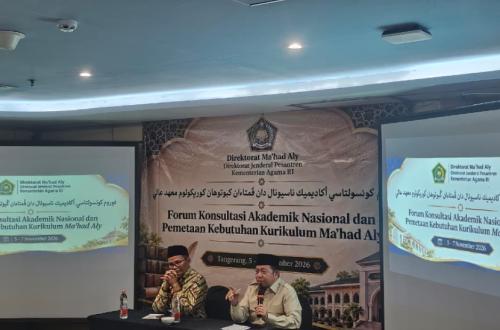
TANGERANG – The Ministry of Religious Affairs has proposed a programme to develop 1,000 doctoral graduates for Ma’had Aly, planned to run from 2027 to 2031. It will begin with an assessment of lecturer requirements and graduate potential at 95 Ma’had Aly institutions across Indonesia.
The ministry’s Director General of Pesantren, Basnang Said, said the assessment was needed to map staffing requirements by academic discipline, student numbers, academic qualifications and the potential of alumni who could be prepared to become lecturers.
Basnang outlined the proposal when opening the National Academic Consultation Forum and Ma’had Aly Curriculum Needs Mapping in Tangerang on Thursday (5 November 2026).
“We need a five-year map of our lecturer requirements, and we will work to secure it,” Basnang said.
The assessment will provide a basis for exploring partnerships to fund further education with the Indonesia Endowment Fund for Education (LPDP). Opportunities for master’s and doctoral study are expected to reflect the needs of each institution, including in the fields of Islamic civilisation, hadith, fiqh and Qur’anic exegesis.
Basnang also proposed identifying promising Ma’had Aly graduates early so they could be prepared for further study. This should be accompanied by an agreement with their institution of origin to ensure that higher academic qualifications benefit the development of pesantren campuses.
“We are now mapping the 95 Ma’had Aly institutions. We are setting up a programme for 1,000 Ma’had Aly doctoral graduates,” he said.
In addition to lecturer development, the ministry highlighted the need for facilities and infrastructure at pesantren-based higher education institutions. Basnang said some Ma’had Aly institutions still share teaching rooms with other schools within their pesantren.
He proposed developing a model building for Ma’had Aly, with rooms for senior management and lecturers, lecture halls, and facilities for research and community service.
“I envisage Ma’had Aly as a higher education institution. It is the same as a UIN, other Islamic higher education institutions (PTKI), or a general university (PTU); there is no difference,” he said.
As an initial step, Basnang raised the possibility of building dedicated facilities at five to ten Ma’had Aly institutions in 2027. Implementation would take account of land readiness, needs, student numbers and budget capacity. The forum discussed an estimated requirement of around Rp 1 billion per site, although the figure still needs to be assessed.
Basnang stressed that facility development was not intended to make all Ma’had Aly institutions uniform. The distinct character and traditions of each pesantren would remain a consideration.
“There is no intention to standardise them, because the Pesantren Law recognises their distinctive identities,” he said.
Another item on the agenda was the integration of Ma’had Aly academic data with the Higher Education Database (PDDikti). Basnang said reliable data and academic recognition were necessary to give Ma’had Aly graduates broader access to further education and employment.
He called for follow-up coordination with the Directorate of Learning and Student Affairs and the Ministry of Religious Affairs’ Centre for Data and Information Technology. The ministry also needs to map student assistance requirements, including exploring access to the Smart Indonesia Card for Higher Education (KIP Kuliah), in accordance with the rules.
For academic career development, Basnang also proposed examining the recognition of prior learning (RPL), lecturer qualification recognition and academic career progression. He said he hoped teachers with deep subject knowledge and extensive experience in pesantren traditions would have opportunities to gain academic recognition through the applicable mechanisms.
“Who knows, perhaps one day Ma’had Aly will produce its first professor?” he said.
Basnang also announced an increase in lecturer incentive assistance for Ma’had Aly in 2026. The monthly payment for eligible recipients has risen from Rp 250,000 to Rp 1 million, and will be provided for eight months.
Meanwhile, Ma’had Aly Director Adib said the National Academic Consultation Forum was the first official meeting to bring together Ma’had Aly stakeholders since the establishment of the Directorate of Ma’had Aly under the Directorate General of Pesantren.
The forum involved the Ma’had Aly Association’s administrators and representatives of the leadership of nine Ma’had Aly institutions. Discussions covered academic needs, institutional mapping and the direction of development for pesantren-based higher education.
Adib said the forum’s findings would inform a development blueprint for Ma’had Aly aligned with the Pesantren Roadmap. The Directorate of Ma’had Aly is also preparing input to support national development policy discussions on the place of pesantren-based higher education.
Basnang said he hoped the forum’s proposals would lead to plans and policies with clear targets and implementation stages. The establishment of the Directorate General of Pesantren is expected to provide an opportunity to develop Ma’had Aly within the national education system without eroding its distinctive scholarly traditions.
“Please put forward all your ideas. The Director and his team will then begin working to turn them into Ministry of Religious Affairs policy in the future,” he said.
Source: jawawa.id (https://jawawa.id/newsitem/religious-affairs-ministry-proposes-1-000-doctor-programme-for-mahad-aly-lecturers-1793983839)
Originally published by Republika (https://news.republika.co.id/berita/to371x416/kemenag-gagas-program-1000-doktor-untuk-dosen-mahad-aly), translated from Indonesian