
Religious Affairs Minister Praises Fatayat NU's Contribution in Various Strategic Fields
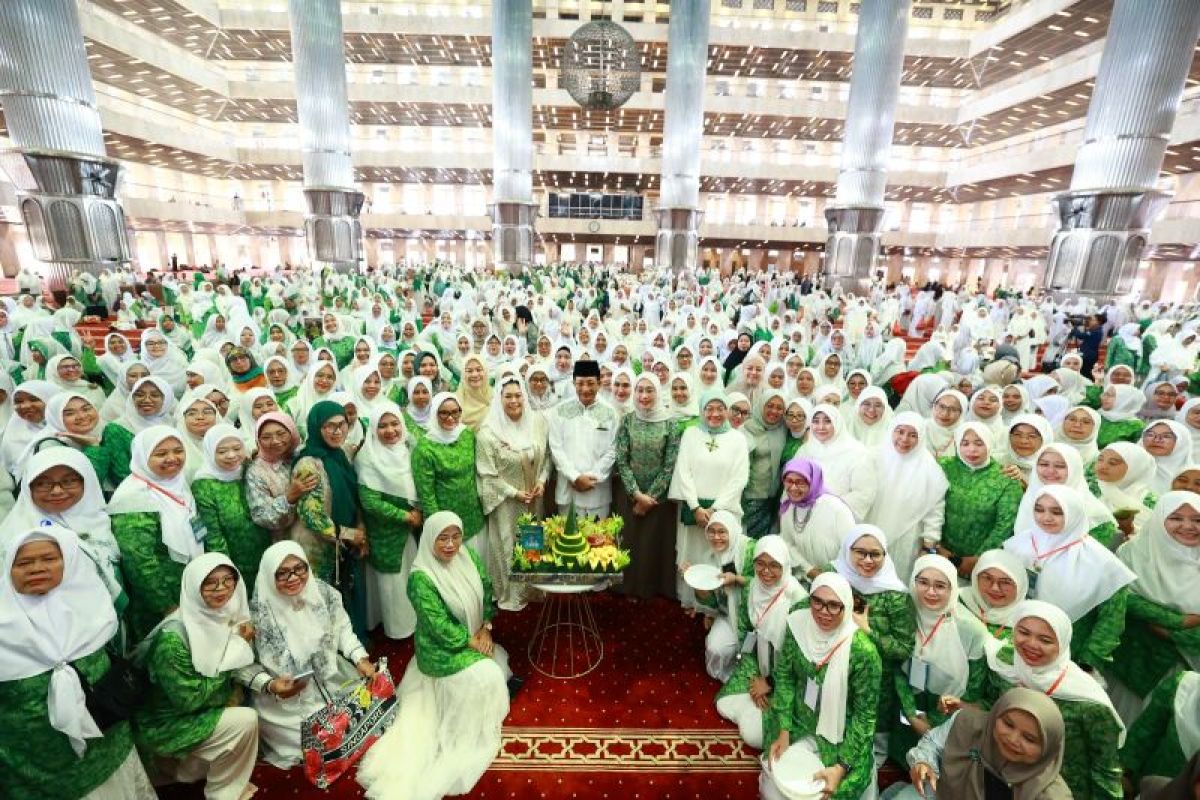
Jakarta (ANTARA) - Minister of Religious Affairs Nasaruddin Umar has expressed his appreciation for the role of Fatayat Nahdlatul Ulama (NU), acknowledging their ability to contribute in various strategic fields, including social affairs, education, government, and community empowerment.
“I do not want to exaggerate, but consider this: are there other female figures from other organisations who are as influential as the female members of Nahdlatul Ulama? Not only in Indonesia, but also in international forums,” said Nasaruddin Umar when attending the 76th anniversary celebration at the Istiqlal Mosque, Jakarta, on Sunday.
Nasaruddin stated that the female members of NU have demonstrated strong leadership capabilities and are comparable to prominent female figures at both national and international levels. He believes this demonstrates that women have equal opportunities to contribute to society and the nation.
The Minister highlighted the increasing number of Fatayat NU members who now hold important positions in government and public institutions.
The Grand Imam of the Istiqlal Mosque also emphasised that women should not feel inferior or marginalised in the name of religion. He affirmed that the relationship between men and women in Islam is based on the principles of equality and mutual complementation.
“There is no religious basis to discredit women. All verses in the Quran that discuss gender relations use the concept of equality,” he said.
He explained that some religious interpretations, which have historically marginalised women, are actually rooted in patriarchal cultures of certain periods, rather than originating from the substance of the teachings of the Quran itself.
Therefore, he encouraged Fatayat NU members to have the intellectual courage to understand religious texts more fairly and contextually.
He cited the interpretation of Surah An-Nisa verse 34 concerning the relationship between men and women as an example. According to him, the Ministry of Religious Affairs has revised several translations that were considered gender-biased to better emphasise functional rather than structural relationships.
“Previously, it was translated that men are leaders over women. Now we understand it as protectors of women. So the relationship is functional, not structural,” he said.
Furthermore, Nasaruddin stated that women have equal opportunities to become leaders if they possess adequate capacity, integrity, and ability. He also mentioned that the Ministry of Religious Affairs is now led by several female rectors at Islamic state universities.