
Religious Affairs Minister: As Long as Israel Exists, Don't Expect Peace
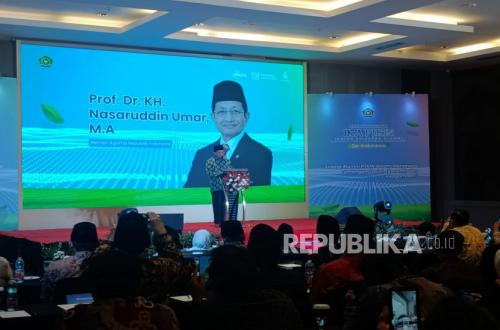
Indonesia’s Minister of Religious Affairs (Menag), Prof. Nasaruddin Umar, has encouraged alumni from State Islamic Religious Higher Education Institutions (PTKIN) across Indonesia to play a role in realising Indonesia as the centre of global Islamic civilisation. According to him, Indonesia has a great opportunity to take on this strategic role amid the ongoing dynamics affecting the Middle East region.
“Let us outline the thoughts on what we must do to truly make Indonesia the centre of global Islamic civilisation,” said Nasaruddin in his speech at the closing of the National Meeting of the State Islamic Religious Higher Education Institutions Alumni Family Association of Indonesia in Jakarta on Friday night (24/4/2026).
According to Nasaruddin, the Middle East has fulfilled its historical role as the birthplace of prophets and the place of the Quran’s revelation. However, for the future development of Islamic civilisation, the region is seen as facing major challenges, particularly due to prolonged conflicts.
“As long as Israel still exists, don’t expect there to be peace there. Here, Alhamdulillah, we are far from Israel,” said this Grand Imam of Jakarta’s Istiqlal Mosque.
He acknowledged that in the current era of technology, geographical distance is no longer a guarantee that a country is completely free from the impacts of global conflicts. Nevertheless, he is optimistic that Indonesia will not be directly affected by the wars occurring in the Middle East in the next 10 to 20 years.
Therefore, Nasaruddin invited PTKIN alumni to build the strength of Indonesian Islamic thought. One important step, according to him, is to promote the translation of works by Indonesian Muslim intellectuals into Arabic and other foreign languages so that they can be more widely known internationally.
“Our target is to make Indonesia, in a not too long time, the centre of global Islamic civilisation. If I may be a bit ambitious, how to make Indonesia the epicentre of global Islamic civilisation,” he said.
Nasaruddin assessed that Indonesia’s capital to realise this aspiration is very substantial. Around one-fifth of the world’s Muslim population is in Indonesia. In addition, he also sees strong support from the government, particularly from President Prabowo Subianto, for strengthening education and empowering the ummah.
“He already knows that the quickest window to make Indonesia famous is through Islamic studies. Because we have no competitors. The Middle East doesn’t have any,” he explained.
He added that several countries that have long been centres of Islamic studies in the Middle East are also facing severe challenges, both economically, socially, and politically. This condition, according to him, becomes momentum for Indonesia to take a greater role in building global Islamic civilisation.
“Let us be grateful that God has destined us to be far from that centre of conflict. This is our challenge: how to seize the time in this very short period to prepare what we must do after the Middle East war,” he said.
“It’s time for us to do something big. And I hope a lot from the alumni friends here to think about this,” said Nasaruddin.