
Religion, Morality, and the Crisis of Integrity
There is a paradox that should make us uneasy. Some time ago, a friend asked me a question via WhatsApp chat. I am sure his question arose from a deep unease in his heart. The question jolted my logic and conscience: “Atheist countries are orderly, honest, disciplined, and prosperous.” Meanwhile, here in Indonesia, we are “a nation that believes in God and has a Muslim majority, yet corruption is rampant, deception has become a habit, and there is a lack of order, discipline, and other negative behaviours.”
It is deeply hurtful to the heart and to logic. I have tried to unravel it from various perspectives, as far as I know, and have strived to be objective in viewing the existing reality.
There is a great irony in modern life: a society can be known as very religious, yet at the same time still face problems of corruption, abuse of power, dishonesty, manipulation, conflicts of interest, and various other forms of moral deviation.
Conversely, there are societies that formally do not make religion the basis of state life, but are able to build relatively strong social discipline, legal compliance, order, administrative honesty, and public responsibility.
This phenomenon must not be superficially concluded as religion causing moral decline, or that societies without religion are automatically more virtuous. Such a conclusion is academically too simplistic.
The real issue is the institutionalization of values: how moral values that are believed normatively succeed or fail to be institutionalised into habits, social norms, legal systems, and concrete behaviour.
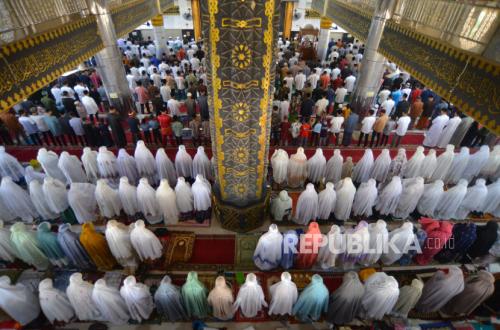
Indonesia is one of the countries with the largest Muslim population in the world. Religion is strongly present in daily life. Places of worship are easy to find. Religious symbols are increasingly prominent in the public sphere. Moral lectures are widespread. Religious education is provided from an early age. Even religious language is increasingly used in political, bureaucratic, economic, and social conversations.
But at the same time, corruption has not disappeared. Nepotism keeps recurring. Conflicts of interest are still considered normal. Abuse of power continues to occur. Manipulation, bribery, lies, and dishonesty remain part of the problems of public life.
The question then becomes more uncomfortable: “If society is becoming more religious, why does integrity not automatically become stronger?”
This question is far more important than simply asking whether our society is religious or not.
Because perhaps the problem is not a lack of religion. Perhaps the problem is that religion too often stops at identity, ritual, and symbol, but fails to become a moral discipline in public life.
And if that is true, then the issue is not merely whether Islam or other religions in Indonesia teach honesty or prohibit corruption. Of course, religious teachings have strict prohibitions against betrayal, injustice, taking the rights of others, and the abuse of trust.
The more difficult problem is: Why do the normatively strong teachings of Islam not always produce social behaviour as strong as its norms?
This is where we need to stop being defensive and start engaging in internal criticism.
There is a tendency to measure the success of religion through things that are easy to see: the number of places of worship, the number of religious schools, the number of religious activities, the number of people who participate in rituals. All of that is important, but it does not automatically indicate the moral quality of society.
Because corruption does not happen in a vacuum. Corruption occurs when someone who knows that taking public money is a sin still takes it.
Nepotism occurs when someone who speaks about justice still uses power to benefit their family.
Manipulation occurs when people who understand that lying is wrong still manipulate information because they gain an advantage.
At that point, the problem is not moral ignorance, but moral inconsistency. The person knows what is right. But the knowledge of what is right loses when confronted with self-interest.
This is what makes the crisis of integrity far more complex than a mere lack of religious education.
One of the problems in formal religiosity is the tendency to equate ritual piety with a person’s moral quality. Yet the two are not identical.
A person can be diligent in worship but not trustworthy. Can be fluent in speaking about sin but insensitive to the suffering of others. Can be active in religious activities but abuse their position. Can speak about charity but exploit their workers. Can call for justice but demand special treatment when their interests are disturbed.
This is where we need to distinguish between religious identity and moral character.
Religious identity answers the question: “What religious group do I belong to?”
Integrity answers a much more difficult question: “What do I do when no one is watching?”
The two can overlap. But they are not always the same. A person can have a very strong religious identity without having an equally strong character.
Islam, as the majority religion in Indonesia, does not place ritual as a goal detached from the formation of human beings. The Qur’an states that prayer should prevent a person from indecent and wrongful acts.
The message is simple but radical: Worship should produce moral consequences. Prayer does not stop at bodily movements. Fasting does not stop at hunger and thirst. Zakat does not stop at the transfer of wealth.
Religious knowledge does not stop at the ability to quote texts. All of it should transform human beings. If not, we face a problem that deserves to be called religious formalism: religion remains alive in form, but loses its transformative power over behaviour.
At a certain point, ritual can even turn into a symbol of social status. People want to be known as pious, want to be considered religious, want to gain moral legitimacy.
But the heaviest demands of religion are often in places that are not visible: when holding money, when holding office, when controlling information, when facing the poor, when having the opportunity to cheat, and when no camera is recording.
It is there that ritual must prove its fruits.
Here we must be careful. It is easy to draw the conclusion: “Indonesia has a Muslim majority but high corruption. That means Islam has failed.”
Such a conclusion is too simplistic. Because we need to distinguish between the quality of a teaching and the quality of the application of that teaching by humans and the institutions they build. Islam can teach trustworthiness, but humans can betray. Islam can teach justice, but rulers can act tyrannically. Islam can prohibit taking the rights of others, but officials can still commit corruption.
The existence of violations of a norm does not in itself prove that the norm is the cause of the violation.
However, this is where criticism of Muslim society must become sharper. If we continue to say that the teachings of Islam are perfect, but at the same time refuse to evaluate why its values fail to become social behaviour, then that normative perfection means little in public life.
What must be tested is not only whether Islam has teachings about integrity, but whether Muslims have succeeded in institutionalising those values.
That question is much more difficult and much more honest.
There is a psychological phenomenon known as moral licensing: a person can feel they have moral capital because they consider themselves to have done many good deeds, making it easier to give themselves tolerance when committing a deviation.
In religious life, this kind of mechanism must be watched out for. Not because worship produces evil. But because humans can use their moral identity to rationalise their own behaviour.
“I am diligent in worship.”
“I give a lot of charity.”
“I am active in religious activities.”
“I am known as a good person.”
All of that must not become a ticket to ignore more fundamental questions: Am I trustworthy when managing other people’s money? Am I fair when I have power? Am I honest when lying benefits me? Do I still respect the rights of others when there is no risk to myself?
The higher a person’s moral claims, the higher their standard of integrity should be. Piety is not a licence to obtain moral dispensation.
Here, criticism of the moralistic approach needs to be raised openly.
We often respond to corruption with sermons. We talk about sin. We remind people about hell. We quote verses and hadiths.
All of that is important.
But corruption is not only born from weak religious knowledge. Corruption is also born from opportunity, power, incentives, weak oversight, conflicts of interest, a permissive culture, and low certainty of punishment.
Therefore, it is unrealistic to expect the problem of corruption to be solved merely by increasing individual piety. Morality works from within. Institutions work from without.
Morality says: “I do not take it because it is wrong.”
Institutions say: “If I take it, the system will find out and punish me.”
A society with integrity needs both. Conscience and consequence.
We need to ask a more radical question. “What if the problem of integrity is not merely because humans are less religious, but because our institutions make it too easy for humans with moral weaknesses to abuse power?”
Humans have interests. Humans have ambitions. Humans can be tempted.
Therefore, healthy institutions are not built on the assumption that all officials will always be good. On the contrary. Good institutions are designed with the awareness that humans can abuse power.
Thus, what is needed is: transparency, accountability, audits, information disclosure, control of conflicts of interest, checks and balances, protection for whistleblowers, independent oversight, and legal certainty.
This does not mean we do not trust humans. It means we are realistic enough to understand humans.
This question often makes us defensive. Yet it should actually be material for introspection.
There are societies that do not overly display religion in the public sphere but are relatively successful in building discipline, legal compliance, transparency, and social trust.
Does that mean they are more moral? Not necessarily. They also have their own moral and social problems.
But there is something worth learning: Moral values become effective when translated into norms and institutions.
A person may not have a religious motivation not to bribe. But if the system is transparent, oversight is strong, the law is consistent, and reputation is very expensive to risk, they have a strong reason not to bribe.
This is where we find the weakness of an approach that relies too heavily on personal piety. We hope humans will be good, but we do not always build systems that make bad behaviour difficult.
Yet modern society needs both: humans of character and systems that are resistant to abuse.
One of the greatest tests of public morality is when family interests collide with the public interest. In a culture with strong kinship ties, nepotism can easily be disguised as “helping family”.
Yet public office is not family property. The state budget is not the property of officials. Public projects are not gifts for relatives. Power is not a personal inheritance.
This is where the principle of justice is tested. It is not difficult to be fair to people who have no relationship with us. What is difficult is to remain fair when injustice actually benefits the people we love.
If religion only teaches morality in personal relationships but fails to be translated into an ethics of office, then a large gap occurs between private morality and public morality.
A person can be a good father and a bad official at the same time. Can be a philanthropist while engaging in conflicts of interest. Can be personally pious but damage the public interest.
Therefore, public piety must have a different standard: not only good intentions, but also fair and accountable procedures.
Indonesian society actually does not lack moral advice. We lack examples that morality has real consequences. Children watch adults. Employees watch leaders. Society watches officials.
If a person who speaks about honesty lies when their interests are threatened, the moral message received by society is not “honesty is important”.
The message received is: Honesty is important as long as it does not disturb my interests.
This is the most dangerous form of moral education. Because humans learn more from what powerful people do than from what they say.
Exemplary conduct is therefore not a moral ornament. It is cultural infrastructure.
Criticism of religiosity should not be considered an attack on religion. In fact, a healthy religion must be able to distinguish between the sanctity of values and the imperfection of humans who claim to practise those values.
If a Muslim official commits corruption, we do not need to conclude that Islam teaches corruption.
But we also must not use that reason to avoid the question: Why was the religious education they received not strong enough to shape integrity? Why did their social environment tolerate deviation? Why did their institutions allow conflicts of interest? Why is society more willing to forgive violations when the perpetrator is considered religious? And why are symbols of piety sometimes more effective at building a reputation than truly upright behaviour?
These questions do not weaken religion. On the contrary, they can be a way to return religion to its ethical function.
We need a change in mindset. Piety must not stop at: I pray diligently, I fast, I give charity, I attend religious study groups, I wear religious symbols, and so on. All of that has its place.
But society also needs to ask: How do I manage a budget? How do I treat subordinates? How do I carry out my office? How do I choose officials? How do I avoid conflicts of interest? How do I treat people who are different from me? How do I behave when the law benefits others but harms me?
It is there that religion enters a much heavier territory: the ethics of power, and it is precisely there that the quality of public religiosity is tested.
We do not need more symbols; we need more consistency.