
Relief as 25-Metre Whale Stranded on Kolong Island Is Rescued
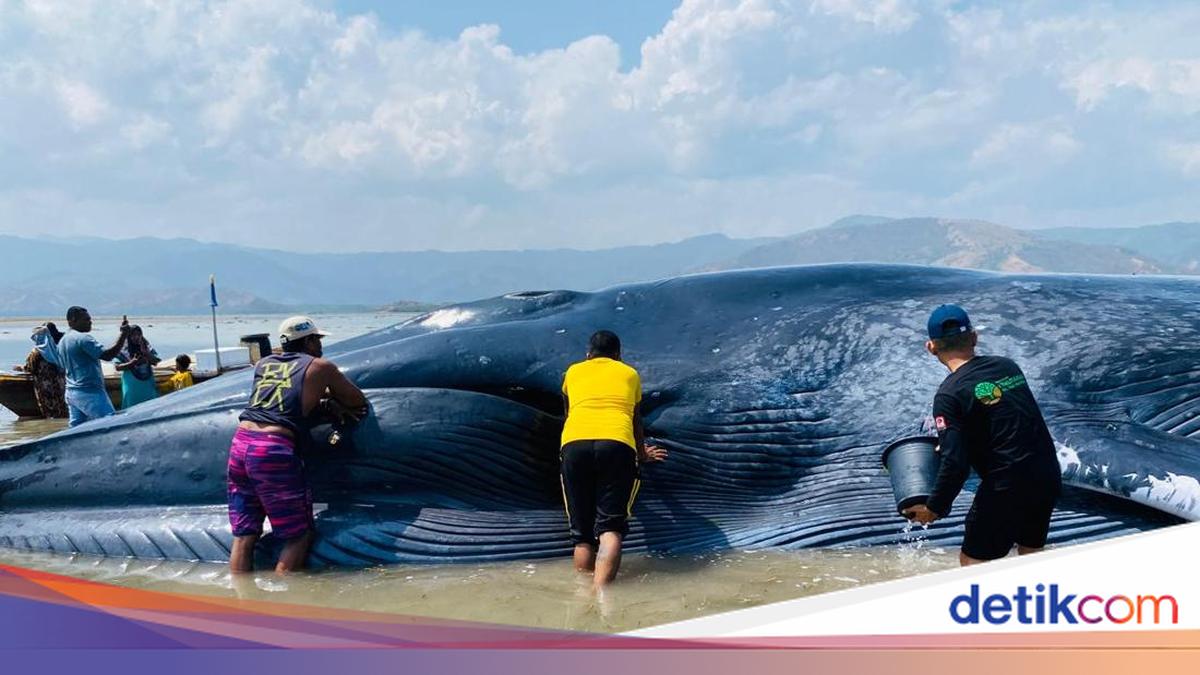
A 25-metre whale became stranded on Kolong Island, opposite Kelelawar Island in the 17 Riung Islands area of Ngada Regency, East Nusa Tenggara (NTT). It was found alive on Friday morning (30 October 2026) and, fortunately, survived until it was rescued and taken back out to sea that afternoon.
The rescue was a relief to many, as the whale was saved. Riung Police chief First Inspector Martinus Riang said the huge animal was pulled back out to sea using 10 boats belonging to local fishermen.
“It was evacuated this afternoon. It was pulled using 10 boats,” Martinus said when contacted on Friday evening (30 October 2026).
Back to deep water
Martinus said the rescue took place at high tide. The marine mammal was still alive and had not sustained any injuries, he said.
“The whale is alive and has returned to deep water,” he said.
The whale was found stranded on Friday morning. Police and residents tried to push it back into deep water, but its size and the low tide made this difficult. They also poured water over its body while waiting for the tide to rise.
Explanation from the NTT Natural Resources Conservation Agency
The stranding site is within the 17 Islands Riung Marine Nature Tourism Park, managed by the East Nusa Tenggara Natural Resources Conservation Agency (BBKSDA NTT).
The whale survived for around 12 hours after becoming stranded before it was safely returned to open water. Residents first reported the stranding at about 5.30am local time. The animal was taken back out to sea at around 5.30pm, when the tide was high.
“The stranded whale was found in shallow water, at a depth of around two to three metres, in a coastal area within the marine protection zone of the 17 Islands Riung Marine Nature Tourism Park,” BBKSDA NTT head Adhi Nurul Hadi said in a statement on Friday evening.
The whale could not be moved immediately because the tide was out. Adhi said BBKSDA NTT officers from the Riung conservation area, together with police, the military, a veterinarian from the Ngada Regency Livestock Service, village officials and local residents, worked to save it. They poured water over its body and ensured that its blowhole was not submerged or covered with sand. Whales breathe using lungs.
“The rescue effort involved maintaining the whale’s condition by pouring seawater over its body and ensuring that its blowhole was not submerged or covered with sand,” Adhi said.
“These efforts also took into account the safety of the officers and members of the public involved,” he added.
Adhi said the whale was identified as a blue whale (Balaenoptera musculus). It measured 2,050 centimetres in length, with a head width of 325 centimetres, a mid-body width or girth of 430 centimetres, a tail length of 407 centimetres, a tail width of 475 centimetres, a flipper length of 235 centimetres, a head length of 455 centimetres and a width of 422 centimetres at the rear of its body.
“The whale spouted once every 1.7 minutes,” Adhi said.
He said officers monitored the whale’s behaviour after it returned to open sea. “Before returning to shore, the joint team monitored its behaviour and confirmed that it continued towards the open sea,” Adhi said.
“We are grateful to everyone who worked together to save this whale, enabling it to return safely to its habitat,” he added.
Initially thought to be a baleen whale
Earlier, Imam Fauzi, head of the Kupang Marine Management Agency, said the marine mammal was initially thought to belong to the mysticete, or baleen-whale, group.
“Based on an initial assessment of its physical features, it appears to be a baleen whale,” Fauzi told detikBali.
One characteristic of baleen whales is that they have no teeth. Instead, they have bristle-like keratin plates in their mouths. Fauzi explained that these plates, which resemble brushes, hang from the upper jaw and are used to filter food.
“Mysticeti, or baleen whales, have no teeth but instead have brush-like keratin fibres on the upper jaw to filter food such as krill, plankton and small fish,” Fauzi said.
He said blue whales and humpback whales were among the species in the baleen-whale group.
Fauzi could not explain why the whale had come close to shore and become stranded as the tide receded. He said a full report would be provided after the whale had been rescued.
Source: jawawa.id (https://jawawa.id/newsitem/relief-as-25-metre-whale-stranded-on-kolong-island-is-rescued-1793407830)
Originally published by detikBali (https://www.detik.com/bali/nusra/d-8731823/akhir-melegakan-paus-raksasa-25-meter-terdampar-di-pulau-kolong), translated from Indonesian