
Rejecting Arms Cargo Bound for Israel, Dockworkers at 113 Ports in 22 Countries Mobilise
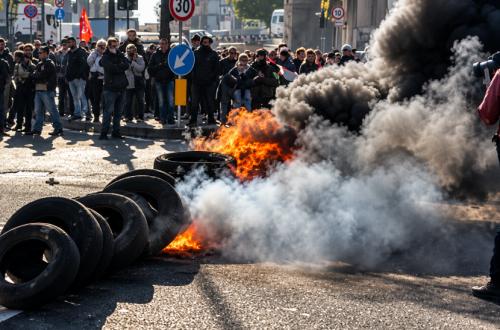
JAKARTA — An international dockworkers’ movement staged coordinated action against the use of civilian trade facilities to transport weapons to conflict zones, including Israel. Strikes, temporary work stoppages and demonstrations took place at ports around the world on Friday (30 October 2026), as seafarers’ safety comes under increasing threat from conflicts in the Middle East and the Black Sea.
Reuters reported that the movement covered 113 ports in 22 countries, based on the scale of the mobilisation announced by its organisers. More than 25 trade unions supported the action, which took place in Europe, Asia, Africa, the Americas and Australia.
Not all the ports included in the movement shut down. Actions varied, ranging from 24-hour strikes and work stoppages lasting several hours to solidarity demonstrations.
The movement opposed the use of ports to transport weapons, ammunition and military equipment to conflict zones. Workers also called for higher wages, better working conditions, improved protection for seafarers and medical support for crews sailing through dangerous areas.
At the Port of Piraeus in Greece, about 3,000 dockworkers and seafarers took part in an action that disrupted cargo handling and halted ferry services to the Greek islands.
Apostolos Kypraios, head of Greece’s merchant marine engineers’ union, strongly opposed workers’ involvement in the logistics networks of war.
“We will not work for their wars, and we will not be their cannon fodder,” Kypraios told Reuters during a demonstration in Piraeus on Friday.
He said the risks to seafarers did not end when their ships left dangerous areas. Their families, too, faced prolonged anxiety over whether their relatives would return.
The Associated Press reported that the suspension of ferry services in Greece was also linked to a separate seafarers’ union strike calling for better pay, safety and working conditions.
The international action reached strategic ports including Valencia and Algeciras in Spain, Le Havre in France, Genoa in Italy, Tangier Med in Morocco, and Nhava Sheva in India.
In Istanbul, Turkey, demonstrators gathered near Haydarpaşa Port to call for an end to weapons shipments to Israel.
Meanwhile, the CGT Ports et Docks federation called a one-day strike at several major French ports, including Le Havre, Marseille, Dunkirk and Rouen.
Thousands of demonstrators enter the Port of Genoa
Opposition to war also spread to city streets in Italy. In a separate report, Reuters said about 15,000 dockworkers, students and other demonstrators entered the Port of Genoa as part of a nationwide protest on Friday.
The Unione Sindacale di Base (USB) union called a 24-hour general strike. Demonstrations took place in more than 40 cities, demanding higher wages and improved public services, and opposing the rising cost of living and military spending.
The action did not proceed entirely without obstruction. The Italian government issued an order restricting strikes in some transport sectors.
In several cities, demonstrations also saw tensions between protesters and security forces.
The mobilisation in Genoa showed how opposition to arms shipments is increasingly connected with labour movements challenging the economic costs of war.
Ports form part of the war logistics chain
International unions argue that commercial ports occupy a strategic position in the movement of military equipment.
Weapons shipments rely on ships, container terminals, storage facilities, logistics companies and workers handling goods at each point in the distribution chain.
Markos Bekris, head of the ENEDEP port workers’ union in Piraeus, told Al Jazeera that weapons require transport infrastructure and workers’ involvement to reach their destination.
This view underpins the approach of unions seeking to disrupt the distribution of military cargo through collective action.
The International Transport Workers’ Federation (ITF) announced its support for the movement on 28 October 2026.
ITF General Secretary Stephen Cotton stressed the importance of respecting workers’ rights and halting arms shipments that could be used to violate international humanitarian law.
In an official statement, the ITF called on governments to stop weapons transfers that exacerbate violations of humanitarian law, protect civilians, and respect transport workers’ right to refuse to handle military cargo without facing retaliation.
The organisation also called for a permanent ceasefire, humanitarian access to Gaza, an end to the occupation and illegal settlements, and support for recognition of a Palestinian state.
The movement received backing from trade unions around the world, including organisations in Germany, Turkey, Australia, Denmark and the United States.
Source: jawawa.id (https://jawawa.id/newsitem/rejecting-arms-cargo-bound-for-israel-dockworkers-at-113-ports-in-22-countries-mobilise-1793411440)
Originally published by Republika (https://news.republika.co.id/berita/tnqxl8451/tolak-kargo-senjata-ke-israel-buruh-113-pelabuhan-di-22-negara-bergerak), translated from Indonesian