
Regular Bioethanol Bunkering Begins at the Port of Santos
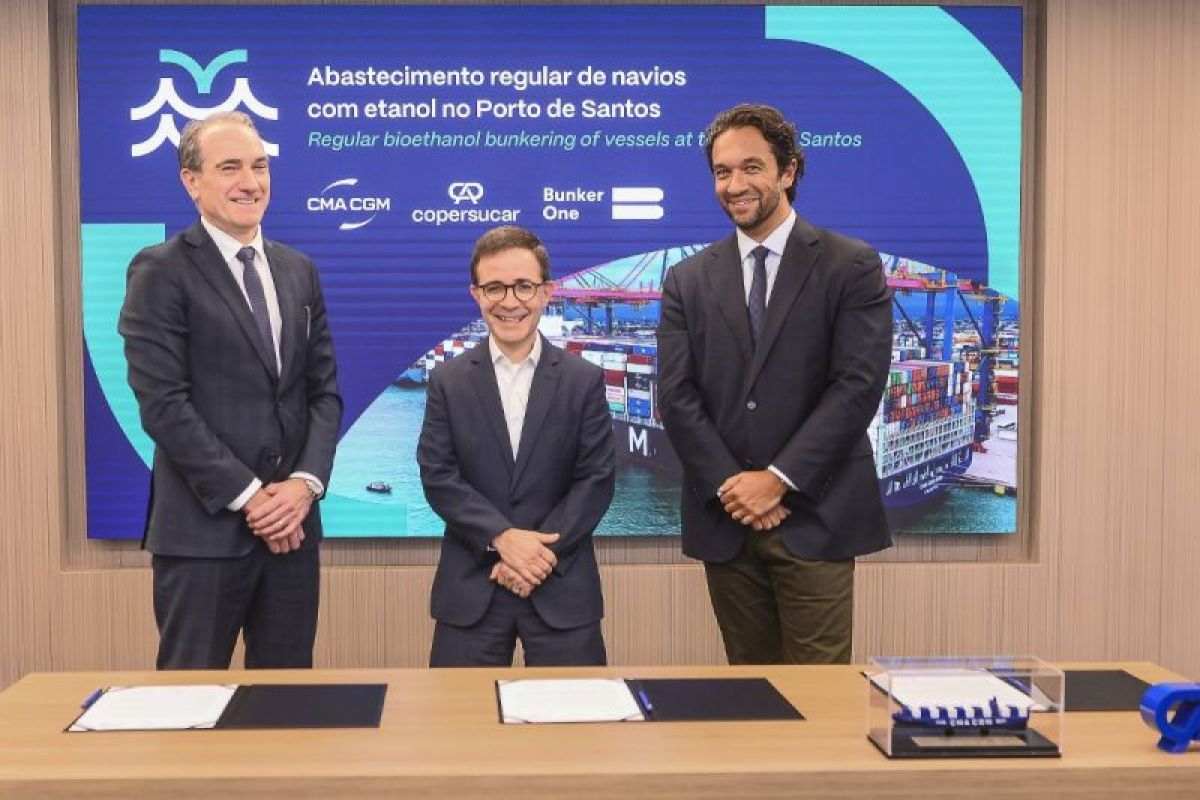
The new phase follows a pilot operation conducted in July through a partnership between Copersucar, CMA CGM, Bunker One, AGEO Terminais, Santos Brasil and the Port of Santos Authority, strengthening Brazil’s potential to decarbonise international shipping.
São Paulo (ANTARA/PRNewswire) — Copersucar, a global leader in sugar and bioethanol; CMA CGM, a global provider of sea, land and air transport and logistics solutions; Bunker One, a subsidiary of Denmark’s Bunker Holding group and a global leader in marine fuel trading; and the Port of Santos Authority (APS) have announced the start of regular bioethanol bunkering operations for ships at the Port of Santos.
The first operation took place this week, on 19 October, when fuel was supplied to CMA CGM IRON, a 13,000-TEU container ship equipped with the world’s first certified three-fuel engine capable of running on bioethanol: the Everllence-B&W G95ME-C10.5-LGIM.
The operation marks a shift from the pilot stage to a regular bioethanol supply model, positioning the Port of Santos and Brazil as leading low-carbon bunkering hubs. Several further bioethanol bunkering operations for CMA CGM ships, using fuel supplied by Copersucar, are planned before the end of this year.
“Following the first operation in July, we are now entering a new phase, demonstrating that bioethanol can be integrated into maritime operations safely, reliably and on a commercial scale. This initiative strengthens CMA CGM’s commitment to accelerating the deployment of low-carbon solutions and supporting the development of a new energy ecosystem for the maritime sector,” said Giovani Grassi, CEO of CMA CGM Brasil.
The bioethanol supplied by Copersucar comes from an established, certified production chain. Sugar-cane cultivation is expanding mainly on degraded pastureland, while the RenovaBio programme sets strict sustainability criteria and requires zero deforestation.
The market opportunity adds to the initiative’s potential. Global demand for marine fuel exceeds 270 billion litres a year. Taking into account the difference in energy content between fuels, replacing just 10% of this consumption could create an additional potential market of around 50 billion litres of bioethanol a year.
“This initiative marks a milestone for bioethanol and the maritime sector: it establishes the world’s first green corridor for bioethanol ship bunkering, while opening up a new global end market for the fuel. Through this initiative, Copersucar is enabling bioethanol’s use in regular commercial operations by connecting Brazil’s production capacity and logistics infrastructure with international demand for decarbonisation. This marks the beginning of a new chapter of growth for the sector, with renewable solutions that already offer the availability, scale and competitiveness needed to advance maritime transport,” said Tomás Manzano, president of Copersucar.
The bunkering operation involved coordinated efforts by several partners, linking production, transport, storage and fuelling. Bioethanol produced by mills affiliated with Copersucar is supplied and transported to the Port of Santos by Evolua Etanol, part of the Copersucar ecosystem, and then stored by AGEO Terminais. This logistics infrastructure enables biofuel to be supplied for ship bunkering.
For the bunkering operation at the Santos Brasil terminal, Bunker One developed a pioneering protocol for Latin America following months of study and training for specialist teams, taking into account the fuel’s low flash point.
Antônio Carlos Sepúlveda, CEO of Santos Brasil, said that carrying out such operations at Tecon Santos reinforced the company’s commitment to developing sustainable logistics in Brazil. “We have worked hard to reduce the carbon footprint of both our operations and those of our customers. Contributing to the energy transition in the maritime sector is also part of this agenda,” he said.
“Brazil has recognised bioethanol’s potential for decades. We are now bringing that experience into international shipping by combining Brazil’s production capacity with Bunker One’s expertise and global reach. By leading this initiative, the Port of Santos is positioning itself as a strategic destination for shipowners seeking to reduce emissions, while other markets are still developing regulations for this type of bunkering,” said Flavio Ribeiro, CEO of Bunker One LatAm.
Anderson Pomini, president of the Port of Santos Authority (APS), said: “APS and all the partners involved in this operation have made history in global shipping and international maritime trade, a sector that accounts for more than 90% of global trade transactions, by pioneering bioethanol ship bunkering. This is a decisive step towards a new era of sustainable development. We are very pleased and proud to have reached this milestone.”
The market’s growth prospects are also linked to the development of the global maritime fleet. According to Det Norske Veritas (DNV), 159 ships currently operate with methanol-ready engines, which can also use bioethanol, and more than 450 new vessels equipped with this technology are expected to be delivered by 2030. This is expected to expand bioethanol’s market potential rapidly.
Source: jawawa.id (https://jawawa.id/newsitem/regular-bioethanol-bunkering-begins-at-the-port-of-santos-1793541074)
Originally published by Antara (Indonesian) (https://www.antaranews.com/berita/5825115/pengisian-bahan-bakar-bioetanol-reguler-dimulai-di-pelabuhan-santos), translated from Indonesian