
Registration for Ministry of Religious Affairs BeZakat Scholarship 2026 Extended
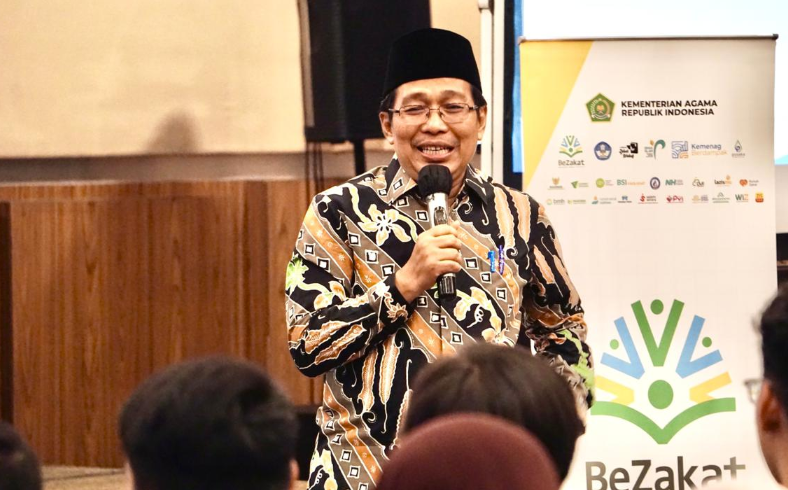
The Ministry of Religious Affairs (Kemenag) has extended the registration period for the 2026 Indonesia Zakat Scholarship (BeZakat) Programme until 21 September 2026. Managed by the Directorate of Zakat and Waqf Empowerment under the Directorate General of Islamic Community Guidance, the programme is intended for new undergraduate students for the 202/2027 academic year.
Registration for BeZakat can be completed online via https://pendaftaran-beasiswa.kemenag.go.id. Prospective participants are advised to carefully review all requirements, including university and field of study regulations, and ensure the application process is completed before the deadline.
The Director of Zakat and Waqf Empowerment, Waryono Abdul Ghafur, stated that BeZakat is designed as more than just financial assistance for education. He noted that zakat can be utilised to build the capacity of the younger generation sustainably.
“Zakat is not only present to meet today’s needs. Through education, zakat can serve as a social investment that opens opportunities for the youth to increase their capacity, build independence, and prepare for the future,” said Waryono on Wednesday (16/9).
He added that the aspect of coaching is a vital part of the BeZakat implementation. Beneficiaries are expected not only to receive help in completing their education but also to gain character strength, competence, leadership, and social awareness.
“We want BeZakat to go beyond merely providing scholarships. There is a coaching process so that awardees grow into a generation that is knowledgeable, ethical, and possesses leadership skills, eventually being able to give back to society,” he said.
Under the 2026 BeZakat programme, beneficiaries receive several facilities. This assistance includes the payment of Single Tuition Fees (UKT) for eight semesters, living allowances in the form of monthly pocket money for 48 months, and a laptop to support academic activities.
In addition to financial support, awardees also receive coaching and mentoring covering character, values, and leadership.
The programme involves 21 state universities as partners, consisting of 10 State Islamic Religious Universities (PTKIN) and 11 State Universities (PTN).
The ten partner PTKIN include UIN Syarif Hidayatullah Jakarta, UIN Sunan Kalijaga Yogyakarta, UIN Walisongo Semarang, UIN Maulana Malik Ibrahim Malang, UIN Sunan Ampel Surabaya, UIN Sunan Gunung Jati Bandung, UIN Imam Bonjol Padang, UIN Alauddin Makassar, UIN Prof. K.H. Saifuddin Zuhri Purwokerto, and UIN Raden Fatah Palembang.
The 11 partner PTN include the University of Indonesia, IPB University, Bandung Institute of Technology, Airlangga University, Brawijaya University, Hasanuddin University, Universitas Pendidikan Indonesia, Padjadjaran University, Gadjah Mada University, Sepuluh Nopember Institute of Technology, and Diponegoro University.
The implementation of BeZakat also involves 2lag Zakat Institutions (LAZ) as partners. The involvement of these various institutions aims to expand the utilisation of zakat funds, particularly in opening access to education while simultaneously improving the quality of human resources.
Waryono assessed that managing zakat for educational empowerment requires cross-sector collaboration, ranging from the government and zakat institutions to universities and students.
“We cannot work alone. The Ministry of Religious Affairs, zakat institutions, universities, students, and various parties need to be within one ecosystem so that zakat funds can be managed precisely and produce long-term benefits,” he said.
Regarding fields of study, BeZakat 2026 is open to students from several disciplines, including science and engineering, health, economics, law and social sciences, education, as well as zakat and waqf management.
The Ministry of Religious Affairs noted that this scope allows the programme to reach students from diverse academic backgrounds. Thus, zakat assistance is expected not only to support the continuity of the beneficiaries’ education but also to encourage them to develop their abilities and contribute to society.
The development of BeZakat is part of the agenda of the Directorate General of Islamic Community Guidance to expand the use of zakat funds as an instrument for community empowerment. The programme is also linked to the Ministry of Religious Affairs’ ‘Asta Protas’ agenda, specifically the agenda of Community Economic Empowerment through the optimisation of zakat, infaq, alms, and waqf.
Furthermore, the use of zakat for education is considered in line with the spirit of ‘Impactful Religious Services’. The assistance is directed to provide long-term benefits through the capacity building of recipients, rather than merely meeting short-term needs.
“When zakat is used to help a student complete their education, it is not just one person being built. There is capacity, family, and a future that we are also strengthening. Therefore, we want the benefits of zakat to continue to grow and provide a wider impact,” he concluded.