
Regional Superior Commodities to Strengthen Food Self-Sufficiency
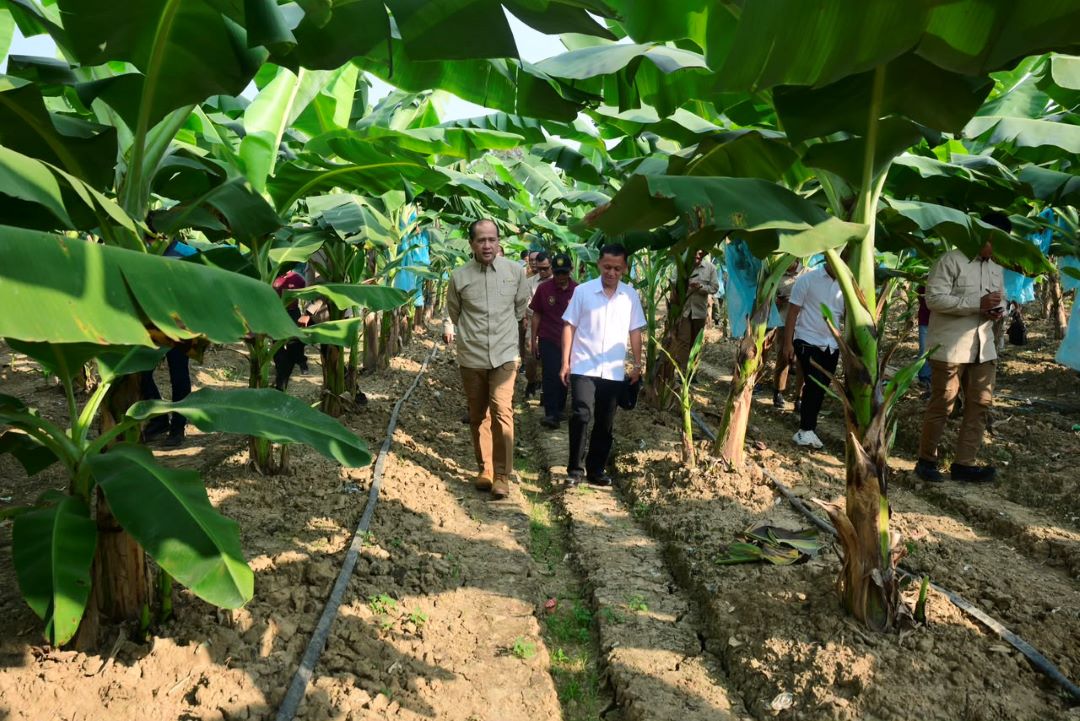
Minister of Transmigration Muhammad Iftitah Sulaiman Suryanagara has said that developing superior commodities according to regional potential can strengthen national food self-sufficiency while improving farmer welfare. “The President’s directive is very clear, namely to achieve food self-sufficiency. Rice certainly remains the main commodity, but Indonesia also has many other food commodities with great potential to strengthen national food security while improving community welfare,” Iftitah said in a statement received in Jakarta on Tuesday (14/7). The statement was made during a visit to the Edo Farm banana demonstration plot in Sentul, Bogor Regency, West Java, as an example of high-value banana commodity development. According to Iftitah, achieving food self-sufficiency is not only determined by increased production but also by the ability to create added value from agricultural commodities so that farmers can feel the economic benefits. “Food security must go hand in hand with farmer welfare. If farmers are not prosperous, food security will not be sustainable,” he said. He assessed that bananas are a commodity with good prospects for development because domestic and international market demand continues to increase, while cultivation potential is spread across various regions of Indonesia, including transmigration areas. Data from the Central Statistics Agency shows national banana production in 2025 reached around 9.82 million tonnes, an increase of about 6.02% from 2024 production of around 9.26 million tonnes. Bananas are the fruit commodity with the largest production in Indonesia. Iftitah said this large production potential must be followed by building a business ecosystem to provide greater added value for farmers and the community. He added that developing superior commodities is not enough just by increasing production, but must also be supported by strengthening farmer institutions through cooperatives, processing, storage, logistics, and market certainty through partnerships with off-takers. “We want farmers not only to be able to produce quality products, but also to have market certainty. When the market opens, prices improve, investment moves, farmer incomes increase, and community welfare is lifted,” he said. The development of superior commodities is also part of the government’s strategy to build transmigration areas as new economic growth centres. The Ministry of Transmigration is currently mapping the potential of superior commodities in 45 national priority transmigration areas in the 2025-2029 National Medium-Term Development Plan as a basis for formulating local potential-based economic development policies. As an initial step, the Ministry is exploring the development of a banana production centre in Lampung as a model for regional potential-based commodity development in transmigration areas. The model is expected to become a pilot for commodity development that can strengthen food security while creating new economic growth centres in transmigration areas. The Ministry is also expanding collaboration with universities, businesses, and local governments to strengthen research, innovation, technology transfer, and the development of superior commodities based on local potential. Through this collaboration, the government hopes that the development of superior commodities in transmigration areas can increase productivity, strengthen competitiveness, create jobs, and improve community welfare.