
Regent Jeje's Response After Witnessing 11-Year-Old Boy with Habit of Eating Leaves
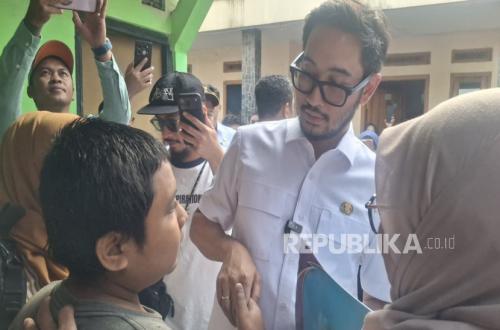
West Bandung Regent Jeje Ritchie Ismail stated that the West Bandung Regency Government will provide greater attention to Muhammad Rizki (11), a disabled child who has the habit of eating leaves.
He directly checked on Kiki, Rizki’s affectionate nickname, in Babakan Cianjur Village, RT 04/07, Gadobangkong Village, Ngamprah Subdistrict, West Bandung Regency (KBB), West Java, on Wednesday (29/4/2026). Jeje spoke with Kiki’s father, Asep Setiawan (45), and other family members.
“Based on the family’s account, Rizki has indeed had the habit of eating grass since seven years ago,” Jeje said.
He has instructed the West Bandung Social Service (Dinsos) to facilitate Kiki and his family to be included in the list of recipients for various aid programmes from both central and local governments.
Jeje also requested the Health Service (Dinkes) to conduct a health examination for the boy. “There will be assistance from Dinsos, Disduk and Dinsos will take the initiative to check Rizki’s health. We’re concerned there might be bacteria since he eats the grass directly without washing it or anything. We will also enrol Rizki in school,” Jeje stated.
Jeje also asked all government apparatus, from village to subdistrict and local government levels, to be more sensitive to the conditions of the surrounding community. Thus, the condition experienced by Rizki can receive attention.
“In the future, problems like this should not have to wait until they go viral. So, from the subdistrict or village side, they identify so they already know things like this or in their area, which residents need special attention,” he said.
Head of the West Bandung Social Service, Idad Saadudin, added that his side will immediately propose to the Ministry of Social Affairs for Rizki and his family to be included in the Integrated Social Welfare Data (DTKS) decile 1-5. The previous proposal was hindered because Rizki’s population identification number (NIK) was still linked to his mother’s in another area.
“Yesterday it was still under his mother’s NIK, now it must be separated and linked to his father’s family card. For decile adjustment to enter decile 1 to 5 because originally it was decile 6. Well, we will propose that,” Idad explained.
His side will also coordinate with Wyata Guna Bandung to provide assistance for Rizki’s condition.
“For guidance, we recommend to Wyata Guna for rehabilitation of speech impairment and mild intellectual disability. Hopefully only those two, not adding more. Hopefully the family can also back up in terms of assistance,” Idad said.
Parents’ story about Rizki’s condition
Kiki, the affectionate nickname for Muhammad Rizki, is a disabled child with mental and speech impairments. He lives with his father, Asep Setiawan (49), and his grandmother in economically limited conditions.
“It’s true, my son Kiki has the habit of eating leaves, from grass to any leaves around. But he knows which ones are poisonous and which are not,” Asep said.
Asep recounted that Kiki’s habit of eating leaves was discovered since he was four years old. At that time, he was still renting in Bunisari, Gadobangkong, and working as a travelling sandal seller to meet living needs.
One day, Asep and Kiki went around selling goods from morning without having breakfast. Approaching noon, since the goods hadn’t sold and they were hungry, Asep decided to go home to find food.
He briefly left Kiki in the rented room in a locked state. “When I returned bringing rice from my parents, I saw Kiki eating taro leaves in the room. It turned out he brought them from outside and kept them in his pocket,” Asep said.
Since then, Asep realised his child had that habit and it persists to this day even though he tries to forbid it. Amid economic limitations, Asep admits he continues to try to provide proper food for his child, with help from his parents.
“There are indeed two factors. First, because of his mental limitations. Second, because of economic factors,” Asep said.
His child’s condition that requires more attention forces Asep not to be able to work fully because he must care for Kiki every day, from bathing, feeding, to supervising his activities.
Ironically, Asep claims he has never received social assistance from the government such as the Family Hope Programme (PKH), Non-Cash Food Assistance (BPNT), or other aid. He hopes for attention from the relevant parties so his child can get proper education and therapy.
“My hope is that my child can go to school and get therapy or treatment. Now it’s not possible yet because of cost constraints. I have trouble working because if not watched, he can leave and not know the way home,” Asep said.