
Regent Jeje to Develop ITB-Initiated 'Maggot Apartment' as Waste Processing Solution
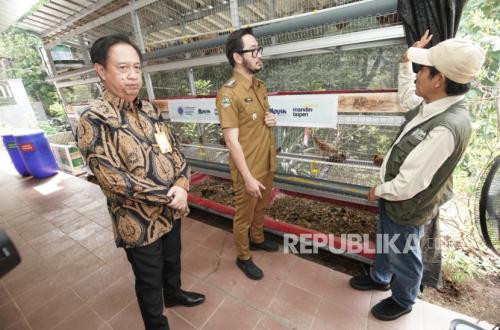
Waste management remains a persistent problem in West Java. However, West Bandung Regency (KBB) is beginning to find a solution to this issue through a simpler yet economically valuable approach: the development of chicken ‘apartments’ that incorporate maggot cultivation.
The maggot apartment programme is the result of a collaboration between the Bandung Institute of Technology (ITB), PT Bank Mandiri Taspen, and the West Bandung Regency government. ITB has built an integrated poultry farming facility and organic waste processing system using maggots, the larvae of the black soldier fly (BSF).
This Corporate Social Responsibility (CSR) programme is designed to create sustainable benefits, encourage community self-reliance, and provide solutions to local environmental problems.
West Bandung Regent Jeje Ritchie Ismail said the development of maggot apartments serves as an alternative for addressing the waste problem in his region. Jeje acknowledged that waste is one of the main challenges facing West Bandung, requiring collaboration between government, academics, the community, and the banking sector.
“With this cooperation, I hope it can be expanded to all districts in West Bandung in the future,” Jeje said during a visit to the Maggot Apartment in Dago Giri, West Bandung, on Tuesday (18/8/2026).
The development of maggot apartments will be supported by training so that communities are able to process organic waste into something of economic value. The programme is expected not to stop as a pilot project but to be replicated in various areas.
“If possible, we hope this programme can be developed in 16 districts and 165 villages in West Bandung,” Jeje said.
The maggot apartment concept is relatively easy to replicate as long as suitable land is available. Public facility locations are considered an ideal option because management can be carried out collectively and the benefits are directly felt by the community.
According to the initiator of the maggot apartment from ITB, Dr Linus Ampang Pasasa, the technology utilises black soldier fly larvae, or maggots, to decompose organic waste in a relatively short time. The processed waste produces maggots that can be used as chicken feed. The technology is capable of decomposing organic waste in just about two days.
“If we put waste into this system, it is decomposed within two days,” Linus said.
According to Linus, the technology is relatively simple and conventional, but it has rapid waste processing capabilities at a relatively low cost. He said one maggot apartment unit costs around Rp 45 million and can be used to raise up to 100 chickens on a plot as small as 1x6 metres.
However, he noted that the number of chickens in one unit is currently only around 40 because the available supply of organic waste is still limited. “If there are too many chickens while the waste is scarce, they will certainly lack food,” Linus said.
Linus said the waste processing capacity can reach around 250 kilograms per day, depending on the number of units and the available supply of organic waste. The organic waste can come not only from households but also from the hotel, restaurant, and café (HOREKA) sector. “We are ready to accept waste from HOREKA here. Not all of their waste is necessarily processed,” he said.
In addition to reducing organic waste generation, the system also produces derivative products in the form of maggots and chicken eggs that have economic value. Maggots can be used as chicken feed, while the eggs produced can be sold to finance the operations of the managing group or used for community social purposes.
“The eggs can be sold to cover the costs of those who manage the facility, or distributed for stunting prevention through community health centres and so on. It just depends on the management,” Linus said.
The maggot apartment programme has received support from Bank Mandiri Taspen as part of efforts to provide activities and economic opportunities for retirees.
According to Bank Mandiri Taspen President Director Panji Irawan, the bank sees maggot-based organic waste management as a productive activity that can involve retirees. Panji said the concept creates an economic ecosystem: organic waste from the community is processed into maggot feed, then the maggots are used as chicken feed, ultimately producing eggs.
“Retirees will be able to fill their days with various activities. For example, helping to clean the environment and collaborating with residents,” Panji said.
Bank Mandiri Taspen is also ready to provide financing support for retirees who wish to engage in such productive activities. As an illustration, Bank Mandiri Taspen has a business financing package for retirees worth around Rp 45 million.
The financing can be adjusted to the needs of developing a waste-processing-based business. In addition to financing, retirees will also receive training and mentoring from experts.
“We already have experts who will work with us as mentors and coaches. There is a use case that can serve as a model,” he said.