
Regarding Mass Bank Accounts, Airlangga States 74 Million People Lack Accounts
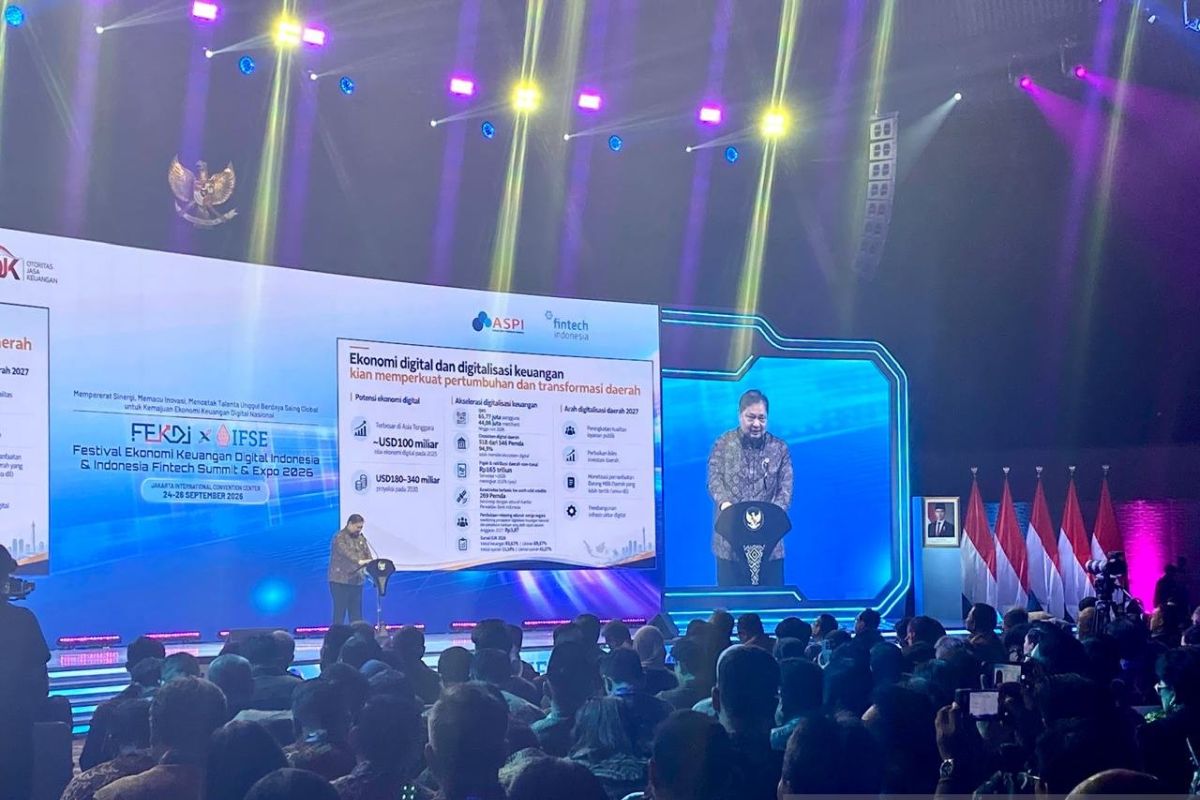
Jakarta (ANTARA) - Coordinating Minister for Economic Affairs Airlangga Hartarto estimates that approximately 74 million residents under the age of 17 do not yet have bank accounts, prompting the government to encourage account openings to ensure equitable ownership across all citizens.
He added that if the government provides funds amounting to Rp50,000 per account per person, the total required funding would be approximately Rp3.8 trillion.
“It was stated by the Minister of Home Affairs that, based on Dukcapil (Civil Registry) data and cross-referenced information, there are about 74 million residents aged 17 and under who do not have accounts,” Airlangga said during the Festival Ekonomi dan Keuangan Digital (FEKDI) x Indonesia Fintech Summit & Expo (IFSE) in Jakarta on Thursday.
Airlangga added that this initiative will soon be discussed again with President Prabowo Subianto to encourage all members of society to actively transact using their accounts.
“Commission XI can also provide support. The President has requested that those aged 17, in addition to obtaining an ID card (KTP), should also have accounts through BRI or BSI, particularly for those in Aceh who use BSI,” said Airlintga.
Meanwhile, at the same event, Minister of Home Affairs Tito Karnavian stated that the government continues to strengthen information technology (IT) infrastructure within the Directorate General of Population and Civil Registration (Dukcapil), including to support digitalisation in regional and financial sectors.
According to him, one way to facilitate financial digitalisation is through the use of digital identity for the Know Your Customer (KYC) process in banking. Consequently, the customer identification process would no longer be manual, such as using photocopies of ID cards, but could be performed using face recognition technology prepared by Dukcapil.
He stated that they have collaborated with various parties, both government and private, to utilise biometric-based face recognition technology for rapid identification. This technology is also being utilised to support e-government.
Currently, the first phase of implementation is directed towards improving the accuracy of social assistance recipient data. Through face recognition, Tito explained, an individual’s identity can be verified within seconds when officers are in the field.
He added that this data can also be combined with the ATR/BPN (Agrarian Affairs) system to verify land ownership and police data to verify vehicle ownership.
Thus, when an individual’s identity is identified via face recognition, related data regarding vehicle and land ownership can be immediately known, allowing the government to determine the eligibility of aid recipients, including based on deciles 1, 2, 3, 4, and so on.
He noted that the use of digital ID has been piloted in Banyuwangi.
According to him, the trial results showed that almost 70 percent of aid recipients were misplaced, while almost 50 percent of the population who were eligible did not receive aid.
Tito stated that this condition can be rectified through the use of an integrated digital system.
“We have expanded this to 43 other pilot regions, and the target by the end of this year is approximately 200 regencies/cities where we will conduct validation using the Dukcapil system integrated with other ministries/agencies,” he explained.
Tito also explained that identity digitalisation is increasingly important in the development of banking and e-commerce. This is because various online services, including e-commerce and digital trade, no longer always require manual ID card submissions but are starting to use digital identities.
“Therefore, the digital identity from the Dukcapil e-KTP is very beneficial for the development of financial digitalisation,” said Tito.
Regarding financial literacy and inclusion, he stated that the government is encouraging all citizens aged 17 and above to have bank accounts. Based on data provided by Danantara and the banking sector, Tito noted that approximately 170 million residents already have accounts. Therefore, he emphasised the need to use Dukcapil data to cross-reference this information.
According to him, about 98 percent of the Indonesian population is registered in Dukcapil, including data on faces, fingerprints, retinas, addresses, residency, status, and various other profile information. This data can be used for rapid screening based on those aged 17 and above, down to the provincial, regency, and village levels.
This data can then be reconciled with the data of the approximately 170 million residents who already have accounts. Through this process, the government can identify by name and address those aged 17 and above who do not yet have accounts, while also mapping them by province and regency/city.
“This is our target in our efforts to ensure they have accounts, so that our finance is no longer exclusive, but inclusive, reaching all Indonesian people, especially those aged 17 and above,” said Tito.
Source: jawawa.id (https://jawawa.id/newsitem/regarding-mass-bank-accounts-airlangga-states-74-million-people-lack-accounts-1790237091)
Originally published by Antara (Indonesian) (https://www.antaranews.com/berita/5756235/soal-rekening-massal-airlangga-sebut-74-juta-orang-belum-punya-akun), translated from Indonesian