
Regaining Investor Confidence, SIER Signs Two LoIs at EJIF 2026
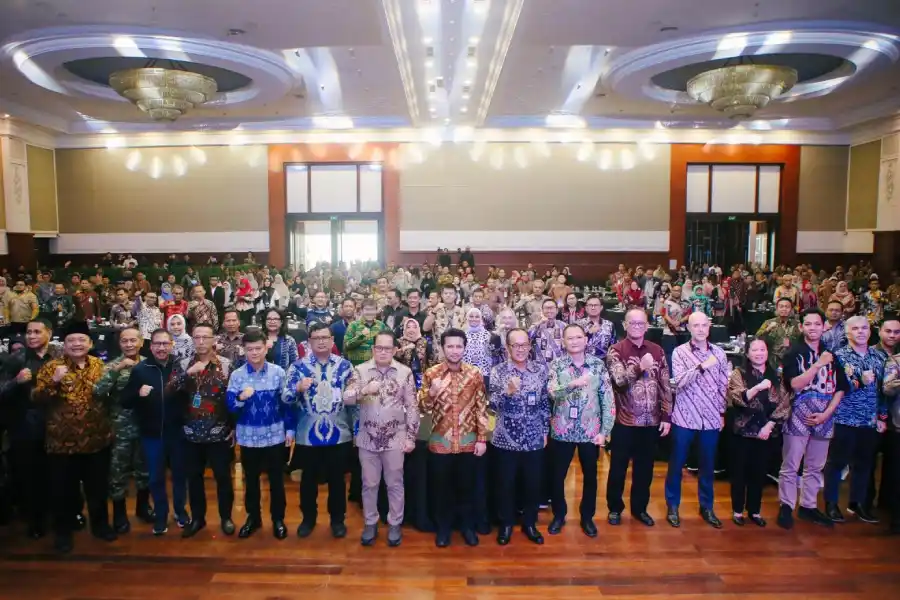
Surabaya – PT Surabaya Industrial Estate Rungkut (SIER) has reaffirmed its commitment to driving investment growth within its industrial estates. During the East Java Investment Forum (EJIF) 2026, SIER signed Letters of Intent (LoI) with two companies: PT Freyabadi Indotama and PT Filtrona Manufacturing Indonesia.
The signing took place amidst the EJIF 2026 event held at Grand City Convex, Surabaya, which ran for two days from 1–2 October 2026. This signing serves as the initial step for both parties to explore and develop further cooperation.
Representing SIER was the Acting Head of the Marketing Division, Dedi Apriyanto. PT Filtrona Manufacturing Indonesia was represented by Site General Manager Pupung Wahyu Purnaman, while PT Freyabadi Indotama was represented by Manufacturing Manager Yaroh. PT Freyabadi Indotama operates in the chocolate industry, whereas PT Filtrona Manufacturing Indonesia operates in the cigarette filter sector.
During the ceremonial opening of EJIF 2026 on Friday (2/10/2026), a photo session was held featuring the signed LoI documents. The session was attended by the President Director of PT SIER, Alif Abadi, alongside representatives from both companies, the Vice Governor of East Java, Emil Elestianto Dardak, the East Java Provincial Secretary, Adhy Karyono, the Head of Representative of Bank Indonesia East Java, Ibrahim, and the Acting Head of OJK East Java, Horas V.M. Tarihorman.
Alif Abadi, President Director of PT SIER, stated that the signing of the LoI reflects investor confidence in SIER as an industrial estate capable of supporting investment needs. He noted that investor trust is vital capital for SIER’s continued development, highlighting the estate’s complete facilities, including warehousing and BPSP support, to bolster operational needs and business growth.
He added that SIER will continue to ensure that the managed industrial estates provide a safe, comfortable, competitive, and sustainable investment ecosystem. “For us, every investment is not merely an addition to business activities, but also part of an effort to build an industrial ecosystem that provides long-term benefits for East Java,” he said.
Concurrently, the Vice Governor of East Java, Emil Elestianto Dardak, expressed his hope that these LoIs would be followed through with actual investment realisation to strengthen the regional economic structure. He emphasised that investment development must be supported by a conducive ecosystem to drive industrial growth and expand economic benefits.
Emil noted that East Java does not wish to merely be an investment destination, but aims to build an ecosystem where investment can flourish and create added value. He highlighted that East Java is the largest contributor to the Indonesian economy and serves as a stable regional economy.
“Today, we are focusing on strategic policy to ensure East Java maintains a conducive ecosystem. East Java is a regional economy, with industry being the primary pillar. Therefore, our focus must be on the excellence of the economic ecosystem, particularly the manufacturing industry present in East Java,” he explained.
Emil further explained that as a regional economic powerhouse, East Java’s economic structure is supported by the industrial sector, specifically manufacturing. Strengthening this sector must be a strategic direction for East Java’s economic development, supported by trade, human resources, infrastructure, and connectivity.
He noted that East Java’s potential is spread across various regions, opening wider investment opportunities through the presence of airports, seaports, and other connectivity infrastructure. He also mentioned the existence of Special Economic Zones (KEK), industrial estates, halal industrial zones, and plans for new industrial areas.
Emil emphasised the importance of viewing investment not just by its nominal value, but by its position and contribution to strengthening East Java’s economic value chain. He concluded that the government plays a crucial role in building a superior ecosystem so that various investment opportunities can develop into economic activities that provide significant added value.