
Refusing to Lose to Vietnam, This is Indonesia's Strategy to Attract Tech Investors
The government is racing to improve itself and prepare human resources to increase competitiveness, aiming to attract investor capital into the rapidly growing technology sector.
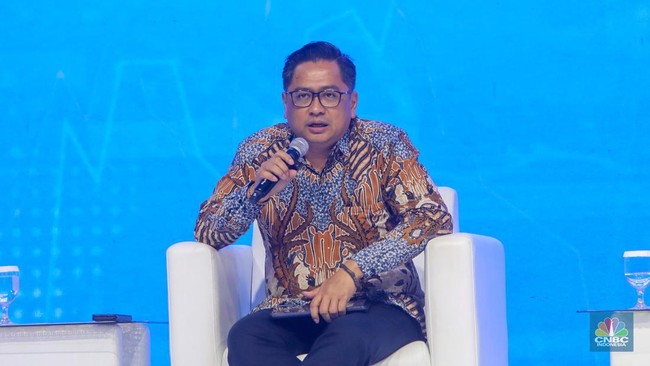
Eka Chandra Buana, Deputy for Macro Development Planning at the Ministry of National Development Planning/Bappelsnas, revealed that various government efforts are underway to attract tech investors, including regulatory improvements, governance transformation, and the preparation of superior human resources.
As is well known, technological development is occurring rapidly and has become a primary target for investors. Investment in the technology sector is becoming highly attractive alongside lifestyle changes towards more practical, digitalised living. Investment in this sector typically targets infrastructure, including data centres, human resources, industry, and markets.
In terms of location, Southeast Asia has garnered attention from global tech giants for capital deployment. This has turned Southeast Asia into a battlefield for the technology industries of major Western and Eastern companies.
Several countries in the Southeast Asian region have been chosen as homes for the expansion of global tech giants, including Singapore, Malaysia, Thailand, and Vietnam. Unfortunately, Indonesia has only received a relatively small portion of the investments from these global technology companies.
Thailand and Vietnam have recently been aggressively courting semiconductor companies to expand, offering tax incentives and other attractions. Most recently, Reuters reported that the electric vehicle company Tesla is establishing a subsidiary, Tesla Motors Vietnam Limited Liability Company, in Ho Chi Grand City, Vietnam, with a capital of 77.667 billion Vietnamese Dong, or approximately IDR 52.78 billion.
Meanwhile, Malaysia has become the world’s sixth-largest exporter of semiconductors. Malaysia is currently focusing its industry on packaging smaller chips capable of increasing computing power.
Amidst the intense competition to attract technology sector investment, the Indonesian government is not remaining idle, continuing to implement improvements and policy innovations.
Eka Chandra explained that the first step taken was diagnosing the reasons why investors are reluctant to invest in Indonesia. A crucial issue identified was institutional regulation.
“It turns out the main obstacle lies in institutional regulation,” he stated when met by CNBC Indonesia at Menara Bappenas, Jakarta, on Wednesday (16/9/2026).
One issue highlighted by the government is overlapping and conflicting regulations between institutions, as well as between central and regional governments. Eka Chandra noted that this is a problem that must be addressed, and a governance transformation is essential to attract investment.
Therefore, in the 2025-2045 National Long-Term Development Plan, the government is initiating a governance transformation that focuses on regulatory restructuring, the formation and strengthening of a single regulatory management agency, and the improvement of public services based on information technology.
Human resource transformation is also being prepared by the government to serve as an attraction for investors. This transformation concerns not only capability but also productivity.
Eka explained that human resource productivity also encompasses education, health, infrastructure, and regulation. He believes that digitalisation should also serve as a tool to increase the productivity of human resources in Indonesia.
Furthermore, Eka identified another challenge: technological disruption must be viewed as a new opportunity.
“What we need to do is view disruption as an opportunity for new expertise. That is what we are doing through STEM (Science, Technology, Engineering, and Mathematics),” he said.
Eka stated that the government is currently focusing on embedding STEM in education to address technological disruption, a process that is being implemented from an early age.
Through these transformative policies, he stated that Indonesian human resources will become more innovative, ultimately helping to attract investor capital, particularly in the technology sector, into the country.
“That is why we always say in the National Long-Term Development Plan that transformation is demonstrated by what? The policy is not ‘business as usual’,” concluded Eka.
Source: jawawa.id (https://jawawa.id/newsitem/refusing-to-lose-to-vietnam-this-is-indonesias-strategy-to-attract-tech-investors-1789556330)
Originally published by CNBC Indonesia (https://www.cnbcindonesia.com/news/20260916152113-4-768432/ogah-kalah-dari-vietnam-ini-strategi-ri-tarik-duit-investor-teknologi), translated from Indonesian