
Reformasi Jilid Dua: A Call for Economic Justice and Bureaucratic Transformation
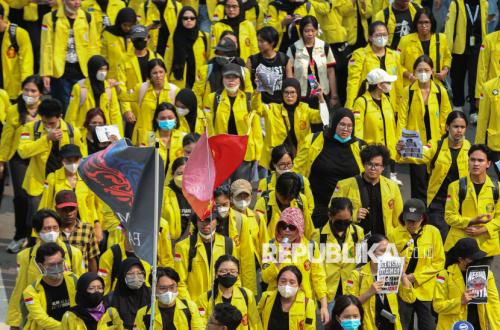
Nearly three decades after the 1998 Reformasi, the call for ‘Reformasi Jilid 2’ has resurfaced. A wave of student demonstrations in Jakarta on 12 June 2026, continuing in Yogyakarta a day later, shows that demands for change are no longer just discourse on social media. Under the slogan ‘Towards a Bankrupt Indonesia’, students voiced anxiety over economic conditions and the direction of government policy. This unease stems from issues directly felt by the public: the weakening rupiah, rising prices of basic necessities, the threat of layoffs, declining purchasing power, and various allegations of corruption in the management of government programmes. Unlike the 1998 Reformasi, which focused on regime change and political democratisation, Reformasi Jilid Dua highlights governance and public welfare.
The five main demands voiced by the students reflect this. They urge an end to state budget waste, a reduction in the prices of staple goods and fuel, an evaluation of the Free Nutritious Meals programme and the Koperasi Desa Merah Putih, a halt to the militarisation of civilian space, and government acknowledgement of its economic policy weaknesses. In essence, what is being questioned is not merely economic figures, but the quality of state management.
Behind these demands lies a more fundamental question: Has the 1998 Reformasi succeeded in delivering the promised prosperity? Democracy has indeed developed. Elections are held regularly, press freedom has expanded, and transitions of power occur peacefully. Yet poverty, inequality, corruption, and economic vulnerability remain recurring problems. Therefore, Reformasi Jilid Dua should be a momentum to evaluate the national constitutional and economic architecture. Limited amendments to the 1945 Constitution must be reconsidered to strengthen checks and balances, clarify long-term development direction, and revive the spirit of economic democracy as mandated by Article 33 of the 1945 Constitution.
Mohammad Hatta’s thinking becomes relevant in this context. Hatta asserted that political independence is meaningless without economic independence. Political democracy must go hand in hand with economic democracy. If wealth and power are concentrated in the hands of a few citizens, or worse, fall into foreign hands, then independence loses its meaning. This is where the problem of oligarchy becomes important. Political scientists such as Richard Robison and Vedi R. Hadiz argue that post-Reformasi Indonesia has not fully escaped the grip of oligarchy. What changed was not its existence, but its modus operandi. If previously oligarchy relied on proximity to the ruler, it now operates through political parties, business networks, media, and various democratic institutions. As a result, economic growth is not always followed by equitable welfare.
However, Indonesia’s problem actually lies not only in political design, but also in the quality of its bureaucracy. This is where the Reformasi Jilid Dua agenda needs to be translated into a ‘bureaucratic hijrah’: a transformation of the state apparatus from a mere administrative machine into a public servant oriented towards social justice. Post-1998 bureaucratic reform has indeed yielded progress, including the digitalisation of public services. Yet a feudal mentality often persists. Positions are still frequently viewed as symbols of power, not a mandate for service. Various corruption cases involving state officials, including the deeply ironic practice of buying and selling Unqualified Audit Opinions, show that procedural reform is insufficient without moral reform.
Therefore, Reformasi Jilid Dua requires at least three major agendas. First, a hijrah of mentality, changing the bureaucratic orientation from ‘ruler, government to be obeyed and served’ to ‘serving’. Second, a hijrah of economic regulation, presenting policies that favour MSMEs, prevent monopolies, and expand public economic access. Third, an inclusive digital hijrah, so that technology truly facilitates the people, rather than creating new barriers.
Evaluation must also be directed at the position and role of Bank Indonesia. BI’s independence is indeed important for maintaining monetary stability. However, amidst demands concerning employment, industrialisation, and public purchasing power, questions arise as to whether monetary policy is sufficiently connected to the needs of the real sector. The linkage between monetary, fiscal, and national development policies needs to be strengthened so that economic stability does not stop at the statistical level alone.
Indeed, Indonesia is not currently in a situation as severe as the 1998 crisis. But macro stability must not obscure micro realities. When food prices rise, healthcare costs become more expensive, and quality jobs become harder to find, the public rightly questions the benefits of the economic growth that has been touted. Therefore, the wave of demonstrations emerging in Jakarta and Yogyakarta should be read as a social alarm, not a political threat. This alarm indicates a gap between the government’s optimism and the real daily experience of the people. If the 1998 Reformasi succeeded in liberating Indonesia from political authoritarianism, then Reformasi Jilid Dua must dare to liberate Indonesia from economic inequality, systemic corruption, unresponsive bureaucracy, and oligarchic dominance over public life. For the true ideal of reformasi is not merely the freedom to choose leaders, but the realisation of social justice for all Indonesian people.