
Reflecting on a Century of Gontor: Re-evaluating the Sincerity of Da'wah Activists
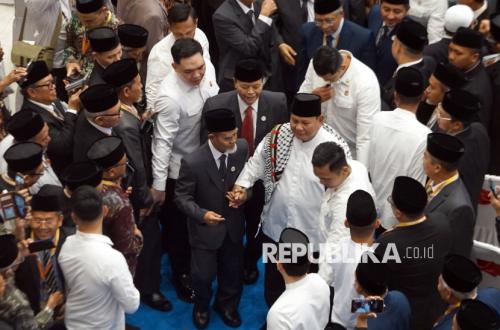
“If what I eat, wear, inhabit, or work with is more than what the students enjoy, please protest, please criticise, please demonstrate!”
This provocative statement was delivered by KH Hasan Abdullah Sahal during the peak of the 100th Anniversary Thanksgiving Reception of Pondok Modern Darussalam Gontor on Saturday, 19 September 2026. In the presence of President Prabowo Subianto and thousands of national figures, the Kyai’s firmness was not merely rhetorical flourish. It served as a spiritual manifestation and an alarm for the governance of contemporary Islamic da’wah, social, and educational institutions, which are slowly shifting away from their original mission of pure service.
Amidst the flourishing growth of religious institutions today, Kiai Hasan Sahal’s statement feels like both an anomaly and a harsh slap to the trends of ‘sharia capitalism’ and the commodification of religion. We are frequently presented with an ironic sight. On one hand, students and congregants are taught to live simply and practice self-restraint in the name of sincerity (riyadhah). On the other hand, it is not uncommon for certain managers or foundation officials to display a strikingly contrasting standard of living.
In sociological discourse, this reality is rooted in the strong emotional closeness and absolute charismatic legitimacy that a religious figure holds over their followers. Consequently, the disparity in facilities between those who teach and those who are taught is often accepted through the justification of structural respect. In the name of reverence for the teacher, congregants are forced to submit to a new style of feudalism. Criticism is often regarded as ‘su’ul adab’ (bad manners). If staff, students, or employees dare to question the transparency of fund management, such critical attitudes are immediately branded as seeds of rebellion that could potentially strip away the blessings of knowledge.
This phenomenon of paternalism and acute feudalism within religious institutions aligns with Clifford Geertz’s observations in his classic study of Javanese social structures. Geertz noted that traditional religious leadership is prone to creating psychological-spiritual dependency, which causes followers to lose their critical faculties if not balanced by a healthy control system. When this sphere of spiritual charisma encroaching upon the realm of public economics without clear boundaries, blind obedience instantly transforms into an opportunity for exploitation.
The Test of Integrity in Worldly Affairs
The sociological unease captured by Geertz is fundamentally aligned with the spiritual warnings emphasised long ago by Imam Al-Ghazali in Ihya Ulumuddin. Al-Ghazali paid serious attention to the phenomenon of Ulama al-Su’ (bad worldly scholars)—religious preachers who gradually turn religious knowledge and institutions into stepping stones to achieve material luxury (taraf) and social status.
It cannot be denied that some elements of the Ummah today are truly having their integrity tested when touching public funds. In these dazzling worldly affairs, there are those who are willing to manipulate the community’s endowment (waqf) assets. Land, buildings, or capital, originally surrendered by donors (waqif) for the sake of religious propagation and public education, are slowly and systematically transferred into private ownership or family dynasties.
By exploiting formal legal loopholes and weak oversight, sacred acts of charity (amal jariyah) are transformed into instruments for private wealth accumulation. Unknowingly, this opportunistic behaviour has wounded the sanctity of Islam itself. Religion is positioned as an immune shield that makes its managers appear immune to the law, immune to audits, and immune to guilt regarding the social inequality occurring within their own backyard.
Religious institutions, which should serve as oases of liberation, run the risk of mutating into dynastic corporations, where financial profit and privilege flow heavily into the pockets of founders and their families. This condition is described as a traditional patron-client relationship that has failed to transform managerially. Subordinates are positioned as ‘servants’ who continuously provide labour and material, while the ‘patron’ enjoys capital accumulation without any equal obligation of accountability.
This is certainly contrary to the exemplary legacy left by the ‘Trimurti’ founders of Gontor (KH. Ahmad Sahal, KH. Zainudin Fanani, and KH. Imam Zarkasyi). In 1958, the founders made a rare and visionary decision: to endow Pondok Modern Darussalam Gontor to the Muslim community. They chose not to bequeath this massive institution to their descendants as private property, but rather to hand it over to the Waqf Board representing the entire Muslim community.
This attitude of pure sincerity was born from a long-term vision for the community and the nation that transcends generational ego. Unfortunately, this precious legacy of values is often missed by the understanding of our modern religious figures, intellectuals, and managers of da’wah institutions. They fail to emulate the substantive excellence demonstrated by the Gontor Founders.
A Proposal for Collective Reflection
Of course, the portrait of managerial deviation in some pockets of religious institutions should not make us close our eyes to a larger reality. Generalising that all Islamic institutions are experiencing moral degradation would be an unjust error. We must look at the facts clearly: outside of these instances, there are still many pesantren, orphanages, and zakat institutions managed by upright, simple, and trustworthy figures. Many kiai in remote parts of the country are willing to dedicate their remaining years, living in extreme simplicity, to ensure that underprivileged children receive a proper education.
Therefore, this writing serves purely as a means of collective reflection (muhasabah). The goal is for us all to remain aware of our own shortcomings and…
Source: jawawa.id (https://jawawa.id/newsitem/reflecting-on-a-century-of-gontor-re-evaluating-the-sincerity-of-dawah-activists-1790600395)
Originally published by Republika (https://analisis.republika.co.id/berita/tm2ibo393/refleksi-satu-abad-gontormenakar-ulang-keikhlasan-para-pegiat-dakwah), translated from Indonesian