
Reflecting on 81 Years of Independence, Ministry of Public Works Channels Sovereignty from Rice Fields to Bridges in Remote Areas
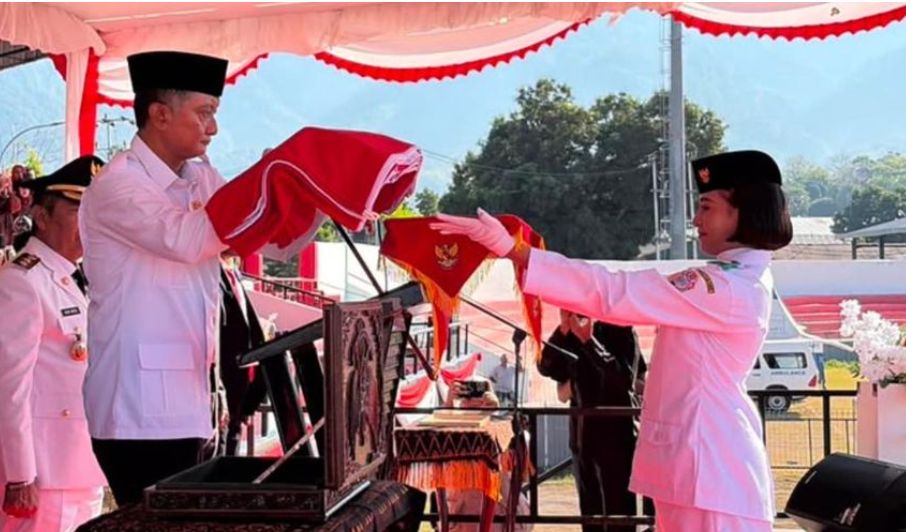
The independence of a nation does not end when the proclamation is declared. For Indonesia, the proclamation of 17 August 1945 was merely the opening door. The real challenge lies in how to nurture and fill that independence so that sovereignty can truly be felt by all citizens in their daily lives.
This was conveyed by Special Staff to the Minister of Public Works, Jemmy Setiawan, in a written release commemorating the 81st Anniversary of the Independence of the Republic of Indonesia on Monday (17/8/2026). Carrying the theme ‘A Sovereign, Just, and Prosperous Indonesia’, Jemmy stressed that the meaning of political independence must be transformed into real independence.
‘Independence must be present in the water flowing to farmers’ rice fields, the roads connecting villages to market centres, the bridges that take children to school, and settlements with access to drinking water and proper sanitation,’ Jemmy asserted.
The Ministry of Public Works’ journey in safeguarding national sovereignty has a very strong historical connection with the birth of this Republic. Established in August 1945, the institution has now served for 81 years.
Jemmy recalled that in the early days of independence, the central office of Public Works occupied the former building of the Departement van Verkeer en Waterstaat in Bandung—a historic building now widely known as Gedung Sate. The building was not merely an office, but a fortress of technical knowledge and important state archives.
History records a heroic event on 3 December 1945. Twenty-one Public Works employees risked their lives defending Gedung Sate from attacks by Allied forces and NICA. Seven of them fell and were immortalised as the Sapta Taruna heroes. This event later became the milestone for the commemoration of Public Works Service Day every 3 December.
‘The message of the Sapta Taruna heroes is very clear: defending independence is not only on the battlefield, but also safeguarding state assets, infrastructure, and institutions. If in 1945 Public Works personnel defended state buildings, then in 2026 that service is continued by building infrastructure so that the state’s presence is felt by all citizens,’ Jemmy explained.
Over time, the role of the Ministry of Public Works has transformed from merely repairing post-revolution infrastructure to becoming the main engine of national development. Historical milestones such as the construction of the Jatiluhur Dam (1957), the Semanggi Interchange, and the Jagorawi Toll Road (1978) are clear evidence of the technocratic capabilities of Indonesian engineers.
Today, under the leadership of President Prabowo Subianto, infrastructure is positioned as a key pillar of the Asta Cita programme, particularly in achieving food, energy, and water self-sufficiency.
Minister of Public Works Dody Hanggodo emphasised that physical development is not the ultimate goal. Infrastructure is a means to boost citizens’ productivity and reduce economic inequality.
According to Ministry of Public Works records, throughout 2025 alone, approximately 13,000 hectares of new irrigation networks were built, along with rehabilitation of 123,000 hectares of existing irrigation networks. When calculated overall, including regional irrigation management, government intervention has reached more than 589,000 hectares of agricultural land.
‘Water that flows on time provides certainty of planting seasons for farmers. From there, productivity rises and infrastructure transforms into the main foundation of national food sovereignty,’ he explained.
In addition to focusing on the irrigation sector and regional road connectivity through the Regional Road Presidential Instruction Programme, the Ministry of Public Works is also focusing on the construction of social infrastructure.
This step is taken to break the chain of poverty from the grassroots level. Throughout 2025, hundreds of religious schools and madrasahs were rehabilitated, and more than 160 pioneering People’s Schools were completed. In 2026, this programme continues to be accelerated through the construction of permanent People’s School buildings.
Furthermore, disaster response preparedness is also a real test of the state’s presence. Entering mid-2026, all national road and bridge access in Sumatra affected by disasters has been functionally restored using the build back better principle.
Amid limited fiscal space and global economic dynamics, the Ministry of Public Works recorded a budget realisation rate of more than 95 percent in 2025.
‘However, success is not only measured by the amount of budget absorption, but by the quality of work, accuracy of targets, and sustainable benefits for the community,’ Jemmy concluded.