
Rediscovering Calm Through Forest Therapy
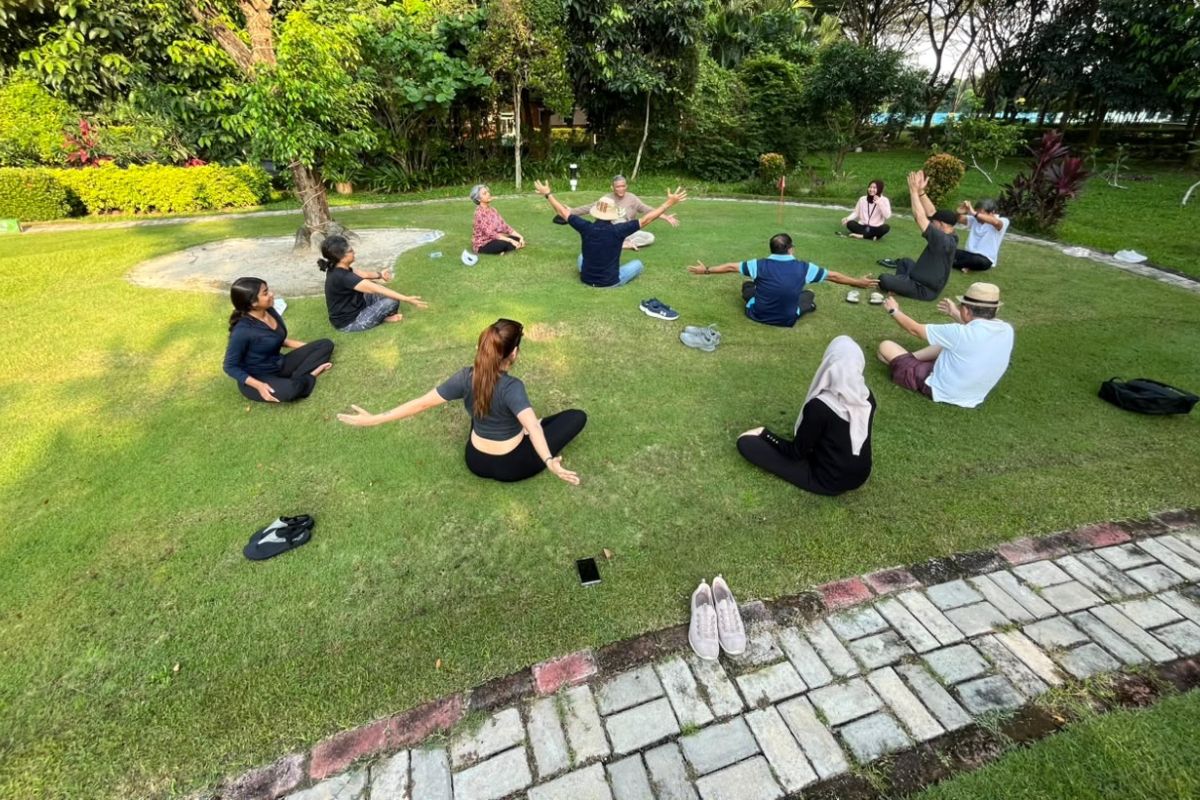
Jakarta (ANTARA) — Sitting still sounds easy. But for Wira, a 33-year-old entrepreneur and housewife, being still proved to be the hardest part of a forest therapy session she attended.
“At first, it felt a little unfamiliar, because I have always lived at a fast pace, which makes being still feel like doing nothing,” Wira told Xinhua after taking part in a forest therapy session at Bogor Botanical Gardens last August.
The experience of slowing down is what forest therapy offers. The practice has its roots in Japan’s shinrin-yoku, or forest bathing, which has been used for health purposes in its country of origin since the 1980s.
According to the official website of the Japan National Tourism Organization (JNTO), forest bathing has become an important part of preventive healthcare in Japan. Several Japanese studies have found that it can improve sleep quality, mood and concentration, as well as reduce stress.
Scientifically, some of the positive effects of forest therapy have been linked to phytoncides: natural volatile compounds produced by plants as a defence against microorganisms, insects and environmental stress.
IPB University Professor Siti Badriyah Rushayati said in an inaugural lecture on 27 June, as cited on the university’s official website, that exposure to forest air can increase the activity of natural killer cells, which help fight infections and cancer cells. Regular exposure to phytoncides may also help lower blood pressure, reduce stress and improve mental wellbeing, she said.
In Indonesia, the practice is becoming more widely known and is often offered as a form of wellness tourism. In parks and forest areas, participants are invited to pause and experience nature through all five senses.
They are guided to walk slowly barefoot, lie on the grass, listen to natural sounds, breathe in the scent of leaves and feel the textures of natural objects around them. The aim is to ground participants in the present moment and allow the body to recover naturally.
As World Mental Health Day, observed on 10 October, approaches, simple ways of caring for mental health are becoming increasingly relevant, particularly for people in modern society who often experience stress and burnout amid fast-paced lives and mounting pressures.
Mental health challenges affect children as well as adults. The Indonesian Health Ministry’s Free Health Check programme (CKG) for 2025–2026 detected anxiety disorders in 4.4 per cent, or about 338,000, of the children screened, and symptoms of depression in 4.8 per cent, or around 363,000. About seven million children had undergone screening. The figures highlight the importance of addressing mental health from childhood.
Mindfulness is a central element of forest therapy. Luh Surini Yulia Savitri, a psychologist and lecturer at the University of Indonesia’s Faculty of Psychology, wrote in an article published on the faculty’s official website on 28 March 2024 that mindfulness means being aware of “here and now”.
She also cited US professor Jon Kabat-Zinn, who defines mindfulness as awareness from moment to moment that does not judge what is happening in one’s own or another person’s thoughts and feelings.
Wira said this was the main difficulty she experienced during the session. “The biggest challenge was letting go of the need to always think and do something,” she said.
“I’m used to thinking through lots of possibilities and preparing for many things. In an activity like this, I learned that not everything needs to be analysed. Sometimes we can simply be present, feel, and let things unfold without immediately looking for meaning or a solution,” said Wira, who has a pre-school-aged child.
Hendro Prabowo, a practitioner and psychology lecturer at Gunadarma University, has used forest therapy for years as a complementary method to help address various psychological problems. He said the biggest challenge is guiding participants who tend to overthink.
The habit of excessive analysis often makes it difficult for participants to be fully present in nature and experience the therapy’s benefits to the fullest, he said.
To help participants recognise changes after a session, Hendro uses a visual method called pain drawing. Before the session, participants are given an anatomical drawing of the human body, asked to mark areas where they feel pain and rate its severity. At the end, they assess the same drawing again.
Hendro said comparing the two drawings allows participants to see the therapy’s immediate effects on their physical complaints.
He added that walking slowly barefoot may improve blood circulation and ease stress. According to Hendro, when the feet touch the ground directly, free electrons from the earth’s surface flow into the body and act as natural antioxidants against free radicals. Improved circulation may gradually help ease physical pain caused by stress and restricted blood flow, he said.
Unlike hiking, which is strenuous and involves uphill and downhill routes, forest therapy should take place on level ground and involve only light physical activity, Hendro said. Cool air, low noise levels, shady trees and a stream that is safe to walk alongside are also important elements.
Professor Siti expressed a similar view, saying that all five senses should be immersed in nature during forest therapy. “If noise levels are too high, the relaxation process will not work optimally,” she said, according to IPB’s official website.
Looking ahead, broader public information and education, along with more trained guides, could make forest therapy accessible to more people. Hendro hopes it will be introduced more widely to older people, workers whose lifestyles have been affected by stress, and teenagers experiencing gadget addiction as a preventive health measure.
He also hopes that growing awareness of forests’ benefits for physical and mental health will encourage people to care more about the sustainability of forest ecosystems, in turn supporting environmental conservation and greener, healthier urban planning.
For Wira, the session outdoors left her with a new understanding of what calm means. “After taking part in this therapy, I realised that calm does not mean having no problems in life. Calm is the ability to stay present and not lose yourself amid everything that is happening,” she said.