
Red Signal for Shipping: Rough Seas Sink Profits of Indonesian Ship Issuers
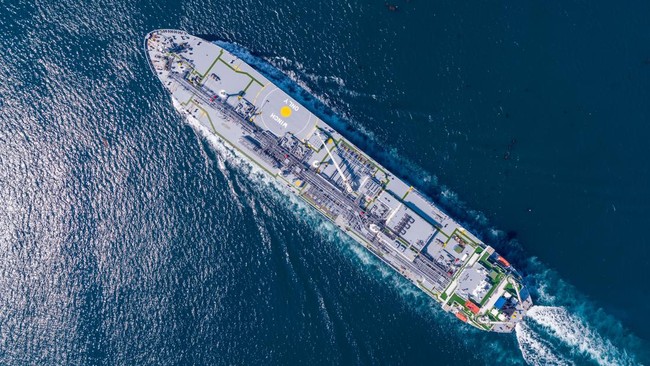
The Iran-United States war is adding new pressure to the global shipping industry.
Disruption in the Strait of Hormuz, a route for around 20% of world oil and gas trade, briefly lifted fuel prices, freight rates and vessel insurance premiums.
Although talks on reopening shipping lanes are showing progress, uncertainty has not fully subsided.
For shipping issuers, the situation is a double-edged sword. Higher freight and charter rates can boost revenue. However, surging fuel prices, insurance and operating costs have the potential to squeeze margins, especially for companies unable to pass cost increases on to customers.
Amid these conditions, Indonesian shipping issuers have been forced to absorb the bitter impact of global market shocks.
Based on financial reports for the June 2026 period (H1 2026), 22 issuers that own or operate vessels had reported their performance as of Wednesday (5/8/2026). Nine companies recorded profit growth, nine experienced profit declines, and four issuers swung from profit to loss.
The comparison uses net profit attributable to owners of the parent entity for the first half of 2026. Figures in US dollars are converted using an assumed exchange rate of Rp18,000/US$.
PT Pelayaran Jaya Hidup Baru Tbk (PJHB) posted the highest profit growth. The company’s net profit soared 68.9% year-on-year (YoY), from Rp5.17 billion to Rp8.73 billion.
The next position was held by PT Temas Tbk (TMAS). The container shipping company’s profit grew 54.3% to Rp441.57 billion.
Next came ALII, WINS and TCPI, which recorded profit growth of 27.5%, 24.4% and 23.8% respectively.
Although also growing, MBSS’s profit increase was relatively thin at just 0.4%. The most notable growth was at PJHB and TMAS, as both posted profit increases above 50%.
In nominal terms, TMAS was the largest profit earner in this group with Rp441.57 billion, followed by ALII at Rp265.32 billion and MBSS at Rp203.79 billion.
Nine issuers still booked profits in the first half of 2026, but their earnings were lower than in the same period a year earlier.
The deepest decline was suffered by PT Pelayaran Kurnia Lautan Semesta Tbk (KLAS). Its net profit plunged 72.5%, from Rp24.83 billion to Rp6.84 billion.
PT Trans Power Marine Tbk (TPMA) followed with a profit decline of 66.7%. After conversion using the Rp18,000/US$ rate, TPMA’s profit fell from the equivalent of Rp171.67 billion to Rp57.13 billion.
SHIP recorded the mildest decline in this group at 17.9%. The company’s profit fell from the equivalent of Rp222.20 billion to Rp182.38 billion.
Meanwhile, five issuers experienced profit declines of more than 50%, namely HUMI, HATM, ELPI, TPMA and KLAS.
Heavier pressure was felt by BESS, NELY, GTSI and LEAD. These four issuers still posted profits in the first half of 2025, but swung to losses in the first half of 2026.
LEAD recorded the largest loss after all values were standardised into rupiah. The company’s loss reached the equivalent of Rp52.12 billion, reversing from a profit of Rp3.04 billion.
GTSI posted a loss equivalent to Rp34.24 billion, while NELY and BESS recorded losses of Rp18.60 billion and Rp5.55 billion respectively.
The percentage change in profit for these four companies is not shown because growth calculations below minus 100% are less representative. The situation is more accurately described as a reversal in performance from profit to loss.
In general, the performance of shipping issuers in the first half of 2026 shows a weakening trend. Of 22 companies, only nine issuers, or around 41%, managed to increase profits.
Conversely, 13 issuers, or 59%, weakened, consisting of nine companies with declining profits and four issuers that swung to losses.
There were also no companies on the list that managed a turnaround from loss to profit. The composition of nine improving issuers versus 13 weakening issuers is a less positive signal for the shipping sector.
However, this does not mean the entire shipping industry is in a bad situation. The impact differs for each issuer, depending on vessel type, fleet utilisation levels, contract structure, debt burden and the ability to pass fuel cost increases on to customers.
Even so, the weakening of the majority of issuers deserves attention. Amid the Iran-US war and still volatile shipping costs, the ability to maintain margins, cash flow and vessel utilisation will determine the sector’s performance in the second half of 2026.
Source: jawawa.id (https://jawawa.id/newsitem/red-signal-for-shipping-rough-seas-sink-profits-of-indonesian-ship-issuers-1786002752)
Originally published by CNBC Indonesia (https://www.cnbcindonesia.com/research/20260805160623-128-756831/sinyal-merah-pelayaran-laut-bergejolak-laba-emiten-kapal-ri-karam), translated from Indonesian