
Red Sea Blockade Looms as Hormuz Crisis Continues, Threatening Global Recession
Jakarta, CNBC Indonesia – The Middle East conflict is escalating. The closure of the Strait of Hormuz has yet to be resolved, and now the Red Sea also faces blockade.
Citing Reuters on Tuesday (21/7/2026), the announcement came from the Houthi group in Yemen, which is allied with Iran. The militia said it would blockade Saudi maritime traffic there.
This follows a flare-up in relations between the two sides since 13 July, after an attack on Sanaa International Airport in Houthi-controlled territory. The Saudi-backed Yemeni government claimed responsibility for the operation, saying its aim was to prevent Iranian aircraft from landing without permission, as they were suspected of carrying officials or support for the Houthis.
The Houthis subsequently blamed Saudi Arabia as the culprit. In retaliation, they launched missiles at Abha Airport in Saudi Arabia and threatened to expand attacks if operations against their territory continued.
The attacks ended a period of relative calm that had lasted for several years. Yesterday, the Houthis increased pressure by announcing a “maritime embargo” against Saudi Arabia.
They stated they would prevent Saudi ships from passing through the Bab al-Mandab strait, the gateway from the Red Sea to the Gulf of Aden. The Houthis described the move as retaliation for a blockade they say Saudi Arabia has imposed on Yemen for nearly 12 years.
So what will the impact be?
It remains unclear how the Houthis intend to enforce a maritime blockade against Saudi Arabia, their northern neighbour along the Red Sea coast, or whether the move will include a resumption of attacks on shipping. However, the closure of Bab el-Mandeb or the Red Sea as a whole would open a new chapter in the energy crisis, amid the wider conflict between Iran and the United States.
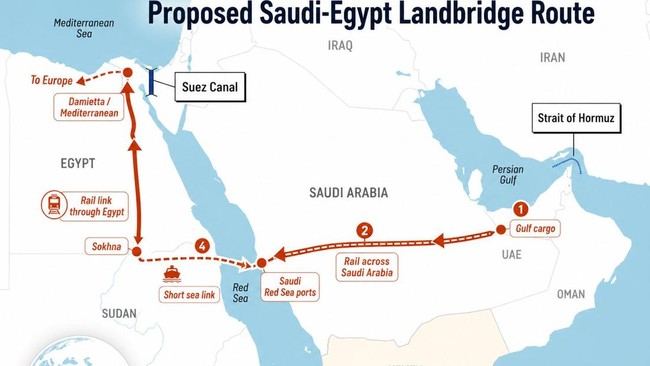
While tensions between Iran and the US have played out in the Strait of Hormuz, the Red Sea has become a vital alternative route for Gulf oil and other products. Serious disruption would mean both of the Middle East’s main oil export routes are closed simultaneously.
Iran’s partial blockade of the Strait of Hormuz, after Israel and the US attacked it on 28 February, disrupted much of the oil and other exports from the Gulf, driving up prices and causing a global energy shock. Saudi Arabia responded by diverting more than 70% of its normal daily crude oil exports to the Red Sea port of Yanbu.
From there, ships bound for Europe sail north through the Suez Canal. Vessels heading to Asia sail south through Bab el-Mandeb.
According to data from Kpler and Signal Ocean, shipments from Yanbu have averaged 4 million barrels per day in recent weeks, up from around 973,000 barrels per day in the previous year. Citing Kpler further, total crude oil volumes transiting Bab el-Mandeb reached 7.4 million barrels per day in June, or about 7% of global oil production, up from 4.2 million barrels per day last year.
This has provided relief to the energy market and helped cap global oil prices. Saudi Arabia is itself now considering expanding its crude oil pipelines to the Red Sea coast.
The 2023 Attacks
This is not the first time the region has faced disruption. After Hamas attacked Israel on 7 October 2023 and Israel launched its devastating campaign in Gaza, the Houthis began firing on Israel and ships in the Red Sea, saying they were doing so in support of Palestine.
Those attacks severely disrupted global shipping, prompting Maersk, Hapag-Lloyd and other major companies to reroute around Africa. That route, of course, is far longer and more expensive.
Red Sea traffic has not recovered since. Traffic through the Suez Canal fell 52% in 2025 compared with 2023 levels, reaching its lowest point in at least 50 years, according to official data.
A US-led mission to restore free navigation in the Red Sea involved repeated strikes on Houthi targets and a defensive campaign that shot down hundreds of drones and missiles. However, several Houthi attacks continued until last summer, and only ended fully with the Gaza ceasefire in October.
Last month, the Houthis said they would bar Israel-linked ships from entering the Red Sea after Israel again launched military strikes on Iran. That threat was never acted upon, and Maersk and Hapag-Lloyd resumed some Red Sea routes they had previously abandoned.
A Global Recession?
In a statement shared with journalists, Jorge Leon, Senior Vice-President and Head of Geopolitics at Rystad Energy, said the Houthis have not explained how they intend to enforce the blockade. However, previous Houthi attacks on commercial vessels show they have both the capability and the will to disrupt Red Sea shipping.
“If no ceasefire materialises and Hormuz remains largely closed while Houthi threats to Red Sea shipments grow, the risk of a significant rise in oil prices is very high,” Leon said, as reported by Al-Monitor.
Matt Smith, Director of Commodity Research at Kpler, said the same in comments carried by Reuters. Asian refiners, for instance, would face delays of around one month as tankers are forced to sail around the Cape of Good Hope.
“The impact would be very large in the first month,” Smith said. “The biggest impact would be on cash flows from Saudi Arabia.”
Meanwhile, John Paisie, President of Stratas Advisors, said the impact would not be limited to the oil market. Refined products could also be disrupted, potentially leading to a global recession.
“If they actually halt and impede oil shipments through the Red Sea, it will affect oil prices as well as refined product prices,” he said. “This weakens the global economy as a whole. At a certain point, you could see a global recession.”
Source: jawawa.id (https://jawawa.id/newsitem/red-sea-blockade-looms-as-hormuz-crisis-continues-threatening-global-recession-1784620387)
Originally published by CNBC Indonesia (https://www.cnbcindonesia.com/news/20260721131857-4-752570/belum-kelar-selat-hormuz-kini-laut-merah-tutup-apa-dampak-ke-dunia), translated from Indonesian