
Red and White Village Cooperatives: From Launch to Sustainability
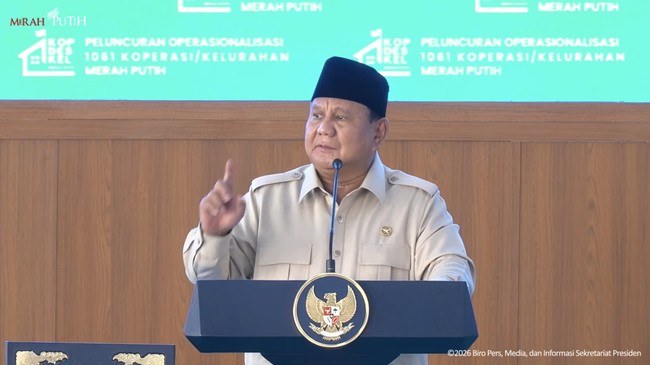
On 16 May 2026, President Prabowo Subianto inaugurated 1,061 Red and White Village Cooperative (KDKMP) outlets nationally in Nganjuk, East Java. This moment was not merely ceremonial; it marked a new chapter for the largest village economic programme in modern Indonesian history. In less than a year since the issuance of Presidential Instruction Number 9 of 2025, more than 80,000 villages have formed KDKMPs. This speed deserves appreciation as a sign of political seriousness.
Now the challenge shifts from building to operating, from launch to sustainability. This consolidation phase is the most decisive. A programme of KDKMP’s scale, with capital of up to Rp3 billion per cooperative and a reach of 80,000 villages, will be tested not by the number of outlets established, but by its ability to survive and grow in the long term. There are at least three crucial operational challenges that must be addressed immediately: institutional legal certainty, positioning the business within the village ecosystem, and strengthening managerial capacity.
Compared to many past village economic programmes, KDKMP was launched with a relatively complete regulatory ecosystem. Presidential Instruction Number 9 of 2025 provides the political foundation, while Minister of Finance Regulation Number 49 of 2025 opens access to financing through Himbara banks with a subsidised interest rate of 6 percent per annum and a ceiling of up to Rp3 billion per cooperative. Operational digitalisation is supported by Minister of Cooperatives Regulation Number 2 of 2025, which regulates the cooperative management information system. This three-layer regulatory framework—political, fiscal, and operational—reflects a strong foundation, but it will only be meaningful if the structure built upon it is carefully designed.
The first challenge is institutional legal certainty. KDKMP is a private entity with a cooperative legal status, yet it stands on village land classified as a state asset. Its physical buildings are constructed with loan capital from PT Agrinas Pangan Nusantara sourced from Himbara banks, while its managers are recruited by the central government and paid through the state budget. Operational costs are planned to come from village funds, and operational vehicles are procured centrally, both also sourced from the state budget. This hybrid construction of private entities and public resources is not impossible to manage, but it requires firm legal certainty to avoid future problems. Without clarity on asset ownership and financial accountability mechanisms, village heads and cooperative administrators are vulnerable to legal grey areas. Two realistic solutions exist. First, integrating KDKMP as a business unit of Village-Owned Enterprises (BUMDes). As entities regulated by Law Number 6 of 2014 on Villages and Government Regulation Number 11 of 2021, BUMDes have a clear territorial function and provide a legal basis for using village land and capital participation from village funds. Operational foundations arranged through village regulations and agreed upon in village consultations will provide the democratic legitimacy often absent from top-down programmes. Second, establishing a clear grant and asset transfer mechanism in the regulations. Land and buildings currently under the control of the village or the state-owned enterprise Agrinas need to be transferred to KDKMP through a legal, transparent, and certain scheme. Without this certainty, cooperative managers will tend to play it safe and avoid the business breakthroughs needed for growth.
The second challenge is finding the right position in the village ecosystem. KDKMP has a scale and state support that other village businesses lack. This advantage can be a strength, but it can also become a threat if not positioned correctly. Reports from several regions indicate that some KDKMPs have opened business units that directly compete with residents’ small shops that have existed for years. If left unchecked, a programme designed to empower could end up killing the livelihoods of the most vulnerable citizens. A more strategic and non-overlapping niche exists: KDKMP as an aggregator and supply chain and value chain connector. In this role, KDKMP would collect agricultural products and MSME goods from residents for marketing outside the village, supply goods to residents’ shops, distribute subsidised fertilisers and social assistance, and serve as a channel for micro-business credit. This is not an easy path, but it is economically more sensible and sustainable, positioning KDKMP as the backbone of the ecosystem rather than a player that consumes it.
The third challenge is building capacity from within. Running a village cooperative is not just bureaucratic administration. It requires skills in financial management, human resources, marketing strategy, product quality assurance, and, most importantly, a deep understanding of village social dynamics. The plan to recruit managers centrally carries the risk of mismatch: managers who may lack business experience and are unfamiliar with the local village context. The solution need not be expensive. The government can establish measurable competency standards for KDKMP administrators and managers, then build a massive and sustainable learning ecosystem. Collaboration with business coaching communities and universities that have community service programmes and business clinics is a proven effective approach in many contexts and can be replicated at scale.