
Red and White Flag Flies on Indonesia's 81st Independence Day
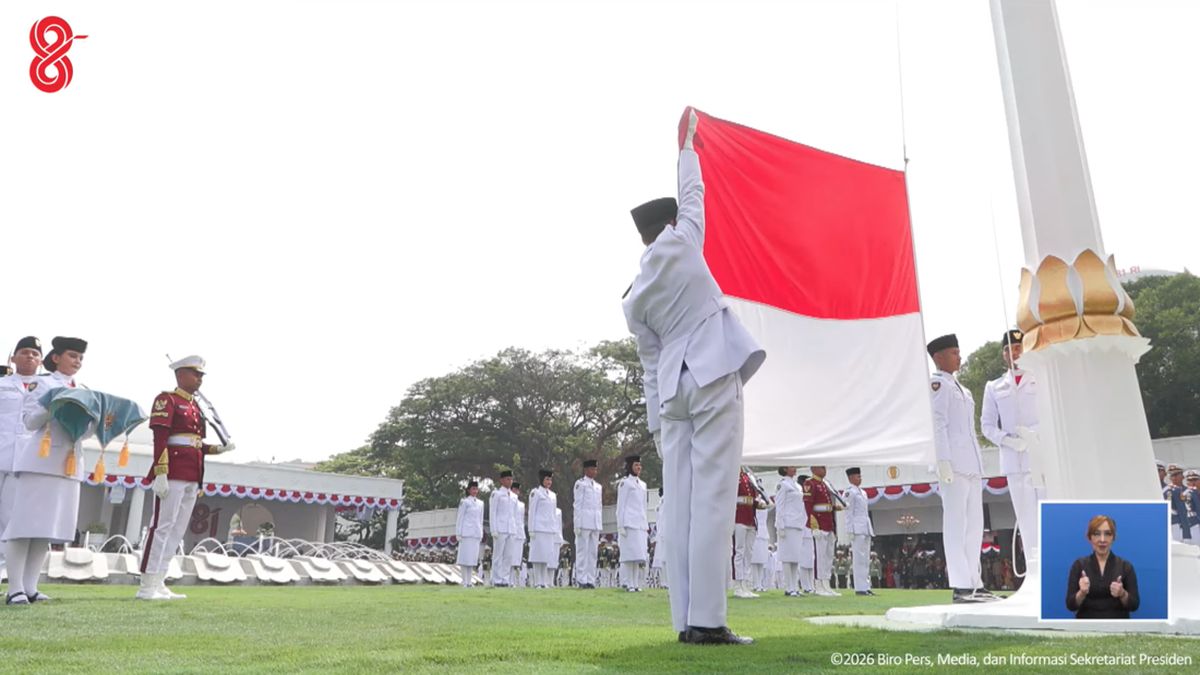
The Red and White flag was officially raised during the 81st Independence Day ceremony at Merdeka Palace in Jakarta on Monday (17/8). The flag-raising procession was one of the main moments in the series of commemorations of Indonesia’s independence.
After the flag-raising troops took their positions, the Red and White flag was carried towards the ceremonial pole. With firm and honourable steps, the flag bearer handed over the Red and White to be hoisted.
The procession took place in a solemn atmosphere. The flag rope was then pulled slowly until the Red and White reached the top of the pole.
As the national anthem Indonesia Raya resounded, the Red and White unfurled and flew in the grounds of Merdeka Palace. Ceremony participants stood upright to honour the flag.
The moment served as a symbol of respect for the struggle of the nation’s founders as well as a reminder that the independence achieved in 1945 must continue to be safeguarded and given meaning.
Not only at Merdeka Palace, the Red and White also flew across various corners of Indonesia, from village yards, mountain peaks, and border areas to spaces far from the stage of state ceremonies.
This year’s 81st Independence Day commemoration carried the theme ‘Sovereign, Just, and Prosperous Indonesia’. The theme is not merely a celebratory slogan but carries a message about the direction that needs to be translated into everyday life.
One interesting development in this year’s independence commemoration was public involvement in determining the visual identity of the anniversary. For the first time, the public was involved through a vote to select the official anniversary logo.
A total of 68,569 votes were cast in the voting held on 24–28 June 2026. The work of Fajar Novario from Padang, West Sumatra, received 30,699 votes, or around 44.73 per cent, and was subsequently designated as the official logo.
The process showed that state symbols can be built through public participation, not solely through bureaucratic decisions.
The choice also demonstrated that a logo is not merely an image. Visual identity carries ideas about unity, diversity, and Indonesia’s future. Fajar and his team developed the design by reflecting on the founders’ perspective on Indonesia’s diversity.
In this context, the symbol of independence needs to be understood as something that continues to move. Its meaning does not stop at form, colour, or numbers.
The Red and White raised on a mountain peak, for example, will have a stronger meaning if accompanied by awareness of protecting the environment. Likewise, the Red and White flying in border areas serves as a reminder of the importance of safeguarding sovereignty while ensuring that communities in the frontier regions experience justice and prosperity.
The Red and White is not merely a piece of cloth raised every 17 August. It is a symbol of willingness to maintain unity, respect diversity, protect living spaces, and deliver justice.
Eighty-one years after the Proclamation, the most important question is no longer how festively Indonesia celebrates its independence. What matters more is how that independence continues to be brought to life in everyday life.
On 17 August 2026 at 10.17 WIB, people across Indonesia were also urged to pause their activities for a moment and stand upright during the 81st Independence Day commemoration. At the same time, the Red and White flag was raised at Merdeka Palace, Jakarta.
The appeal was set out in the Minister of State Secretary’s letter Number B-13/M/S/TU.00.03/08/2026 dated 11 August 2026.
As the Red and White slowly rose to the top of the pole and then flew under the Indonesian sky, the moment once again served as a reminder that independence is not merely an event to be commemorated. Independence is a responsibility that continues to be passed down and given meaning from generation to generation.