
Red and White and the unfinished work
The Red and White flag flies in village yards, on mountain peaks, in border areas, and in spaces far from the stage of state ceremonies.
Behind the various trappings, the 81st anniversary of the Republic of Indonesia’s independence raises a more fundamental question: how is independence understood after Indonesia has been independent for 81 years?
The question matters because independence ceremonies now take many forms. Pacitan Regent Indrata Nur Bayuaji is scheduled to lead the Proclamation Seconds ceremony from Luweng Ombo Cave, while 500 climbers carry the Red and White to Ogal Agil Peak on Mount Arjuno, East Java.
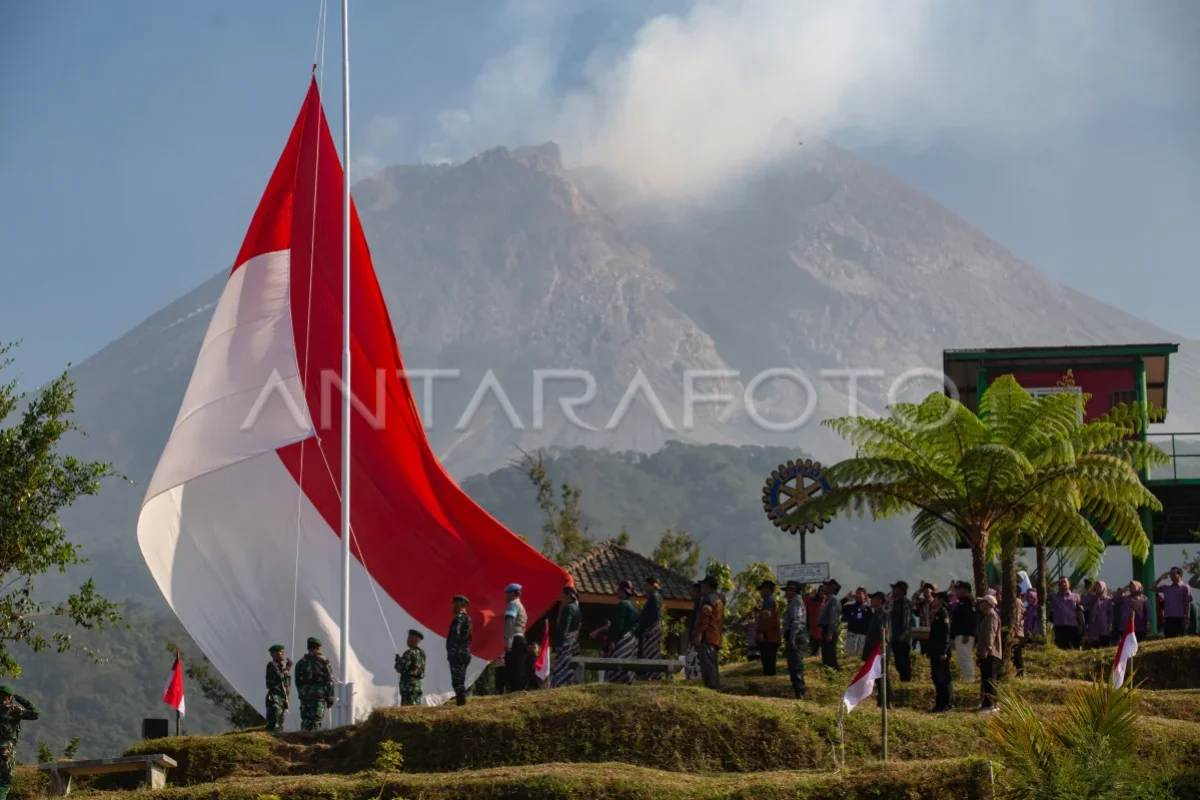
A giant Red and White flag will be raised during a ceremony on the slopes of Mount Merapi, at Bukit Klangon, Cangkringan, Sleman, in the Special Region of Yogyakarta. In border areas, the National Border Management Agency is also holding simultaneous ceremonies at 15 cross-border posts.
The variety of locations shows that the ceremony is no longer merely a ritual centred on government office grounds. It can take place in the depths of the earth, on mountain heights, on border islands, and even inside an aquarium. Ancol, for example, has prepared the raising of the Red and White in a shark aquarium as part of the independence commemoration series.
Such trappings certainly have appeal. However, the festivities must not allow the substance of independence to be pushed aside. Flags, competitions, entertainment stages, parades and ceremonies should serve as entry points for remembering why a nation celebrates its independence.
The theme of Indonesia’s 81st Independence Day this year, ‘Sovereign, Just and Prosperous Indonesia’, provides a fairly clear framework. The theme is not merely a visual slogan but contains a direction that must be translated into everyday life.
Moving symbols
One interesting development in this year’s commemoration is public involvement in determining the visual identity of independence. For the first time, the public was involved through a vote to choose the official Independence Day logo.
A total of 68,569 votes were cast in the voting held from 24 to 28 June 2026. The work of Fajar Novario from Padang, West Sumatra, received 30,699 votes, or around 44.73 percent, and was designated as the official logo. The process shows that state symbols can be built through public participation, not just bureaucratic decisions.
The choice is interesting because a logo is not merely an image. It is a visual language that carries ideas about unity, diversity and the future. Fajar and his team developed the design by reflecting on how the nation’s founders viewed Indonesia’s diversity.
In that context, symbols of independence need to be understood as something that moves. Their meaning must not stop at form, colour or numbers. The Red and White raised on a mountain peak, for example, will have stronger meaning if the activity also strengthens awareness of protecting the environment.
This is evident in Expedition 81 on Mount Arjuno. Besides the flag-raising, the activity includes planting 500 Ficus and mountain pine seedlings, installing fire prevention notice boards, and cleaning hiking trails. Independence is then translated into action to care for living spaces.
Such meaning-making is important to expand. Sovereignty is not only about territory and defence. It is also about the nation’s ability to safeguard water sources, food, biodiversity, living spaces, and the wealth of knowledge that Indonesia possesses.
For that reason, the ceremony at Luweng Ombo Cave also carries an interesting message. The expedition, which took place from 9 to 19 August 2026, carried a mission of exploration, mapping, research, conservation and documentation of the karst area. The independence commemoration is combined with knowledge work and environmental protection.