
Record Purge: Xi Jinping Expels 33 Elites as a Quarter of Officials Disappear
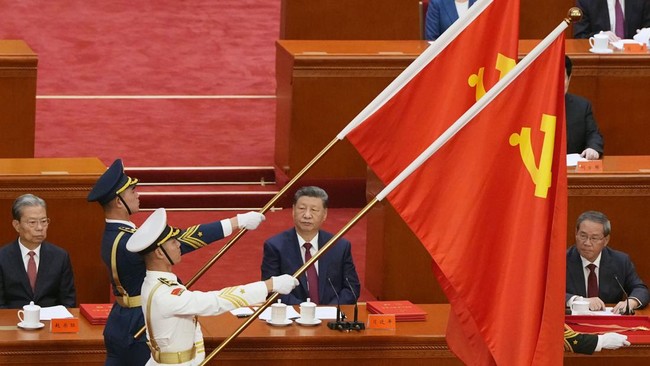
Jakarta, CNBC Indonesia – An unusual scene unfolded at a major meeting of China’s senior officials this week. Many seats were empty, while dozens of officials had been expelled from the Chinese Communist Party (CCP).
The situation highlights how President Xi Jinping is tightening his oversight of party and military officials. The number of officials expelled this time also set a record in the modern history of the meeting.
According to The Guardian, 33 officials were formally expelled from the CCP after their dismissals were ratified at the Fifth Plenum, held from 26 to 29 October 2026.
But that was not the only striking figure.
Of the 376 full and alternate members of the CCP Central Committee appointed in 2022, only 279 attended this meeting.
That means 97 people, or about 25.8% of the original total, were absent. The absence rate was the highest in the modern history of CCP plenary meetings, particularly since the end of Mao Zedong’s leadership.
Some of those absent are known to have been removed through disciplinary action and anti-corruption investigations. Not all the absences, however, have been officially explained.
Attendance has, notably, continued to decline in recent years.
At the Third Plenum in July 2024, 364 Central Committee members and alternate members attended. The figure fell to 315 at the Fourth Plenum in October 2025, before dropping again to 279 in October 2026.
The decline reflects the growing number of officials no longer attending important party meetings, as investigations and disciplinary action have spread through China’s government.
Among the 33 officials whose expulsions were ratified this time were several prominent figures who had previously held important posts.
They included Zhang Youxia, formerly the second-ranking figure in China’s military leadership after Xi Jinping, and Ma Xingrui, former Communist Party secretary in Xinjiang.
Others were Liu Jianchao, a former senior Chinese diplomat; Jin Zhuanglong, a former Minister of Industry; and Yi Huiman, former chairman of the China Securities Regulatory Commission.
Sixteen of the 33 expelled officials were from the military. This shows that the purge has reached not only the civilian government but also the highest ranks of China’s armed forces.
China’s purge of officials grows, setting a new record
Xi Jinping’s campaign to purge party officials is not new.
Since taking office in 2012, he has made fighting corruption one of the government’s main priorities.
But the number of officials expelled at Central Committee meetings has risen sharply in recent years.
According to CNBC Indonesia’s review of official CCP communiqués, the dismissals of 10 officials were ratified at the Fifth Plenum in 2015. At the equivalent meeting in 2020, no ratification of dismissals was mentioned in the official communiqué.
The figure appeared again at the Third Plenum in 2024, when three officials were confirmed as expelled from the party.
A year later, the number rose to 14 at the Fourth Plenum in October 2025.
Now, in October 2026, the number of ratified expulsions has surged to 33, more than double the previous year’s total.
The scale of the purge represents only a small part of China’s anti-corruption and disciplinary efforts over more than a decade.
At a press conference on Friday (30 October 2026), Zhang Fuhai, deputy secretary of the CCP Central Commission for Discipline Inspection, said Chinese oversight bodies had handled 8.105 million cases and sanctioned 7.922 million people since Xi took power in 2012.
Of those, 963 were officials managed and directly supervised by the CCP Central Committee.
These figures illustrate the breadth of China’s enforcement campaign. It has targeted not only lower-ranking officials but also people holding important positions in government and the party.
However, the millions of people sanctioned were not all dismissed or imprisoned. Disciplinary measures vary according to the nature and severity of the offence.
China, notably, appears to have no plans to ease the campaign.
At the Fifth Plenum, which ended on Thursday (29 October 2026), the CCP agreed on four main priorities for strengthening its anti-corruption drive: intensifying the fight against corruption; tightening oversight of power; fostering an anti-corruption culture; and strengthening systems to prevent corruption.
These measures show that fighting corruption remains one of Xi Jinping’s main priorities after nearly 14 years in power.
For the Chinese government, enforcing discipline is seen as essential to strengthening the party and ensuring that central government policies are implemented by officials at every level.
The widening purge, however, has also raised questions about its impact on China’s leadership structure.
Neil Thomas, a senior fellow at the Asia Society, said the growing number of empty seats at the meeting reflected Xi’s focus on enforcing internal party discipline.
Other observers have questioned whether the campaign is aimed solely at fighting corruption or is also being used to remove officials considered disloyal to Xi’s leadership.
Whatever the debate, the effects of these sweeping changes are beginning to show in China’s military leadership.
The Central Military Commission, the highest body in command of the People’s Liberation Army, had seven members appointed in 2022.
Following a series of dismissals, only two remain: Xi Jinping and Zhang Shengmin.
Zhang Shengmin, who plays an important role in overseeing discipline and anti-corruption efforts in the military, was promoted at this week’s meeting.
He was appointed to the CCP Politburo, one of the party’s highest decision-making bodies. With his appointment, Zhang is now the only military representative on the Politburo.
These major changes are unfolding as China begins preparations for the 21st CCP National Congress, scheduled for the second half of 2027.
Held every five years, the congress will give the CCP an opportunity to renew its leadership, including the membership of the Central Committee and Politburo.
Xi is expected to continue in office for a fourth term, extending his tenure as China’s longest-serving leader since Mao Zedong.
Nevertheless, the large number of officials removed also presents challenges.
Some analysts say a purge on such a wide scale could leave a more limited pool of qualified officials available to fill important posts.
That issue is becoming increasingly pressing ahead of the 2027 leadership changes. Vacant positions will need to be filled by officials capable of implementing government policy and winning the confidence of the party leadership.
China’s challenge, therefore, will be not only to sustain its anti-corruption campaign but also to ensure that the wholesale replacement of officials does not disrupt government operations or national decision-making.
This is especially important as China faces economic and geopolitical challenges that require coordination and decisions from its top leadership.
The 2027 CCP National Congress will therefore be a key moment for seeing how Xi Jinping reshapes the leadership after the wave of dismissals in recent years.
Source: jawawa.id (https://jawawa.id/newsitem/record-purge-xi-jinping-expels-33-elites-as-a-quarter-of-officials-disappear-1793368269)
Originally published by CNBC Indonesia (https://www.cnbcindonesia.com/research/20261030130000-128-780914/rekor-baru-xi-jinping-pecat-33-elite-seperempat-pejabat-menghilang), translated from Indonesian