
Reasons why US space companies withdrew from Paris Summit
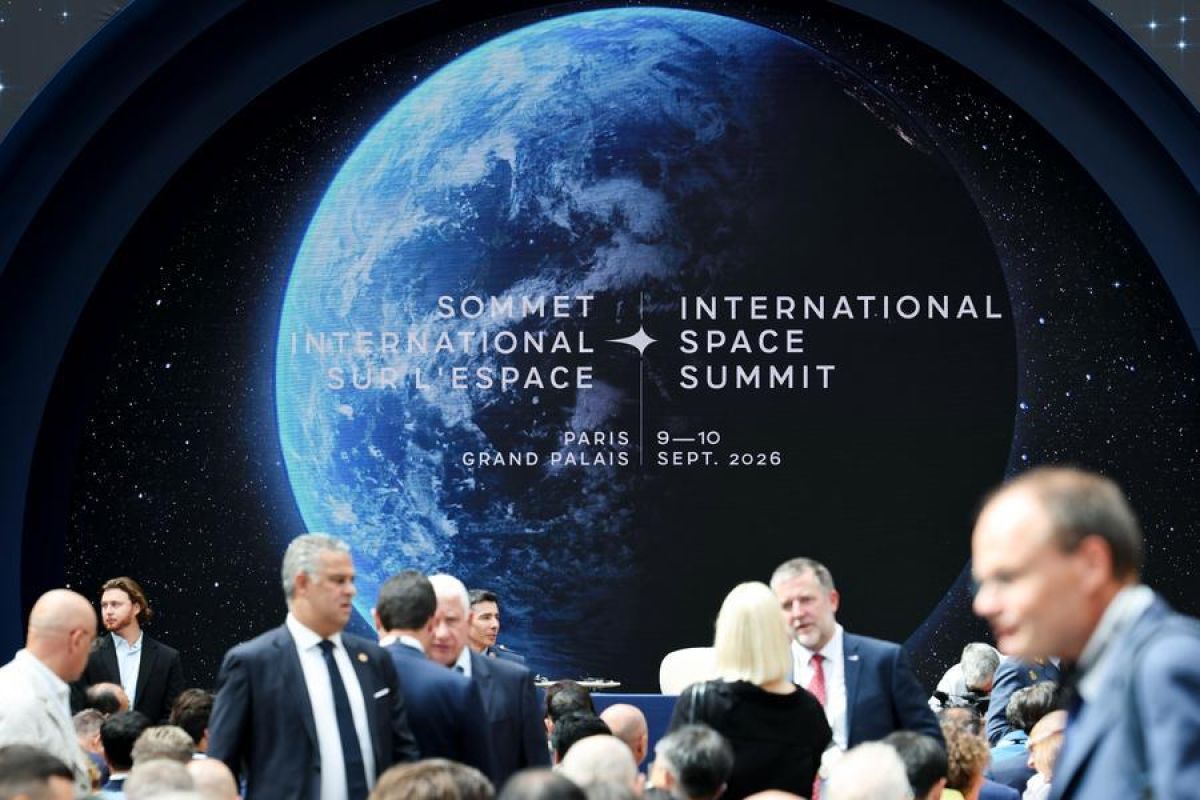
Paris (ANTARA) - The first International Space Summit opened on Wednesday (9/9), with nearly 120 foreign delegates discussing the future of space, ranging from security and regulation to commercial development.
However, several major United States (US) space companies were absent after reports emerged that they had faced pressure from the US government.
The withdrawal of these companies reflects increasing competition within the space industry, where Washington is attempting to maintain US superiority in space, while Europe seeks to achieve greater autonomy.
Withdrawal Under Pressure
A French space ministry official stated that SpaceX, Blue Origin, rocket manufacturer Stoke Space, and the space data centre startup Starcloud had informed French authorities regarding the cancellation of their participation in the summit.
Politico previously reported that the White House Office of Science and Technology Policy (OSTP) had urged several US space companies not to attend the event, warning that participation could be perceived as support for European policy positions.
According to Politico sources, OSTP officials told industry representatives that France had not coordinated with the US regarding the summit, accusing France of anti-competitive practices and claiming that the event’s discussion panels were not designed to include American perspectives and could undermine the efforts of the US industry.
“We certainly want to continue working with our partners and allies in the US, even though changes in strategic direction and political pressure sometimes make this task complicated without necessary reason,” said a spokesperson for the French Ministry of Higher Education, Research, and Space.
“America is not only welcome, we want you to be there,” said Philippe Baptiste, the French space minister, on the X platform. “Do not be afraid of multilateralism,” he added.
Director of the Foundation for Strategic Research, Xavier Pascro, stated in an interview with the Belgian public broadcaster RTBF on Wednesday that the absence of major US companies was influenced by political factors, as the European Union (EU) is preparing its Space Act.
“The new law will establish a framework for the governance of space activities, and the US also wants to have a say in the setting of these new rules. Therefore, there is an aspect of symbolic confrontation,” said Pascro.
“Space is affected by geopolitical upheaval,” said Thomas Pesquet, the French astronaut serving as Macron’s special envoy for the summit, in an interview with the French television channel TF1 on Tuesday (8/9).
Space Competition
The withdrawal occurred shortly after US President Donald Trump posted an image on the Truth Social platform featuring the text “THE MOON IS OURS” alongside the US flag.
In December 2025, Trump signed an executive order titled “Ensuring American Space Superiority,” which calls for the US to return citizens to the Moon by 2028, laying the foundation for economic development on the Moon and preparing for journeys to Mars.
Senior space editor at Ars Technica, Eric Berger, noted that one of the motivations for the withdrawal of these US companies was that US policy officials view the commercial space industry as one of America’s key strengths that must be protected.
A space company official attending the summit linked the withdrawal to Trump’s attitude towards Europe and Macron. “This is very typical of Trump,” the official said. “Trump likes to belittle Europeans… and even more so Macron, who somehow represents European ‘leadership’.”
At the same time, France and other European nations are working to strengthen Europe’s own space capabilities and reduce dependence on the US.
“The positive side is that we are diversifying our partnerships worldwide and investing in our space industry. It is not about separating ourselves, but rather seeing what we can achieve with other partners,” said a space official.
French Member of the European Parliament Christophe Grudler, who is involved in drafting the EU Space Act, stated that if other players in the space sector showed a more cooperative attitude, they “would certainly receive credit.”
One area of tension is satellite communications. Edward Northmore wrote in Tech Times that the EU’s IRIS² satellite programme is one of the reasons why the OSTP accuses France of “anti-competitive practices.”
He noted that Europe’s efforts to strengthen sovereignty in the satellite sector could pose a commercial challenge to SpaceX’s position in the satellite-based broadband services market.
A CEO of a satellite company told Politico that the two main issues at stake relate to access to two limited resources: orbit and spectrum, in a context where SpaceX maintains a policy of total dominance over both.
“Therefore, it is not surprising that Europe wants to focus on this area, and it is not surprising that the US government responds with a boycott,” the CEO added.