
Reasons for Unstable Weather in Indonesia: Scorching Heat Followed by Heavy Rain
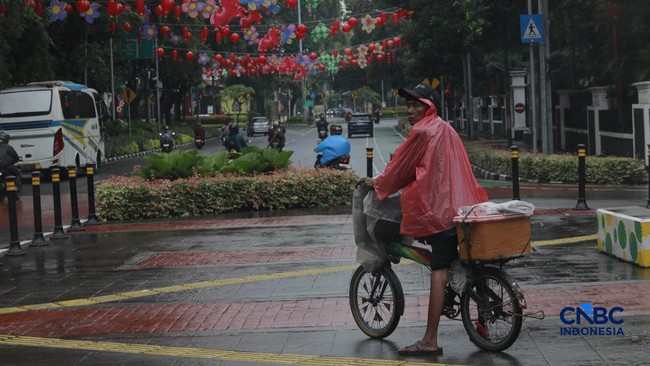
Predictions from the BMKG regarding a prolonged dry season due to the El Niño phenomenon, which could reach ‘Godzilla’ levels, are increasingly discussed. However, several regions in Indonesia are still frequently lashed by rain. So, why is this happening?
Dosen from the Department of Geophysics and Meteorology at IPB University, Sonni Setiawan, explained that this condition is still considered normal. Currently, Indonesia is in the transitional season or pancaroba period, meaning the weather patterns are not yet stable.
‘Because this is still pancaroba, and the start of the season is not uniform across all regions of Indonesia,’ Sonni stated in his comments, quoted on Thursday (9/4/2026).
He said that the ongoing rain does not mean the dry season prediction is off track. Indications of moving towards the dry season are still evident, one of which is the rise in sea surface temperatures in the central and eastern Pacific Ocean.
This temperature rise serves as an early signal for the development of the El Niño phenomenon, which has the potential to suppress rainfall in Indonesia. Even based on BMKG projections, this year’s dry season is estimated to last longer, around six months.
Not only that, the start of the dry season is also predicted to arrive earlier, especially in Java, which usually enters the dry season in July.
‘This rise in sea surface temperature impacts the reduction in cloud formation in Indonesia,’ he explained.
Could It Be More Extreme?
Sonni explained that El Niño and La Niña are large-scale ocean-atmosphere interaction phenomena that affect tropical air circulation, known as the Walker Circulation. These phenomena generally occur every 4-5 years.
Meanwhile, the term ‘El Niño Godzilla’ refers to a super El Niño condition, where sea surface temperatures in the Pacific rise much higher than a normal El Niño, even reaching above 2.5 degrees Celsius. This extreme phenomenon was recorded in 1982, 1997, and 2015, triggering global impacts such as severe droughts to forest fires.
However, for now, he assesses the strength of El Niño as still at a weak to moderate level. ‘Honestly, its strength is still weak to moderate,’ he said.
In his analysis, Sonni also mentioned the possibility of a link between strong El Niño and sunspot activity. Based on historical data, super El Niño often occurs after the peak of sunspot activity.
With the sunspot peak estimated to occur in 2025, the potential for a strong El Niño in 2026 is considered open. Nevertheless, he emphasised that this finding still requires further study.
Amid these conditions, the public is urged to continue referring to official information and to understand that the current weather is part of the complex dynamics of the seasonal transition.
Source: jawawa.id (https://jawawa.id/newsitem/reasons-for-unstable-weather-in-indonesia-scorching-heat-followed-by-heavy-rain-1775721058)
Originally published by CNBC Indonesia (https://www.cnbcindonesia.com/lifestyle/20260409123403-33-725283/alasan-cuaca-di-ri-labil-panas-mendidih-lalu-hujan-lebat), translated from Indonesian