
Reasons Behind IHSG's Surge of Nearly 2% to 7,445
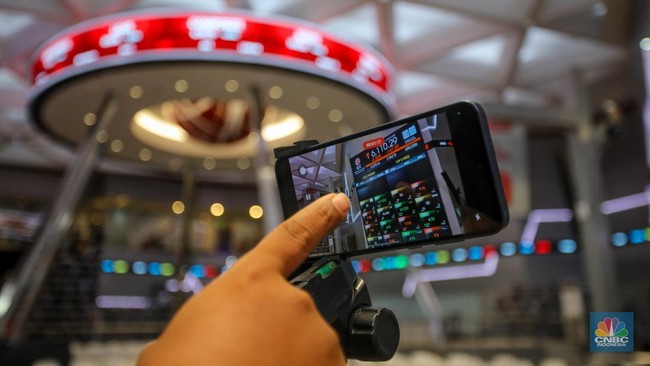
Jakarta, CNBC Indonesia - The Composite Stock Price Index (IHSG) surged nearly 2% this morning, Friday (10/4/2026). In the early first trading session, the index rose 1.87% to 7,445.38, or strengthened by 120 points.
This increase continues the IHSG rebound that has been ongoing for the past two days, starting when the index sharply surged during Wednesday’s trading (8/4) with a rise of more than 4%.
164 stocks fell, 377 rose, and 176 were unchanged. Transaction value reached Rp 2.66 trillion, involving 7.76 billion shares in 352,649 transactions.
Market capitalisation was also pulled up to Rp 13,171 trillion.
Quoting Refinitiv data, all trading sectors recorded gains today, with the highest increases booked by the infrastructure, energy, and basic materials sectors.
Shares of conglomerate issuers and large-cap blue-chip issuers were recorded as the main drivers of the IHSG’s performance today.
Barito Renewables Energy (BREN) shares became the main engine driving the IHSG with a contribution of 10 index points. Shares of the Barito Group owned by Prajogo Pangestu were compactly strengthening in today’s trading.
Other issuers that became the main drivers of the IHSG’s performance today include DSSA from the Sinar Mas Group, TPIA from the Barito Group, and coal mining issuer Bayan Resources (BYAN) owned by Low Tuck Kwong.
Indonesia’s financial markets will close trading this week today. Market players need to consider several developing sentiments, from the war in the Middle East to important economic data.
Asia-Pacific stock markets opened mostly stronger on Friday’s trading (11/4/2026), amid a fragile two-week ceasefire between the United States and Iran that keeps market players vigilant.
Citing CNBC, the conflict in the Middle East, which has lasted more than a month, still overshadows sentiment, especially due to the closure of the Strait of Hormuz, a vital global energy route.
Although a ceasefire has been announced, traffic in the Strait of Hormuz remains very limited. Iran stated it would reopen the route if all attacks against its country are stopped, while Israel is also reported to have approved the agreement.
US President Donald Trump previously halted attacks on Iran on Tuesday as part of efforts to ease the conflict. However, he warned Iran not to impose fees on oil tankers passing through the strait.
On the other hand, Iran’s Parliament Speaker Mohammad Bagher Ghalibaf accused the United States of violating the ceasefire agreement. This accusation further adds to uncertainty in global markets.
From the stock markets, South Korea’s Kospi index strengthened 1.68% and Kosdaq rose 1.14%. In Japan, the Nikkei 225 jumped 1.65%, while the Topix moved relatively flat.
Japanese Prime Minister Sanae Takaichi stated that her country plans to release oil reserves for 20 days starting in May. Japan is known to have oil reserves sufficient for 230 days as of 6 April.
In contrast, Australia’s S&P/ASX 200 index weakened 0.51%. Meanwhile, Hong Kong’s Hang Seng futures contract was at 25,900, higher than the previous close at 25,752.40.
Global oil prices are still moving upwards, with West Texas Intermediate (WTI) strengthening 0.69% to US$98.55 per barrel. Meanwhile, Brent crude rose 0.91% to US$95.92 per barrel, after briefly breaking through the US$100 per barrel level in the previous session.
In last night’s trading on Wall Street, US stock indices closed higher although oil prices had fallen from their highest levels. This rise reflects investor optimism towards the easing of geopolitical conflict.
The S&P 500 index rose 0.62% to 6,824.66, while the Nasdaq Composite strengthened 0.83% to 22,822.42. The Dow Jones Industrial Average also rose 275.88 points or 0.58% to 48,185.80, while returning to positive performance throughout the year.