
Reasons Behind IHSG's Sudden 1% Drop After Opening Up 1%
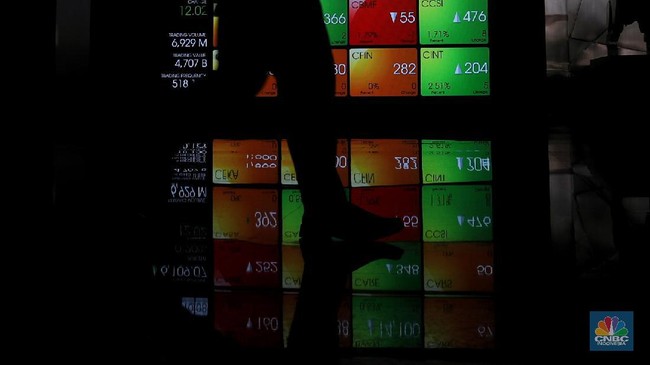
Jakarta, CNBC Indonesia — The Composite Stock Price Index (IHSG) suddenly reversed direction after 15 minutes of opening today, Tuesday (12/5/2026). At the opening, the IHSG surged strongly and even rose 1% at one point. However, by 09:16, the IHSG turned around and plunged to the level of 6,831.84, or down 1.07%. On a sectoral basis, the technology sector became the biggest drag with a correction of 3.43%, followed by utilities -2.85%, primary consumer -1.46%, healthcare weakening 1.44%, and non-primary consumer down 0.84%. From the stock perspective, PT Mora Telematika Indonesia Tbk (MORA) became the biggest weight on the IHSG with a contribution to the decline of 24.2 index points. MORA shares initially surged strongly with an increase of more than 15% and became the main driver of the IHSG. However, not long after, MORA plummeted to touch the lower auto-reject limit (ARB) of 15% at the level of 7,650. Next, there is PT Bank Central Asia Tbk (BBCA) which pressured the index by 7 points, PT Barito Renewables Energy Tbk (BREN) by 5.9 points, and PT Astra International Tbk (ASII) by 4.99 points. Big-cap banking shares also uniformly entered the red zone. PT Bank Mandiri (Persero) Tbk (BMRI) pressured the IHSG by 3.91 points, while PT Bank Rakyat Indonesia (Persero) Tbk (BBRI) contributed to the weakening by 3.14 points. Market participants tended to engage in selling actions and a wait-and-see stance ahead of the MSCI review announcement scheduled for today. The market is concerned that Indonesia may experience another reduction in weight in the global MSCI index, which could trigger an outflow of foreign funds. Ahead of the announcement, regulators to market participants unanimously assess that Indonesia’s capital market reforms do have the potential to trigger short-term pressure, but are believed to have a positive impact in the long term. Chairman of the Financial Services Authority (OJK) Board of Commissioners Friderica Widyasari Dewi said that they are still awaiting the MSCI announcement results, while emphasising that the capital market reform steps taken by the regulator are part of efforts to strengthen market integrity. “Even if there is short-term adjustment, we see this as short-term pain. But Insya Allah long-term gain,” said Friderica at the Indonesia Stock Exchange (BEI) Building, Monday (11/5/2026). The Indonesia Stock Exchange acknowledges the potential for a decline in Indonesia’s weight in MSCI in the short term if no new stocks enter the index. “If that is done by MSCI and no new stocks enter MSCI, in the short term Indonesia’s weight may decline. But that is short-term pain for long-term gain,” said Jeffrey. BEI emphasised that capital market reforms will continue, including encouraging an increase in issuers’ free float to meet global standards. In addition to domestic factors, global sentiment is still weighing on emerging markets after the strengthening of the US dollar and the rise in US government bond yields, making investors tend to reduce exposure to risky assets. Although the IHSG is under pressure, several stocks still serve as supports for the index. PT Merdeka Gold Resources Tbk (MDKA) became the main driver with a contribution to the increase of 2.58 index points. Followed by PT Dian Swastatika Sentosa Tbk (DSSA), PT Chandra Asri Pacific Tbk (TPIA), and PT Pacific Strategic Financial Tbk (APIC). Meanwhile, the rupiah exchange rate started trading this morning at a historic weakening level as it has reached Rp17,500/US.ReferringtoRefinitivdata, theGarudacurrencyexperiencedaweakeningtothelevelofRp17, 500/US at 9:15 WIB. Where at the opening, the Rupiah opened in the red zone with a weakening of 0.43% to the level of Rp17,480/US$. The DXY at opening was also observed strengthening 0.21% to the position of 98.115. This was triggered by US President Donald Trump who said the ceasefire with Iran is now “on the brink” after Tehran rejected Washington’s proposal to end the war. Iran demands an end to the conflict on all fronts, including in Lebanon, compensation for war damage, lifting of the US sea blockade, guarantees of no further attacks, and restoration of its oil exports. Tehran also emphasised its control over the Strait of Hormuz, a route that usually carries around 20% of the world’s oil and gas supply. Trump called Iran’s response “completely unacceptable” and said the ceasefire in effect since 7 April is now very fragile. Iran asserts its demands are legitimate, while Parliament Speaker Mohammad Baqer Qalibaf warned that Iran’s military is ready to respond to any aggression.