
Realising an Inclusive Jakarta for All Generations
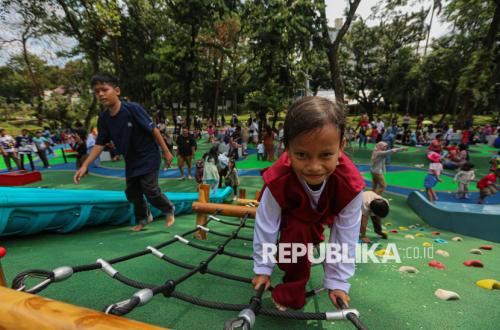
Morning at the Green Open Space (RTH) in Kampung Kalibata, Srengseng Sawah, Jagakarsa, South Jakarta, is bustling with footsteps. Children play, adults exercise, and elderly residents stroll around the park.
For Aminah (66), a local resident, the park provides an additional option for exercising close to home. Before RTH Kampung Kalibata opened, she often went to the Setu Babakan area. “It is nicer for exercise, especially since it is also close to home,” Aminah said on Thursday (23/7/2026).
RTH Kampung Kalibata was inaugurated by Jakarta Governor Pramono Anung on 24 October 2025. The 5,328-square-metre park is located next to the pre-existing Citra Betawi Child-Friendly Integrated Public Space (RPTRA). The area is designed as a public space with ecological, social, and educational functions. “So there are more choices. Every morning, many people run and walk. The elderly, adults, children, everyone is there,” Aminah added.
The existence of a park used across generations is one of the city’s development goals. A city must not only provide roads, buildings, and transportation but also spaces that can be used safely by children, adults, and the elderly. Aminah also utilises the elderly health post (Posyandu Lansia) routinely held at the neighbourhood association (RW) office. There, senior residents can check their blood pressure and blood sugar levels while receiving information about their health conditions.
For children, public spaces serve a different function. Dede (37), another resident, said the RPTRA provides a safer place to play compared to streets or open areas lacking supervision and child-friendly facilities. “It is good. There are more safe places to play,” Dede said.
Jakarta currently has 324 Child-Friendly Integrated Public Spaces spread across various areas. These facilities are not only for playing but also for learning, sports, and family interaction. Governor Pramono Anung stated that Jakarta has consistently been recognised as a Child-Friendly Province since 2022. However, he stressed that this title must be reflected in services that children and families truly feel. “The DKI Jakarta Provincial Government will continue to ensure that Jakarta is truly a child-friendly city. Since 2022, Jakarta has been one of the provinces that consistently achieves the Child-Friendly Province title,” Pramono said during the 42nd National Children’s Day commemoration at City Hall.
The DKI Provincial Government is strengthening child protection through education, public spaces, care services, and violence prevention. These programmes include the Jakarta Smart Card Plus, diploma legalisation, 13-Year Compulsory Education, and Free Private Schools. For the 2026/2027 academic year, the Free Private School programme involves 103 schools at the elementary, junior high, senior high, vocational, and special needs levels, with a capacity of 10,109 new students. “For children living in Jakarta, as a child-friendly city, I hope you take advantage of the opportunity to study seriously,” Pramono said.
The DKI Provincial Government also provides childcare services and a 24-hour Women and Children Protection Centre. The Chairman of the Indonesian Child Protection Agency, Seto Mulyadi, assessed that these policies demonstrate a commitment to children’s best interests.
On the other side, Jakarta is also facing a demographic shift. Approximately 1.16 million residents, or 10.6 percent of the total population, are elderly. This number means the needs of senior citizens must be incorporated into city planning, from health and social protection to transportation and spaces for social interaction. As of June 2026, the Jakarta Elderly Card (Kartu Lansia Jakarta) had been distributed to 168,497 eligible residents. The DKI Provincial Government also provides Elderly Health Posts, Integrated Elderly Clinics, and home health visits through the ‘Pasukan Putih’ (White Troops) programme. Up to the second quarter of 2026, Pasukan Putih had conducted 59,023 visits to vulnerable groups, achieving 96.86 percent of the target. This service is crucial for elderly residents with chronic illnesses or mobility limitations that make visiting health facilities difficult.