
Realising a Digital Transformation That Is ‘Connected, Growing and Protected’
Internet penetration statistics, startup investment figures and enforcement action against harmful content need to be turned into tangible benefits for the public.
Denpasar (ANTARA) - The government of President Prabowo Subianto and Vice-President Gibran Rakabuming Raka has completed two years in office. The anniversary is not only an occasion for gratitude, but also an opportunity to assess Indonesia’s digital transformation.
One of the Red and White Cabinet’s Asta Cita priorities is to accelerate the country’s digital transformation. This strategic programme involves collaboration across ministries and agencies, including the Ministry of Communication and Digital Affairs.
The second anniversary of President Prabowo Subianto and Vice-President Gibran Rakabuming Raka coincided with Bali Tech Week, held from 19 to 23 October 2026 by the Ministry of Communication and Digital Affairs (Komdigi).
The timing of the two events was no mere coincidence. With more than 900 business meetings, Bali Tech Week brought together start-ups, investors and technology companies from various countries.
The event featured 13 main agenda items covering artificial intelligence (AI), start-up development, the gaming industry, cyber security, investment, digital infrastructure and the future direction of digital economy policy. Organisers also targeted participation by more than 4,000 people from around the world.
Key and urgent issues addressed included expanding internet access across Indonesia, accelerating digital economic growth, improving the quality of digital talent and ensuring public safety in cyberspace.
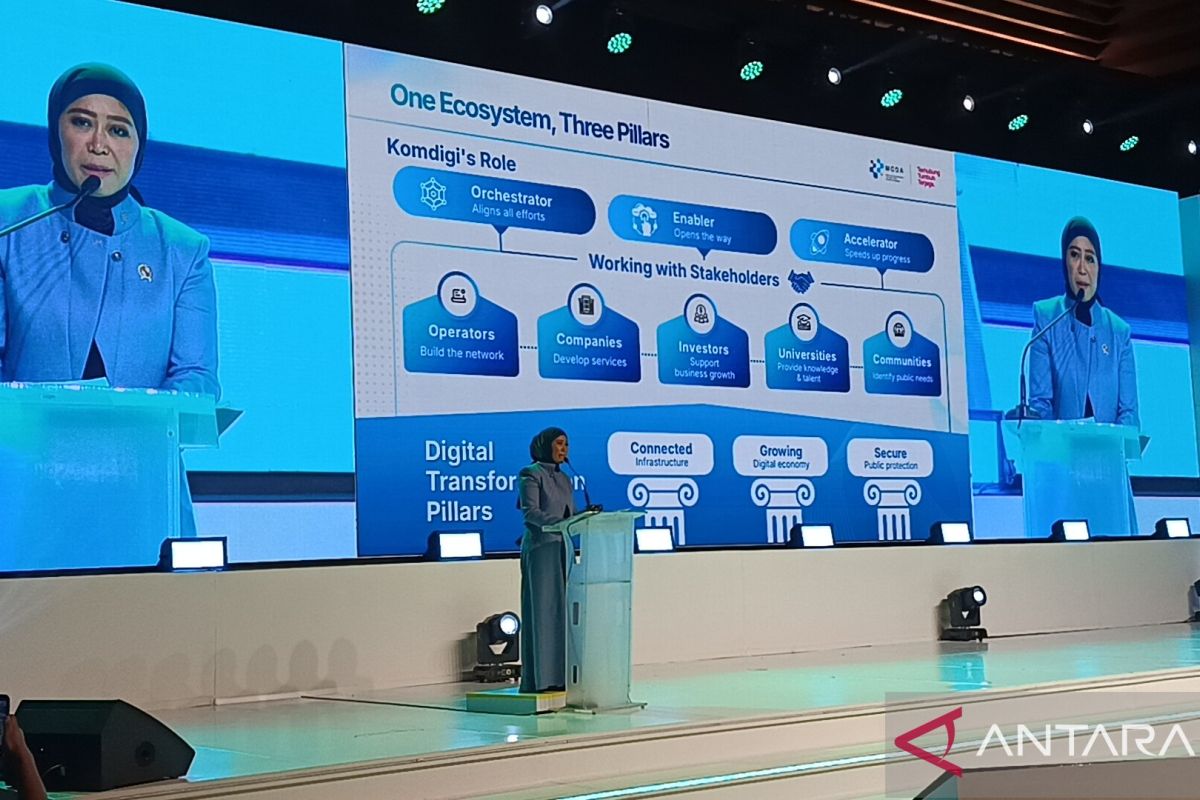
In response to these challenges, Communications and Digital Minister Meutya Hafid said the development of the national digital ecosystem would rest on three main pillars: “Connected, Growing and Protected”.
The three keywords reflect a government policy direction that seeks not only to expand networks, but also to ensure connectivity drives economic growth and delivers tangible benefits to the public.
“Our main task is no longer just to build connectivity in Indonesia, but also to ensure that this connectivity translates into growth—whether in the economy, society or the improvement of public services,” Meutya said at the Bali Tech Week 2026 forum in Bali.
Meutya said the connectivity pillar had seen internet access reach around 235 million people in Indonesia, with penetration at 81.72 per cent.
Meanwhile, 4G networks covered 98.96 per cent of the population, with average mobile broadband speeds of 84 Mbps. Average fixed broadband speeds stood at 67 Mbps.
The government aims to increase fixed broadband speeds to 100 Mbps by 2029, while narrowing the gap in internet quality between Java and eastern Indonesia.
To meet that target, the government is opening up the 1.4 GHz frequency spectrum for Fixed Wireless Access (FWA) technology. The technology is expected to provide internet speeds of up to 100 Mbps at affordable monthly prices of between Rp100,000 and Rp150,000.
The use of the 700 MHz and 2.6 GHz spectrum is also intended to expand networks, including 5G, into rural areas. Komdigi is also exploring cooperation with the Ministry of Energy and Mineral Resources to use electricity infrastructure to support telecommunications networks.
Expanding access is a crucial foundation for digital economic growth. However, the government still faces the challenge of ensuring people make optimal use of connectivity in education, entrepreneurship, public services and innovation.