
Reading the Reasons Behind Purbaya's Dismissal and the Direction of Fiscal Policy Under Suahasil's Leadership
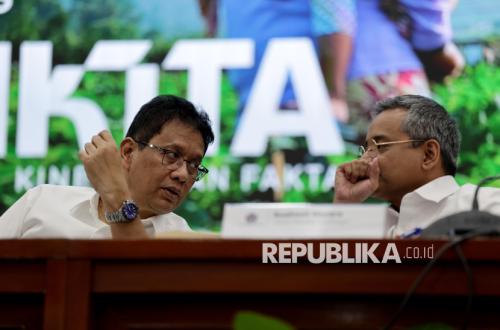
REPUBLIKA.CO.ID, JAKARTA – The abrupt removal of Purbaya Yudhi Sadewa from the position of Finance Minister by Indonesian President Prabowo Subianto on Monday (14/9/2026) has raised questions. The immediate inauguration of Suahasil Nazara on the same day has also led the public to speculate about the direction of fiscal policy going forward.
Economist Josua Pardede takes the view that the replacement of Purbaya with Suahasil is more appropriately read as a recalibration of fiscal management, rather than a total change in the government’s economic direction.
“(This is because) the Government has not openly conveyed one specific official reason why Purbaya was replaced. Therefore, we need to distinguish between official facts and interpretations of the series of dynamics that preceded it,” Josua told Republika on Tuesday (15/9/2026).
What is confirmed is that the President replaced Purbaya and appointed Suahasil, while Suahasil immediately stated that the President’s mandate to him as Finance Minister of the Republic of Indonesia is to safeguard the health and credibility of the state’s finances.
However, looking at the sequence of developments, Josua sees an accumulation of problems on three levels at once, namely policy consistency, communication, and perceptions of fiscal discipline. Among the points highlighted is Purbaya’s leadership style, popularly referred to as the ‘cowboy style’.
“Purbaya’s very direct style frequently opened up areas of difference with the internal workings of the Finance Ministry, other economic ministries, government agencies, economists and the media. He also criticised changes to a number of policies that were deemed to shift too quickly, thereby reducing certainty for economic actors,” he explained.
Josua said this matters because the position of Finance Minister differs from a sectoral ministry. A single statement regarding the deficit, government cash, taxes, debt, or state-owned enterprise (SOE) dividends can immediately translate into a shift in risk perceptions towards the rupiah and government securities (SBN).
“There is also the dynamic of central-regional fiscal relations and Danantara. Complaints from regional governments regarding Transfers to Regions (TKD) and communication with the regions were seen as one source of pressure, whilst the plan to request around Rp 120 trillion in dividends from Danantara was questioned because it was deemed not to align with the initial design of Danantara’s management of SOE dividends,” he revealed.
Josua stressed that this is indeed not the President’s official explanation for the replacement. However, in political-economic terms, this sequence points to a larger problem, namely the need for clearer boundaries between the financing needs of the state budget (APBN), Danantara’s independent management, and the government’s fiscal obligations.
The next factor, Josua continued, is the need to restore policy certainty in the eyes of the market. Purbaya’s tenure took place amid concerns over the widening deficit, the weakening rupiah, differences of approach with the central bank regarding liquidity support, and the downgrading of Indonesia’s rating outlook by Fitch and Moody’s due to policy uncertainty and spending plans.
“Suahasil’s appointment was subsequently widely read by market players as an effort to bring about more stable and predictable management. So, in my view, this replacement is not merely a matter of Purbaya being too aggressive in pushing growth. The more fundamental issue is whether that growth push remains within a policy framework that is consistent and credible,” he explained.