
Reading the Pressure on the Rupiah Proportionally
Note: This article reflects the author’s personal opinion and does not reflect CNBCIndonesia.com’s Editorial Board.
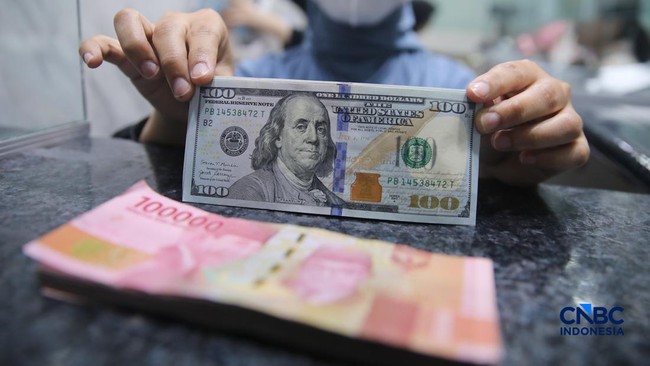
Whenever the rupiah breaches a new psychological level, an old pattern always returns: a series of comments equating today’s conditions with the 1998 monetary crisis. Recently, several economists have openly projected the rupiah could breach Rp22,000 and even Rp25,000 per US dollar in the second half of 2026, with the IHSG at risk of plunging to the 5,000s. This narrative spreads quickly on social media, is picked up by the public, and helps shape market expectations.
I will not claim that the rupiah is fine. The pressure is real: as of 18 May 2026, JISDOR records the rupiah at Rp17,666, the weakest level since Bank Indonesia’s data series began in 2013, while foreign exchange reserves have fallen by USD 10.3 billion since the end of 2025 to USD 146.2 billion.
But comparing today’s situation with 1998 is misleading, and that error is dangerous. Not because the comparison harms the economy’s image, but because a wrong diagnosis will yield wrong policy prescriptions, while worsening conditions through market-expectation channels.
Three claims that frequently appear, and why all three are not balanced
Claim one: the rupiah has breached its record low, just like in 1998. In fact, during the 1997-1998 crisis the rupiah collapsed from Rp2,380 per dollar in June 1997 to around Rp17,000 on 22 January 1998 — a depreciation of more than 80 percent since the rupiah was floated on 14 August 1997. Even by mid-June 1998, the rupiah tumbled to Rp16,000 from Rp8,000 in early May, a 50 percent collapse in just six weeks.
Compare with current conditions: from the start of 2026 to 18 May, the rupiah has weakened by about 5.96 percent. The scale and speed are vastly different. What is often forgotten is that the ‘weakest record’ on JISDOR applies only to data series since 2013, not across Indonesia’s entire history. Comparing nominal exchange-rate figures across decades without factoring in inflation and the economic base is a basic analytical error that serious economists should not commit.
Claim two: Indonesia’s debt burden is out of control, the same as in 1998. It is true that Indonesia faces a debt wall of Rp833.96 trillion in 2026 according to ISEAI analysis, with interest payments of Rp599.44 trillion, bringing total obligations for the year to Rp1,433 trillion. This figure is large, and the fiscal structure deserves critique.
But the context is very different from 1998. At that time, Indonesia’s fundamental problem was private, dollar-denominated debt that was unhedged and unmonitored by authorities. In March 1998, of total external debt of USD 138 billion, USD 72.5 billion was private debt, two-thirds of which had short maturities, with around USD 20 billion due in the same year, while foreign-exchange reserves stood at only USD 14.44 billion.
When the rupiah fell, private debt burdens automatically surged and the banking sector collapsed: the liquidation of 16 banks in November 1997, conducted without a deposit guarantee, triggered panic and mass withdrawals, forcing the government to inject Bank Indonesia Liquidity Assistance (BLBI) up to Rp144.5 trillion to 48 banks.
Today, the government’s debt structure is dominated by rupiah-denominated government bonds (SBN) at 70.49% of total stock, with foreign-currency SBN only 17.27%. Foreign ownership of SBN stands at 12.87% as of April 2026.
The currency-mismatch risk that was the structural trigger of the 1998 crisis is now far smaller. Private foreign debt is now required to be reported to Bank Indonesia, something that did not exist in the pre-crisis era. Comparing these two situations is like equating a mild fever with pneumonia simply because both involve body temperature.
Claim three: foreign exchange reserves keep shrinking; Indonesia is heading for a foreign currency liquidity crisis. Indeed, foreign exchange reserves fell by USD 10.3 billion since the end of 2025, from USD 156.5 billion in December 2025 to USD 146.2 billion at the end of April 2026.
This decline needs monitoring. But in 1998, Indonesia’s foreign reserves were only USD 14.44 billion, with external debt six-and-a-half times reserves. Today, reserves cover roughly six months of imports, well above the international adequacy standard of three months of imports.
Indonesia also has bilateral swap arrangements with several major central banks, instruments that did not exist in 1998. The decline in reserves is the cost of interventions consciously chosen by BI, not a sign of exhausted ammunition.
Patterns of argument to be wary of
Beyond specific claims, there are recurring rhetorical patterns among commentators who equate today’s conditions with 1998. First, they mix nominal measures with real measures. The Rp17,666 exchange rate today compared with Rp16,500 in the budget assumption is treated as a major miss, when in percentage terms the gap is only 7.1 percent — a difference that can still be absorbed via the APBN-Perubahan mechanism.
Second, they ignore composition. Citing ‘debt obligations of Rp1,433 trillion’ without distinguishing that the figure comprises Rp833.96 trillion in maturing principal that can be rolled over through new SBN issuances and Rp599.44 trillion in interest payments, which are recurring APBN expenditures, is a misleading simplification.
Furthermore, the overall government debt structure is dominated by rupiah-denominated SBN at 70.49%, so most obligations can be met in the domestic market without adding pressure on the foreign exchange reserves.
Third, they use extreme projections as rhetorical devices. Projecting the rupiah to Rp22,000 without explaining the macro assumptions behind it is not analysis but market provocation. Ironically, such projections can become a self-fulfilling prophecy: when enough market participants believe, the expectation can actually push the rupiah to the forecast level through capital outflows.
What is real, and worth watching